Navigating the Patent Prosecution Highway (PPH) at the USPTO – Strategy, Statistics, and Recent Shifts
The Patent Prosecution Highway (PPH) offers a critical mechanism to accelerate USPTO examination by leveraging foreign allowances. Despite recent USPTO policy shifts adjusting target pendency, current statistics confirm PPH drastically improves first-action allowance rates, reduces prosecution costs, and shortens overall pendency.
The Global Patent Gauntlet
Are you watching your IP budget evaporate in endless RCEs and prolonged pendency? What if you could cut both your U.S. prosecution timeline and your lifetime patent costs in half? Why fight the exact same patentability battles in multiple jurisdictions when you can leverage your international allowances to bypass the U.S. examination backlog?
In the modern innovation economy, time is one of the most critical assets a technology business possesses. For domestic enterprises, solo innovators, and international corporations alike, navigating the United States Patent and Trademark Office (USPTO) can often feel like a battle against the calendar. Entering 2025, the backlog of unexamined U.S. patent applications surged past 830,000, driving the average time to a First Action on the Merits (FAOM) beyond 22 months for standard applications. In certain complex technology centers, such as those handling software or advanced chemical compounds, that initial wait can comfortably exceed two years.
Against this backdrop of rising pendency, the Patent Prosecution Highway (PPH) remains one of the most potent strategic tools available to patent professionals. Originally launched in 2006 as a pilot program between the USPTO and the Japan Patent Office (JPO), the PPH has evolved into a robust global network of work sharing agreements. By allowing applicants who have received a determination of allowable claims from an Office of Earlier Examination (OEE) to request fast-track examination at an Office of Later Examination (OLE), the PPH fundamentally alters the prosecution timeline.
However, successfully prosecuting a PPH application at the USPTO requires far more than merely checking a box and submitting a translated foreign claim set. It demands a highly strategic approach to claim correspondence, an understanding of recent USPTO policy adjustments, and a tactical awareness of how U.S.-specific statutes—particularly 35 U.S.C. § 101 and § 112—interact with foreign allowances.
The Architecture of the PPH
The foundational premise of the PPH is administrative efficiency through work sharing. When a participating foreign intellectual property office, or the Patent Cooperation Treaty (PCT) International Searching Authority, concludes that at least one claim in an application is patentable, the applicant can use that work product to accelerate corresponding applications in the United States.
The USPTO participates in both the Global PPH network and the IP5 PPH network (which includes the European Patent Office, the JPO, the Korean Intellectual Property Office, and the China National Intellectual Property Administration). This broad participation provides practitioners with immense flexibility in designing a global filing strategy. For instance, a positive Written Opinion from the International Searching Authority (PCT-PPH) can be immediately leveraged upon entering the U.S. national stage, bypassing years of standard docketing delays.
The absolute core requirement for entry into the PPH program is "sufficient correspondence." The claims submitted to the USPTO must be of the same or narrower scope as the claims deemed allowable by the OEE. They cannot introduce new categories of invention or broader limitations. This requirement forces practitioners to make a critical strategic choice: Is the speed of allowance worth the potential sacrifice of broader claim scope?
By the Numbers: The 2024–2025 Statistical Advantage
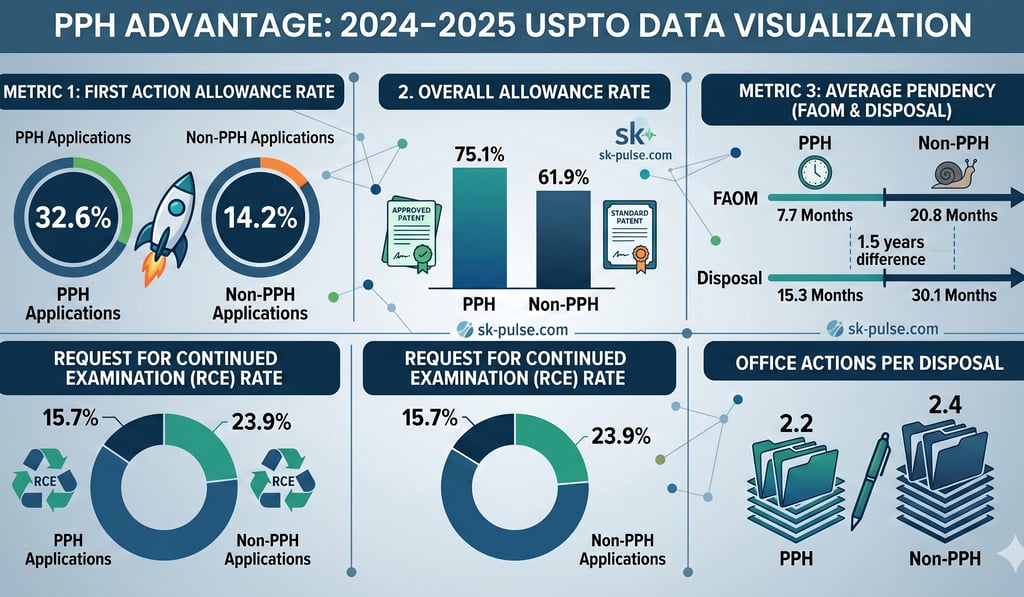
To truly understand the value of the PPH, one must look at the data. The USPTO closely tracks the performance of PPH applications against standard, non-expedited applications. The most recent comprehensive data released by the USPTO covering Calendar Year 2024 and early 2025 paints a striking picture of the PPH advantage.
The implications of these statistics are profound for portfolio management:
.
1. The First Action Allowance Phenomenon:
Perhaps the most staggering metric is the First Action Allowance rate. At 32.6%, a PPH application is more than twice as likely to be allowed on the very first office action compared to a standard application (14.2%). Because the U.S. examiner is provided with the search strategy, prior art, and allowability reasoning from the OEE, the issues are already distilled. If the claims are properly mapped, the examiner is frequently positioned to issue a Notice of Allowance immediately, bypassing the traditional dance of rejections and amendments.
2. Drastic Cost Reductions:
The financial impact of PPH prosecution is clearly reflected in the Request for Continued Examination (RCE) rate and the "Actions per Disposal" metric. Only 15.7% of PPH applications require an RCE, compared to nearly a quarter (23.9%) of non-PPH filings. By reducing the number of office actions (2.2 vs. 2.4) and drastically lowering the need for RCEs or appellate briefs, the lifetime prosecution cost of a PPH asset is significantly lower. For lean operations or businesses managing tight intellectual property budgets, this capital efficiency is invaluable.
3. Total Pendency:
Historically, PPH applications achieved a final disposition (allowance or abandonment) in 15.3 months—exactly half the time of standard applications, which languished for an average of 30.1 months. Getting an issued U.S. patent a year and a half earlier accelerates the ability to enforce rights, secure licensing revenue, and bolster corporate valuation during fundraising rounds.
The 2025 Policy Shift: The "Half-Pendency" Rule
While the historical data strongly favors the PPH, practitioners must adapt to recent procedural changes at the Office. In late 2025, the USPTO announced a significant recalibration of the PPH acceleration program.
Historically, the Office targeted an average first-action pendency of roughly 7.5 months for all PPH cases. However, as the backlog of standard applications grew, the gap between PPH and non-PPH pendency became increasingly disproportionate. To promote a more equitable distribution of workload across the examining corps, the USPTO implemented an adjustment to PPH docketing.
Under the new guidance, the USPTO aims to align PPH pendency so that these applications are examined at a rate roughly half that of comparable non-PPH cases within the specific technology area. This means that if a particular software art unit has a standard FAOM pendency of 28 months, a PPH application in that unit will now target a 14-month FAOM, rather than the previous 7.5-month universal target.
While this adjustment narrows the acceleration benefit compared to prior years, the relative advantage remains entirely intact. PPH applications still jump significantly ahead in the queue, ensuring that applicants receive expedited treatment tied directly to the realities of their specific examiner's docket.
Strategic Masterclass: Executing PPH at the USPTO
Securing the benefits of the PPH requires precise execution. A poorly managed PPH entry can result in dismissed petitions, unintended claim limitations, or catastrophic U.S.-specific rejections.
Tactic 1: The Fast-and-Narrow Anchor Strategy
Because PPH claims must sufficiently correspond to the foreign allowed claims, they are often narrower than what a practitioner might initially pursue in the U.S. A highly effective strategy is to use the PPH to secure a "fast and narrow" anchor patent.
By filing the PPH application with the narrower corresponding claims, the applicant locks in an early U.S. patent asset. This early issuance provides immediate commercial value and deterrent effect. While the PPH application is pending, or immediately upon allowance, the practitioner files a standard Continuation application. This continuation is not bound by the PPH constraints, allowing the practitioner to pursue broader, U.S.-optimized claims targeting specific competitor products or infringement scenarios.
Tactic 2: Navigating the 101 and 112 Minefields
A common misconception is that a foreign allowance guarantees a U.S. allowance. It does not. The OEE’s determination of novelty and non-obviousness (Sections 102 and 103) is highly persuasive to a U.S. examiner, but foreign offices do not apply U.S. subject matter eligibility laws.
An invention deemed perfectly patentable in Europe or Japan may run headlong into a 35 U.S.C. § 101 Alice/Mayo rejection in the United States, particularly in software, artificial intelligence, and bioinformatics. Furthermore, translations of foreign claims often run afoul of 35 U.S.C. § 112 (definiteness). Literal translations of foreign claim language can introduce terms that lack antecedent basis or use terminology that is considered indefinite under U.S. jurisprudence. Practitioners must carefully review and adapt the translated claims—ensuring they remain within the scope of the OEE allowance while strictly conforming to USPTO formatting and 112 requirements.
Tactic 3: Strict Form Hygiene
Administrative errors are the most common cause of PPH petition dismissal. The USPTO recently noted that a significant percentage of applicants filing PPH requests for national stage applications (under 35 U.S.C. § 371) were using outdated forms. If an applicant uses an older form and fails to explicitly request that national stage processing begin, the PPH petition can be delayed or denied. Practitioners must integrate strict form hygiene into their docketing workflows, ensuring that the latest USPTO PPH request forms are utilized and that all required express statements regarding claim correspondence are clearly articulated.
Tactic 4: Eliminating Paperwork with the IP5 Global Dossier
Could a simple digital integration eliminate the headache of cross-border document translations and submissions for your global portfolio?
For practitioners managing international portfolios, the administrative burden of filing a PPH petition—compiling foreign office actions, sourcing certified translations, and uploading allowed claim sets—has historically been a tedious barrier to entry. Fortunately, the integration of the Global Dossier has quietly revolutionized this process, particularly for applications originating within the IP5 (the USPTO, EPO, JPO, KIPO, and CNIPA).
The Global Dossier is a consolidated digital platform that allows participating patent offices to securely access each other's application files in real time. When filing a PPH request at the USPTO based on an allowance from another IP5 office, practitioners can leverage this integration to drastically reduce their required document submissions. If the OEE is an IP5 member, the U.S. examiner can directly retrieve the necessary prosecution history via the Global Dossier. Consequently, the USPTO explicitly waives the requirement for the applicant to manually submit copies of the foreign office actions and the allowed claims.
Furthermore, because the Global Dossier provides integrated machine translations for many documents, it can occasionally save applicants the steep costs of commissioning formal English translations of the OEE's patentability reasoning. By simply indicating on the PPH petition form (PTO/SB/20) that the documents are available via the Global Dossier, practitioners can secure all the strategic advantages of expedited examination while stripping away the administrative friction that used to slow it down.
The Takeaway
The Patent Prosecution Highway remains an indispensable lever in global patent strategy. While the USPTO's recent "half-pendency" policy adjustment reflects the realities of a strained examination corps, the underlying mathematics of the PPH—doubled first-action allowance rates and halved prosecution costs—are undeniable. By strategically utilizing the PPH to secure rapid anchor patents, aggressively utilizing the Global Dossier to minimize overhead, and remaining vigilant against U.S.-specific eligibility hurdles, practitioners can aggressively advance their portfolios and deliver highly efficient, high-value outcomes in an increasingly congested patent landscape.
Disclaimer: The content provided on S.K. Pulse is for educational and informational purposes only. The operator of this site is a patent law professional, not a licensed attorney. Nothing on this website constitutes legal advice.