The 2025–2026 Patent Landscape: Global Shifts, AI Dominance, and the Asian Surge
Despite persistent macroeconomic uncertainties, tightening venture capital markets, and complex geopolitical friction, global corporate research and development hit historic highs over the past year. The intellectual property filings trailing this massive capital investment tell a fascinating and undeniable story. Through decades of navigating the intricate realities of United States Patent and Trademark Office (USPTO) procedures, one fundamental truth becomes clear: patent statistics are never just administrative numbers. They are the ultimate leading indicators of global economic power.
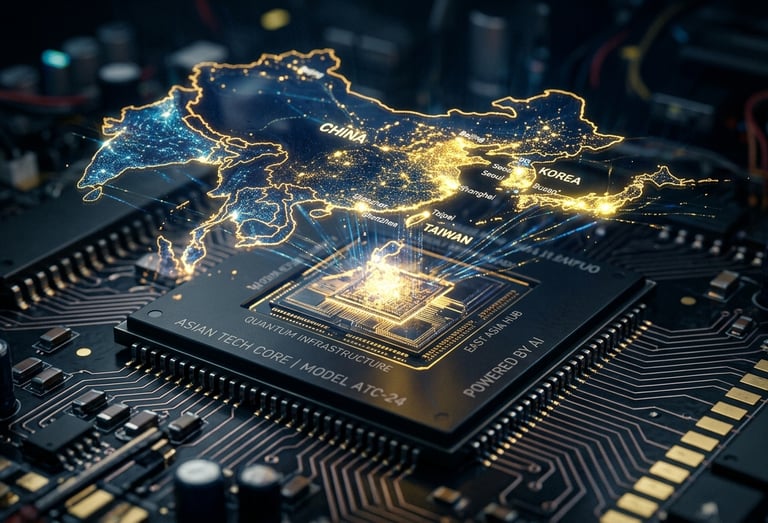
Analyzing the finalized 2025 data from both the World Intellectual Property Organization (WIPO) and the USPTO reveals a distinct reality for 2026. While the U.S. remains the world’s most crucial battleground for commercialization, the locus of foundational innovation continues its decisive shift toward East Asia. This movement is not an anomaly; it is a structural realignment fueled almost entirely by the relentless global demand for artificial intelligence infrastructure and semiconductor manufacturing.
For professionals operating solo business entities and navigating the cross-cultural currents between the U.S. and East Asia, these statistics offer a roadmap. Here is what the numbers tell us about the future of global innovation.
WIPO PCT Filings: The Global Leaderboard
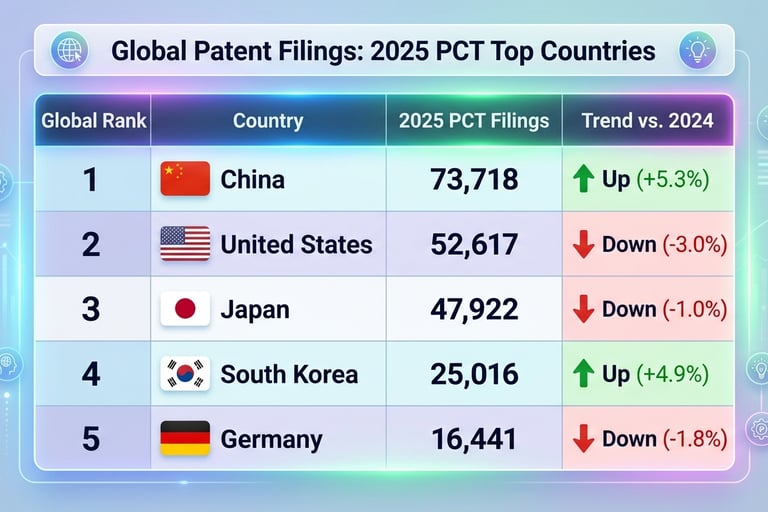
The Patent Cooperation Treaty (PCT) mechanism serves as the primary barometer for international innovation intent. Filing a PCT application is an expensive, strategic decision indicating that an inventor or corporation believes their technology has significant cross-border commercial value. In 2025, international patent applications filed through the PCT system grew by 0.7% to reach a record 275,900 worldwide.
However, the raw total is less important than the geographic distribution of this growth. Traditional Western innovation hubs saw slight contractions in their international filing volumes, while East Asia accelerated its dominance.
China has expanded its leading position, leveraging massive state-backed R&D initiatives to flood the international system with telecommunications and software filings. Meanwhile, South Korea extended an extraordinary 28-year unbroken growth trend. Given the country's population size relative to the U.S. or China, South Korea’s density of innovation remains unparalleled, driven by a deeply ingrained cultural emphasis on technological export and digital advancement. Conversely, the slight dips in the U.S. and Germany suggest a period of consolidation, where corporations are becoming highly selective about which assets warrant the high costs of international protection.
The USPTO Paradox: Asian Conglomerates on American Soil
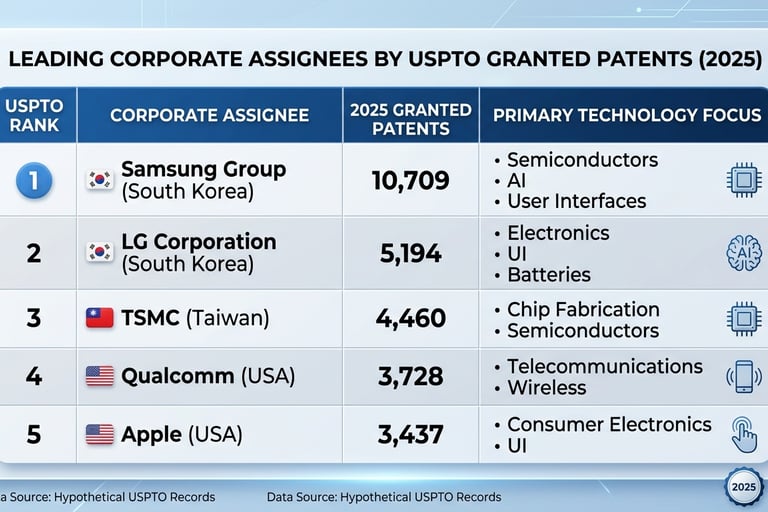
Shifting focus to the U.S. domestic market highlights a fascinating geopolitical dichotomy. The USPTO issued approximately 327,641 utility patents in FY 2025. Yet, when analyzing the entities actually securing these vital U.S. assets, the leaderboard is completely dominated by East Asian conglomerates.
Securing intellectual property in the United States is a strategic necessity. The U.S. represents the most lucrative consumer and enterprise market on earth. The data confirms that companies based in South Korea and Taiwan are out-patenting domestic U.S. tech giants on American soil, utilizing the USPTO as a crucial shield for their global supply chains.
The Samsung and TSMC Phenomenon The presence of Samsung and TSMC at the very top of this list is the defining narrative of the decade. Samsung’s staggering volume—clearing over 10,000 granted patents—is not merely about smartphones. Their patent portfolio represents a vast moat built around memory architectures, next-generation display technologies, and the hardware required to run on-device AI.
TSMC’s aggressive USPTO filing strategy is even more telling. As the premier foundry of the world, TSMC manufactures the silicon brains designed by Apple, Nvidia, and AMD. By heavily patenting their chip fabrication and 3D packaging techniques within the United States, TSMC essentially dictates the technological boundaries of American hardware design. In an era where semiconductors are treated as critical national security assets, these patent portfolios are not just legal documents; they are geopolitical leverage.
The Technology Winners: Infrastructure over Iteration
The volume of filings reveals who is innovating, but the specific technology classifications reveal where the smartest capital is flowing.
The AI Boom Meets Hardware 2026 is rapidly shaping up to be the golden age of AI patents at the USPTO. Following years of complex Section 101 (subject matter eligibility) battles regarding software patents, the focus has violently shifted. The massive growth is no longer just in abstract algorithmic models; it is in AI-native hardware. We are seeing explosive growth in patents covering neural processing units (NPUs), efficient data center cooling mechanisms, and low-latency memory integration.
Advanced Semiconductor Packaging Moore’s Law is facing physical limitations. To keep making chips faster and more powerful, the industry has pivoted to "advanced packaging"—stacking different types of chips on top of each other like microscopic skyscrapers. This specific sector saw the highest year-over-year growth rate in the USPTO mechanical and electrical art units.
The Technology Losers: The Cycle of Innovation
Innovation occurs in strict, predictable cycles, and the 2025 statistics show clear contractions in formerly hyped sectors.
5G Telecommunications: Filings related to 5G infrastructure have notably cooled. This is a natural progression; the foundational standards are set, the networks are deployed, and the industry is currently in a commercialization phase while quietly beginning the early foundational R&D for 6G.
Consumer Virtual Reality (VR): Patent volume for consumer-focused VR hardware experienced a sharp contraction. Following massive hype cycles, the market is pivoting away from bulky consumer headsets toward lightweight, enterprise-grade augmented reality (AR) and seamless AI wearables.
The Solopreneur Takeaway: Finding the White Space
For a solo inventor, startup founder, or independent digital professional, looking at a spreadsheet where Samsung files 10,000 patents a year can feel overwhelmingly intimidating. It begs the question: how does a smaller entity compete in a landscape dominated by tech leviathans with unlimited legal budgets?
The answer lies in understanding the difference between infrastructure and application.
Massive conglomerates are concentrating their intellectual property budgets on building the foundational infrastructure of the future. They are patenting the silicon fabrication methods, the underlying large language model architectures, and the global telecommunication standards. This heavy concentration at the bottom leaves vast, untouched "white space" in the application layers at the top.
There is immense, highly lucrative potential for agile innovators to secure patents in niche implementations. A tech giant may patent the processor, but a solopreneur can patent the unique method of utilizing that processor to optimize agricultural drone flight paths, or a novel user interface for a specialized financial software tool.
Furthermore, operating as a modern solopreneur allows for extreme geographic arbitrage. By maintaining an agile corporate structure—such as a U.S.-based S-Corp—while living and observing trends in high-growth Asian markets, independent innovators can spot consumer needs and cultural shifts long before they hit the Western mainstream.
By utilizing mechanisms like the PCT to protect these targeted, highly specific inventions, you can successfully stake your claim alongside the giants. The global patent system is not reserved exclusively for conglomerates; it is a tool designed to reward those who can spot the gaps in the market and act with precision.
Disclaimer: The information provided in this article is for educational and informational purposes only and does not constitute legal advice. As a professional in the field of patent law, I provide these insights as a general guide to USPTO and international procedures. I am not a registered patent attorney. Patent laws, assignment formalities, and international treaties are highly complex and continuously evolving; always consult with a qualified, registered patent practitioner to evaluate the specific ownership circumstances of your intellectual property.