The Cheap Illusion: What a Provisional Patent Application Actually Does
There is no such thing as a "provisional patent." Discover why 50% of provisional applications are abandoned, how the "napkin sketch" trap destroys priority dates, and the ultimate strategy to legally extend your patent monopoly to 21 years.

If you have ever watched a startup pitch on television or attended a local networking event, you have undoubtedly heard an eager entrepreneur confidently declare: "We are fully protected. We just got a provisional patent!"
If you are a layman, you might nod in appreciation of their business savvy. But if you are an intellectual property professional, you are probably cringing on the inside.
Why? Because in the eyes of the United States Patent and Trademark Office (USPTO), there is absolutely no such thing as a "provisional patent." The government will never send you a ribbon-sealed certificate with that title. You do not hold a patent. You simply hold a provisional patent application.
It is the most popular, yet most dangerously misunderstood, tool in the modern inventor's arsenal. Today, we are going to tear down the illusion. We will look at exactly what a provisional application actually does, why half of them end in total failure, the catastrophic "napkin sketch" trap, and the ultimate strategic reason why brilliant patent attorneys use them every single day.
By the Numbers: The 50% Graveyard
To understand the sheer scale of the provisional application illusion, we only need to look at recent USPTO statistics.
Every year, the USPTO receives roughly 150,000 provisional patent applications. Because the federal filing fees for a provisional application are incredibly cheap—tiered for large, small, and micro entities but always costing just a tiny fraction of a standard utility filing—inventors flock to this option. It is the fastest, cheapest way to legally stamp "Patent Pending" on your website and pitch deck.
However, the historical conversion data reveals a staggering reality: approximately 50% of all provisional applications are never converted into non-provisional applications. Half of these filings simply vanish into the ether, completely abandoned by the inventors. For some, this abandonment is actually a successful business strategy; they used the cheap filing to test the market for a year, realized nobody wanted to buy their product, and strategically walked away without spending thousands of dollars on a full patent.
But for many others, their provisional application dies because they fell into a series of hidden legal traps that destroyed their rights before the real examination even began.
Trap 1: The 12-Month Ticking Clock
The defining characteristic of a provisional application is that it is a temporary placeholder. It is effectively a digital black box. No USPTO examiner will ever open it, no examiner will ever search for prior art against it, and no examiner will ever grade it. It simply sits in a government server, holding your place in line.
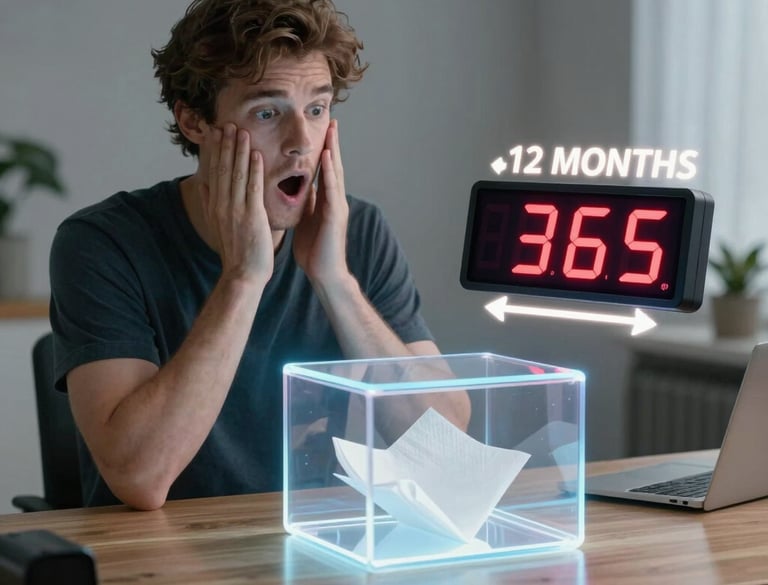
But it only holds that place for exactly one year.
According to the strict rules of MPEP 201.04 and 35 U.S.C. 111(b), a provisional application has an unyielding 12-month lifespan. The clock starts ticking the exact second you hit submit.
"A provisional application automatically becomes abandoned when its pendency period expires 12 months after the provisional application filing date by operation of law."
There are no extensions. You cannot pay a fee to get another six months. If you do not file your complete, formal Non-Provisional (utility) application claiming priority back to that provisional before the 365th day, the provisional dies. Your "Patent Pending" status evaporates, and your invention is suddenly exposed to the public domain.
Trap 2: The "Napkin Sketch" Delusion (Section 112)
This is the trap that destroys the highest number of amateur inventors.
Because the government fees are so remarkably cheap, and because the USPTO explicitly states that provisional applications do not require formal patent claims or perfectly formatted margins, inventors assume the legal requirements are equally cheap. They assume they can just submit a rough sketch, a three-paragraph summary of their idea, and lock in their priority date.
This is a catastrophic error.
The purpose of filing a provisional is to get an early "priority date." If you file a provisional on January 1st, and a competitor invents the exact same thing on March 1st, you win because your date is earlier.
But here is the catch: to legally rely on that January 1st date, your provisional application must fully satisfy the rigorous legal standards of 35 U.S.C. 112. It must contain a complete, thorough written description that fully enables a person having ordinary skill in the art to actually build and use the invention.
If your provisional was just a vague "napkin sketch" that left out crucial technical details, the examiner will look at it a year later and say, "This document doesn't actually explain how the machine works." The examiner will then sever the link to your provisional application, strip away your early priority date, and leave you completely defenseless against any prior art that was published during that missing year.
If you put garbage into a provisional application, your priority date is garbage.
Trap 3: The "New Matter" Dilemma
Innovation is inherently messy. It is rarely finished on the first try.
Imagine you invent a revolutionary new commercial drone. You write a brilliant, highly detailed provisional application describing the rotors, the battery, and the chassis, and you file it on January 1st.
Over the next six months, you build prototypes and realize the drone needs a specialized gimbal mount to keep the camera steady. You design an amazing gimbal and add it to your product. When December rolls around, you hand everything over to your patent attorney to file the final Non-Provisional application.
Here is the dilemma: The Non-Provisional application will include the drone and the new gimbal. But what priority date do they get?
The USPTO enforces a strict "New Matter" rule. Because the gimbal was not explicitly described in the January 1st provisional black box, the gimbal does not get the January 1st priority date. The drone gets the January date, but the gimbal only gets the December date. If a competitor published a paper about a similar gimbal in August, your gimbal claims will be rejected, even though you had a provisional application on file.
This is why top-tier patent professionals often file multiple provisional applications throughout the year—one in January for the drone, one in June for the gimbal, and one in October for a software update—and then roll all of them into a single, massive Non-Provisional application at the end of the year.
The Ultimate Strategic Advantage: The Patent Term Clock
If provisional applications are so dangerous, so strict, and so easily invalidated by vague drafting, why do the best patent attorneys in the world recommend using them?
Because of the Patent Term Clock.
As we discussed in previous articles, the patent bargain grants you a 20-year monopoly. But when does that 20-year countdown actually start?
35 U.S.C. 154(a)(2) dictates that the 20-year term begins on the date the Non-Provisional application is filed. The 12 months your invention spends sitting in the provisional black box do not count against your 20-year monopoly.
This is the ultimate strategic advantage. By filing a highly detailed, professional-grade provisional application, you effectively buy yourself an extra year of "Patent Pending" status. You get 12 months to pitch to venture capitalists, test the market, and refine your manufacturing without sacrificing a single day of your actual 20-year granted patent lifespan. You effectively stretch your intellectual property protection to 21 years.
The Takeaway
A provisional application is not a cheap shortcut to a patent. It is a highly strategic, legally binding placeholder. If you treat it like a cheap napkin sketch, it will be worthless when you actually need it to defend your company. But if you draft it with the same rigorous technical detail as a full patent, it becomes an incredibly powerful financial tool, giving you a full year of commercial breathing room and an extended legal monopoly.
Do not be the entrepreneur bragging about a "provisional patent." Be the strategic innovator who uses a provisional application to quietly secure the market.
Disclaimer: The content provided on S.K. Pulse—including but not limited to articles concerning United States Patent and Trademark Office (USPTO) procedures, patent filings, and legal regulations—is for educational and informational purposes only. The operator of this site is a patent law professional, not a licensed attorney or a registered patent agent. Nothing on this website constitutes legal advice, nor does the consumption of this content create an attorney-client relationship. All IP decisions, especially those involving provisional priority claims and Section 112 requirements, should be made in consultation with a qualified, registered patent attorney.