The Global Ownership Puzzle—Mastering Patent Assignments and Recordation Traps in 2026
Have you ever successfully prosecuted a patent to issuance, only to discover during a multimillion-dollar acquisition that your company does not actually own it? In the fast-paced, high-stakes world of global intellectual property in 2026, securing an allowance from an examiner is only half the battle. The other half is ensuring an unbroken, legally ironclad chain of title.
Patent assignment—the legal mechanism by which ownership of an invention is transferred from the creator to a company—seems straightforward on paper. However, the intersection of streamlined United States practices and rigid European formalities creates a dangerous minefield for international applicants. Let’s decode the terminology on your patent certificate, explore the USPTO’s electronic recordation system, and highlight the disastrous pitfalls awaiting applicants who assume U.S. assignment rules apply overseas.
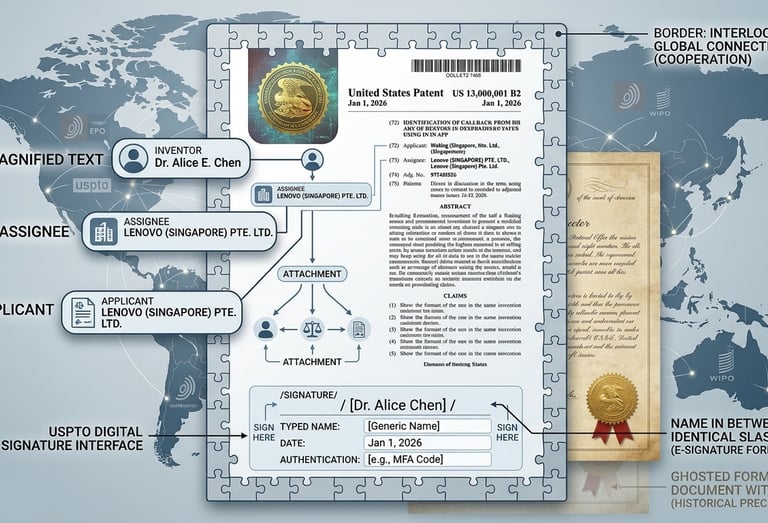
Decoding the Certificate: Inventor, Applicant, and Assignee
Before diving into the mechanics of transfer, we must define the players. If you look at the front page of a newly issued 2026 U.S. patent, you will see three distinct terms that often confuse junior practitioners and corporate executives alike.
The Inventor: Under U.S. law, an inventor must be a natural human being—the person who actually conceived of the claimed invention. AI cannot be an inventor, and a corporation cannot be an inventor. The inventor is the foundational origin of all patent rights. By default, the moment an invention is conceived, the inventor owns it.
The Assignee: This is the entity (usually a corporation, university, or holding company) that has legally purchased or been transferred the property rights to the invention from the inventor.
The Applicant: This term underwent a radical shift thanks to the Leahy-Smith America Invents Act (AIA). Prior to September 16, 2012, U.S. applications generally had to be filed in the name of the human inventors, making them the official applicants, even if the patent was assigned to a company. Post-AIA, the system was modernized. Today, the corporate Assignee can file the patent directly in its own name, making the corporation the official "Applicant."
The USPTO Approach: Ministerial Recordation and Speed
How does the USPTO handle the transfer of these rights? In stark contrast to many international bodies, the USPTO operates on a system designed for frictionless commercial speed.
When you submit an assignment document to the USPTO’s Electronic Patent Assignment System (EPAS), the Office does not put it under a microscope to verify its legal validity under state contract law. According to MPEP § 313, "The recording of a document is not a determination by the Office of the validity of the document or the effect that document has on the title to an application or a patent."
The USPTO’s role is purely ministerial. They act as a public bulletin board, recording the document to provide public notice. However, this does not mean recordation is optional or without immense legal weight. Under 35 U.S.C. § 261, an assignment must be recorded with the USPTO within three months from its date of execution (or prior to a subsequent purchase). If you fail to record it within this window, your unrecorded assignment is completely void against a subsequent buyer who purchases the patent in good faith without knowing about your secret deal.
Modern Mechanics: Scans, E-Signatures, and the 2026 Reality
Are we still demanding wet-ink signatures and wax seals? Thankfully, no. The USPTO has aggressively embraced digital workflows.
Under current practices governed by 37 C.F.R. § 1.4(d), the USPTO readily accepts electronic signatures (the "S-signature," formatted between forward slashes, e.g., /John Doe/). Furthermore, the USPTO generally assumes that a scanned PDF of an assignment document is a true, accurate, and original representation of the underlying legal instrument. You do not need to mail physical paper to Alexandria, Virginia.
While this makes filing incredibly efficient, it also places the burden of rigorous record-keeping entirely on the applicant's shoulders. If an ownership dispute arises in federal court, relying solely on an S-signature on a scanned PDF—without a rock-solid internal corporate policy proving who typed those slashes—can invite aggressive evidentiary challenges from opposing counsel.
The Global Collision: Where U.S. Practices Fail Overseas
Here is where the true danger lies. Because the USPTO makes assignments so fast and flexible, U.S. practitioners often develop a false sense of security. What happens when a streamlined U.S. assignment crosses the Atlantic?
1. The Dual-Signature Trap
In the United States, an assignment typically only requires the signature of the assignor (the inventor giving away the rights). The USPTO does not require the receiving corporation (the assignee) to sign the document.
However, in many European jurisdictions—specifically the UK and France—an assignment is merely a worthless piece of paper unless it is executed by both parties.
Pitfall Example: A tech startup in Silicon Valley executes a standard, U.S.-style, inventor-only assignment for a new software platform. The startup files a U.S. provisional, and a year later, files a counterpart in the UK. During UK prosecution, an ownership dispute arises. The UK Intellectual Property Office looks at the U.S. assignment and deems it invalid under UK law because the corporate assignee never signed it. The startup suddenly realizes they do not actually own their UK patent rights.
2. The "Right of Priority" Distinction
This is perhaps the most lethal trap for overseas applicants. In the U.S., when an inventor assigns their "rights in the invention," it is generally presumed they are also transferring the right to claim priority to that initial filing.
Europe treats this very differently. The European Patent Office (EPO) views the "right to the invention" and the "right to claim priority" as two distinctly separate legal rights.
Pitfall Example: A German inventor files a priority application in Germany, then assigns the invention to a U.S. parent company using a standard U.S. assignment form that vaguely transfers "all rights in the invention." The U.S. company then files an international PCT application claiming priority to the German filing. The EPO rejects the priority claim, arguing that the U.S. assignment never explicitly transferred the right of priority. Because the priority claim is broken, intervening prior art invalidates the entire European patent family. Always explicitly include the phrase "including the right to claim priority" in global assignment templates.
3. Notarization and the Apostille
The USPTO does not strictly require an assignment to be notarized to be recorded. However, under 35 U.S.C. § 261, a certificate of acknowledgment under the hand and official seal of a notary public constitutes prima facie evidence of the execution of the assignment. It is a highly recommended "nice-to-have" in the U.S.
In foreign jurisdictions, however, it is often a hard requirement. Many Asian and Middle Eastern patent offices will reject an assignment entirely unless it is heavily legalized, often requiring notarization followed by an official government Apostille. A scanned PDF of an unnotarized U.S. S-signature will simply not survive scrutiny in these regions.
PCT and EPO Best Practices for 2026
How do you manage this chaos? The golden rule for global portfolios is to resolve ownership discrepancies at the international stage before they fracture into dozens of national problems.
If a change in ownership occurs, record the assignment under PCT Rule 92bis during the international phase. By registering the assignee change centrally with the World Intellectual Property Organization (WIPO) before the 30-month national phase entry deadline, the updated applicant is automatically recognized by almost all designated national offices, saving you from filing 20 separate assignment recordations in 20 different countries.
Furthermore, if you are prosecuting before the European Patent Office, it is absolute best practice to record your dual-signed assignments with the EPO prior to the grant of the patent. Waiting until after the patent grants to record an assignment can severely complicate the European validation process across individual member states.
Summary While the USPTO’s 2026 assignment practices favor rapid, electronic, ministerial recordation using inventor-only signatures, relying on these relaxed standards globally is a recipe for disaster. International applicants must proactively utilize dual-party signatures, explicitly transfer priority rights, and leverage PCT Rule 92bis to ensure their chain of title withstands the rigorous formalities of foreign jurisdictions like the EPO.
Disclaimer: The information provided in this article is for educational and informational purposes only and does not constitute legal advice. As a professional in the field of patent law, I provide these insights as a general guide to USPTO and international procedures. I am not a registered patent attorney. Patent laws, assignment formalities, and international treaties are highly complex and continuously evolving; always consult with a qualified, registered patent practitioner to evaluate the specific ownership circumstances of your intellectual property.