The Underdog's Advantage—Navigating the Three-Tier Federal Fee System and the Micro Entity Revolution
Have you ever looked at the USPTO fee schedule and felt a sudden wave of sticker shock? For decades, the path to securing a U.S. patent was paved with exorbitant federal filing fees, essentially creating a financial paywall that locked out many brilliant, independent minds. But what if the system recognized that a garage inventor shouldn't pay the same examination fees as a multi-billion-dollar tech conglomerate?
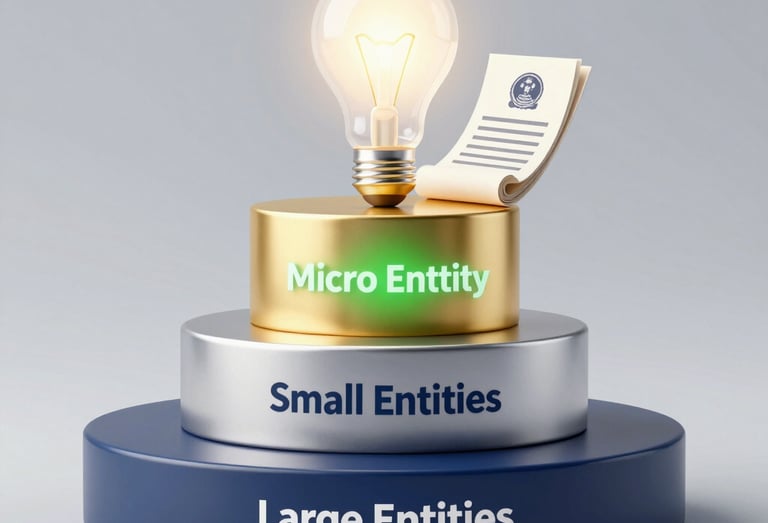
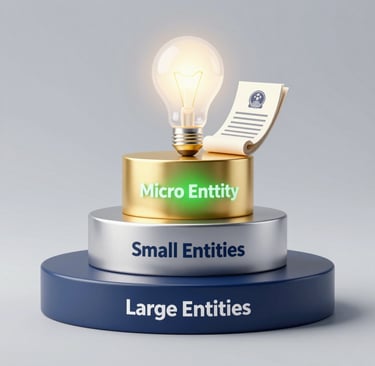
Prior to 2013, the United States Patent and Trademark Office (USPTO) operated on a relatively rigid two-tier fee system. You were either a "large entity" paying full price, or a "small entity" receiving a discount. However, as the global innovation landscape rapidly evolved, it became evident that this binary system was still too financially burdensome for true underdogs. The solution arrived in 2013, ushering in a revolutionary three-tier federal fee system that fundamentally altered patent prosecution strategies for independent inventors and startups alike. Let's explore how this three-tier system works today, the hidden procedural traps within it, and how the micro entity status changed the game forever.
Tier 1: The Baseline Large Entity
At the top of the USPTO's classification pyramid sits the Large Entity. By default, every patent applicant is presumed to be a large entity unless they affirmatively establish entitlement to a smaller status. But who exactly falls into this tier? Generally, a large entity is a for-profit company with more than 500 employees. However, it also includes any entity—regardless of its actual size—that has assigned, granted, conveyed, or licensed any rights in the invention to a large entity, or is under an obligation to do so.
Large entities pay 100% of the established USPTO fees. While these costs can be substantial—spanning filing, search, examination, issuance, and eventual maintenance fees—large entities absolutely dominate the patent landscape. Why? Because they possess the corporate infrastructure and capital to absorb these costs as standard R&D overhead.
Recent statistics from FY 2023 and early 2026 highlight a stark reality: large entities not only file the overwhelming majority of patent applications, but they also succeed at a much higher rate. In recent analyses of disposed applications, large entities achieved a remarkable 80% allowance rate. They account for nearly 79% of all issued patents but only 57% of abandonments. This data suggests that large entities have the financial runway to weather multiple Office actions, fund Requests for Continued Examination (RCEs), and pursue appeals without being starved out of the prosecution process by administrative fees alone.
Tier 2: The Middle Ground of Small Entity Status
For those who lack the massive war chests of Fortune 500 companies, the USPTO offers the Small Entity status. Historically, this status granted a 50% discount on most fees, though recent legislative pushes (such as the Unleashing American Innovators Act) have generously expanded this to a 60% reduction.
To qualify as a small entity under 37 C.F.R. § 1.27, the applicant must fit into one of three categories: an independent inventor, a non-profit organization, or a small business concern with 500 or fewer employees
But here is where the complexities begin. Are you an independent inventor who just signed a non-exclusive licensing agreement with a massive corporation to manufacture your prototype? If so, you have likely lost your small entity status. The Manual of Patent Examining Procedure (MPEP) clearly outlines this restriction. Under MPEP 509.02, an individual or small business can claim the discount only if they have not transferred rights to a larger entity.
Small entities represent a crucial middle ground. Along with micro entities, they filed approximately 24% of all utility applications in the U.S. in FY 2025. However, their financial constraints do show in the statistics. Small entities achieve an allowance rate of roughly 61%—a notable 19-percentage-point drop compared to their large entity counterparts. They represent roughly 20% of patent grants, but 36% of abandonments, indicating that the cost of prolonged prosecution still takes a heavy toll even with a 60% discount.
Tier 3: The 2013 Game-Changer—Micro Entity Status
In March 2013, the landscape shifted dramatically. To foster innovation among under-resourced creators, the USPTO officially implemented the "Micro Entity" status, granting an unprecedented 80% discount on most patent fees.
This status represents the underdog’s underdog. However, the USPTO does not hand out this deep discount lightly; the qualification criteria are the most rigorous in the entire fee system. An applicant can qualify as a micro entity via two distinct pathways: the "Institution of Higher Education" basis, or the far more common "Gross Income" basis.
The Gross Income Basis
To qualify under this basis, you must clear a strict series of hurdles. First, you must inherently qualify as a small entity. Second, you must not have been named as an inventor on more than four previously filed U.S. non-provisional patent applications. Third, and most critically, you must meet strict financial limits.
Under MPEP 509.04(a), an applicant must not have a gross income exceeding three times the median U.S. household income for the preceding calendar year. As of 2026, this threshold sits just over $251,190. But does this limit only apply to the lead inventor? Absolutely not. MPEP 509.04(a) leaves no room for ambiguity, explicitly stating:
"Each inventor and each non-inventor applicant (e.g., an assignee-applicant) must individually meet the gross income limit. The gross income limit applies to the assignee (if any) regardless of whether the assignee is identified as the applicant... Accordingly, each assignee, licensee, and inventor must individually meet the gross income limit.
Example: Consider a software startup founded by two college friends. They meet the small entity requirement and the four-application limit. Founder A made $60,000 last year. Founder B, however, has a lucrative day job and reported a gross income of $250,000. Because Founder B individually exceeds the gross income threshold, the entire application is disqualified from micro entity status. They must file as a small entity instead.
The Institution of Higher Education Basis
But what if you exceed the gross income limit? Is micro entity status completely out of reach? Not necessarily. The second pathway allows applicants to qualify if they obtain the majority of their income from a U.S. institution of higher education, or if they have assigned (or are obligated to assign) their IP rights to such an institution.
Example: A tenured university professor makes $300,000 a year, well over the gross income limit. However, her employment contract obligates her to assign all her inventions to the university's technology transfer office. Because the university qualifies as an institution of higher education, the professor and the university can claim micro entity status, bypassing the gross income ceiling entirely. It is a brilliant legislative maneuver designed to spur academic commercialization.
The Statistical Reality for Micro Entities
While the 80% discount is a massive boon, recent statistics paint a sobering picture of the micro entity journey. Micro entities account for only about 2% of issued patents but make up roughly 7% of abandonments. Alarmingly, their overall allowance rate sits at just 40%—exactly half the success rate of large entities.
Why the vast disparity? It often boils down to prosecution stamina and strategy. Micro entities, despite the steep fee discounts, are more likely to file applications without the aid of experienced patent practitioners, rely on lower-quality provisional filings, or abandon their applications entirely when faced with a complex, multi-layered Office action that requires expensive legal counsel to overcome.
The Procedural Traps of Certification
The USPTO does not take these claims lightly, and the procedural mechanics of claiming this status are rigid. According to MPEP 509.04(c), a certification of micro entity status can only be signed by specific authorized parties: a registered patent practitioner, or the applicant themselves. However, there is a catch for corporate assignees. The MPEP clarifies that if the assignee is an organization rather than a person, an officer of the assignee corporation is not authorized to sign the certification on their own; a registered practitioner must sign it. This procedural trap is an easy place for self-represented startups to stumble.
Furthermore, entity status is not static; it can—and often does—change during the lifespan of a patent. If a micro entity signs a licensing deal with a large entity mid-prosecution, they must formally update their status and pay the appropriate higher fees moving forward. Intentionally claiming a smaller entity status when you do not qualify is considered fraud on the USPTO. It is a fatal error that can render your issued patent completely unenforceable.
The America Invents Act (AIA) Connection
The introduction of the micro entity status in 2013 did not happen in a vacuum. It was a direct result of the Leahy-Smith America Invents Act (AIA), arguably the most sweeping overhaul of the U.S. patent system in over half a century.
Signed into law in 2011, the AIA was designed to harmonize the U.S. system with global standards, most notably transitioning the country from a "first-to-invent" system to a "first-inventor-to-file" framework. Critics at the time worried that this transition would disproportionately harm independent inventors, who might lack the resources to rush to the patent office as quickly as massive corporations. The creation of the micro entity status was, in many ways, the legislative counterbalance—a deliberate concession to ensure that the U.S. patent system remained financially accessible to the individual innovator even as the procedural rules tightened.
We will explore the profound, structural shockwaves of the AIA in much greater depth in Article 17, unpacking how it redefined prior art, created the Patent Trial and Appeal Board (PTAB), and forever changed the speed at which innovators must act.
The Takeaway
The 2013 introduction of the micro entity status under the AIA transformed the USPTO's fee structure into a dynamic, three-tier system. By offering 60% and 80% discounts to small and micro entities respectively, the system democratizes IP protection. However, stark statistical disparities in allowance rates—80% for large entities versus just 40% for micro entities—prove that while the entry fee has been lowered, long-term financial stamina remains a critical factor in patent success.
Disclaimer: The information provided in this article is for educational and informational purposes only and does not constitute legal advice. As a professional in the field of patent law, I am sharing insights into USPTO procedures, but I am not a registered patent attorney. Patent laws and fee structures are complex and subject to frequent change; always consult with a qualified patent practitioner to evaluate the specific entity status of your intellectual property.