
The AI Workspace Shift: Why the Mini PC is Replacing the Tower
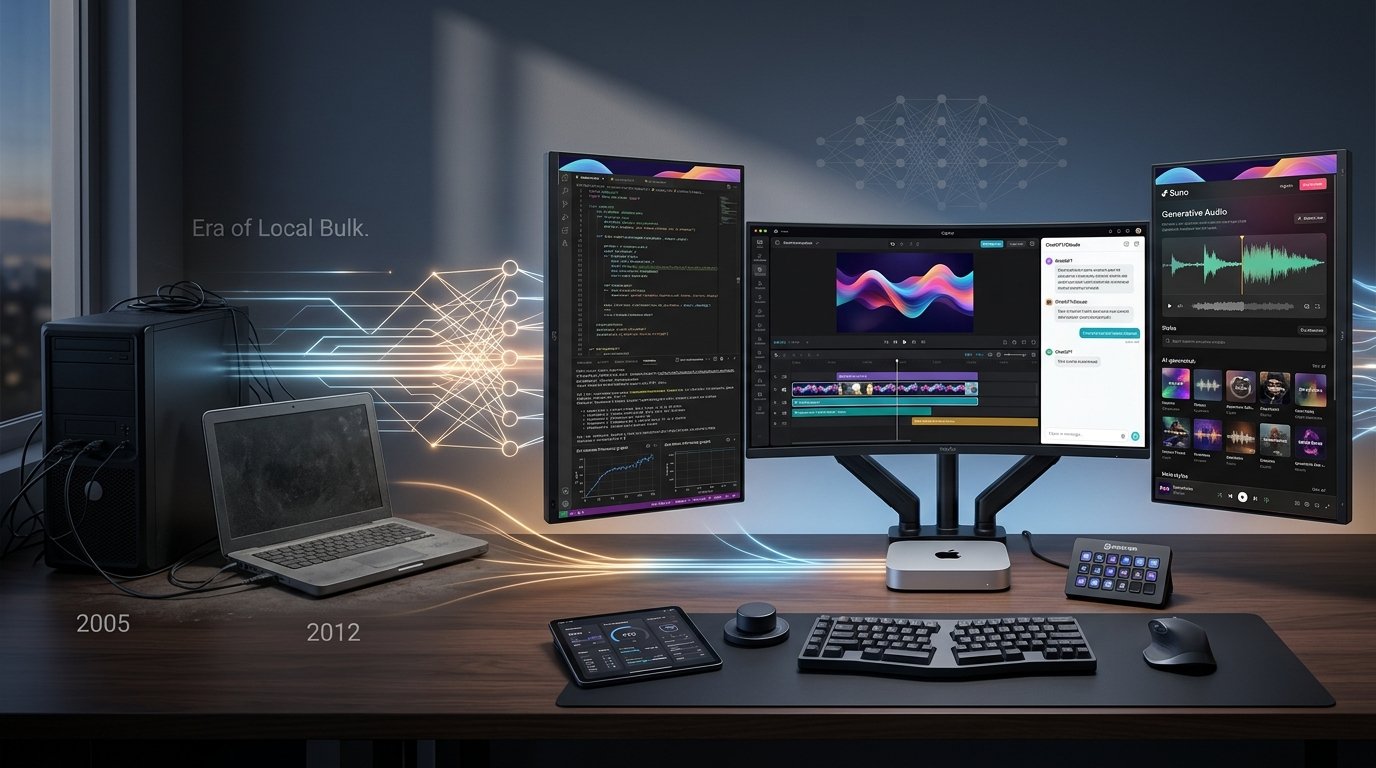
As we rely more heavily on generative AI tools—from drafting code with Claude and generating tracks in Suno, to processing heavy video edits in CapCut—the computing hardware we need is fundamentally changing. The era of the massive, heat-generating desktop tower is giving way to something much smaller, yet shockingly capable.
The State of the Market (2026)
The personal computing landscape is currently undergoing a massive reorganization. While traditional laptops still command about 77% of the overall PC market, the mini PC sector is experiencing explosive growth—projected to reach $120 billion with an 8.5% annual growth rate.
Why the sudden surge? Local AI inference.
Professionals are realizing they no longer need a massive PCIe-slotted tower to run complex tasks. With the rise of high-bandwidth unified memory and neural processing units (NPUs), incredibly dense, small-form-factor machines are now outperforming the bulky workstations of just three years ago.
The modern hybrid AI workspace: high power, low footprint.. Source: 9to5Mac
Form Factor Showdown: Which Fits Your AI Workflow?
Depending on how you use tools like ChatGPT, Gemini, and local AI agents, your hardware needs fall into one of three categories.
1. The Traditional Desktop PC
- The History: The undisputed king of the 90s and 2000s office. Built for modularity, cooling, and brute force.
- The Reality Today: Unless you are building 3D environments in Unreal Engine or running massive, multi-GPU server racks for training foundational AI models, a traditional tower is overkill. They consume massive amounts of power and take up valuable desk real estate.
2. The Laptop
- The History: Born for portability, laptops became the default corporate machine in the 2010s, allowing professionals to work from coffee shops to airport lounges.
- The Reality Today: Laptops are fantastic for cloud-based AI tools (like standard ChatGPT or Gemini web interfaces). However, when you start running local AI models, heavy Suno audio generations, or exporting 4K CapCut videos, laptops suffer from thermal throttling and battery drain.
3. The Mini PC
- The History: Originally introduced as low-powered “thin clients” for basic web browsing or point-of-sale systems.
- The Reality Today: The ultimate hybrid solution. Modern mini PCs pack desktop-class performance into a 5-inch square. They offer superior cooling to laptops, allowing sustained performance during heavy AI tasks, while keeping your desk completely clean.
The Market Leader: Apple’s M4 Mac mini
If there is one machine driving the current mini PC boom, it is the M4 Mac mini. Apple recently redesigned the chassis, shrinking it down to an ultra-compact 5-by-5-inch footprint.
More importantly, it is currently the undisputed champion for running local AI agents. Thanks to Apple Silicon’s unified memory architecture, the GPU can access RAM instantly without bottlenecks. This allows a machine the size of a lunchbox to run sophisticated language models and render heavy CapCut timelines completely silently. It is currently the highest-selling desktop on Amazon for a reason—it offers professional-grade power at an entry-level price point.
(Note: As an Amazon Associate, I earn from qualifying purchases.)
Check current M4 Mac mini pricing on Amazon