Why I No Longer Change Money at Gold Shops in Vietnam: What the 2026 Rules Mean for You
Last Updated: September 26, 2026 by Simon K., Borderless Founder & IP Professional
Last week, my phone rang with an unfamiliar number. It was the delivery rider bringing a small order I had placed on Lazada: a tablet stand. I went downstairs, took the package, and handed him 75,000 dong in cash. My credit card was saved in the app, but I chose cash on delivery because I had some spare cash I wanted to use up. He counted the bills, nodded, and rode off to his next stop.
That ten-second exchange sums up something every newcomer to Vietnam learns quickly: this is still very much a cash country. And if you live on cash, you need a reliable way to get dong. For years, the popular answer was the neighborhood gold shop. In 2026, that answer became a legal risk, not just for the shop but for you.
Vietnam Still Runs on Cash
In roughly two years of living in Vietnam, on and off, I honestly cannot recall seeing a local friend, neighbor, or shop owner pay with a credit card. Vietnamese people pay in two ways: cash, or a QR code.
QR payments are everywhere, from cafés to street stalls. But it’s worth understanding what they are. A VietQR payment moves money straight out of the payer’s bank account the moment they scan. In practice, it works like a debit card in app form. There is no credit line behind it. If the money isn’t in your account, the payment doesn’t happen.
Credit cards are accepted at most convenience stores and many restaurants. From what I’ve seen, though, that option exists mainly for foreign tourists. And as I explained in my previous article, paying with a foreign credit card often means foreign transaction fees on top of every purchase.
Online shopping tells the same story. Shopee and Lazada, the two biggest shopping platforms here, offer plenty of ways to pay: credit and debit cards, e-wallets, and bank transfers. Yet cash on delivery is still the go-to choice for many shoppers, in Vietnam and across much of Southeast Asia. Even with my card saved in the app, I often end up doing the same, just like with that tablet stand.
So my practical advice for anyone moving to Vietnam, or anywhere in Southeast Asia, is simple: even if you plan to use QR codes and cards, always keep a reasonable amount of cash on hand. Small bills are best, because a delivery rider or street vendor may not be able to break a 500,000-dong note.
The real question, then, is not whether you’ll need cash. It’s where you get it.
The Gold Shop Habit
When I first arrived in Vietnam, almost everyone gave me the same advice: “Don’t exchange money at the bank. Go to a gold shop.” Expat forums said it. Travel blogs said it. Even friendly locals said it.
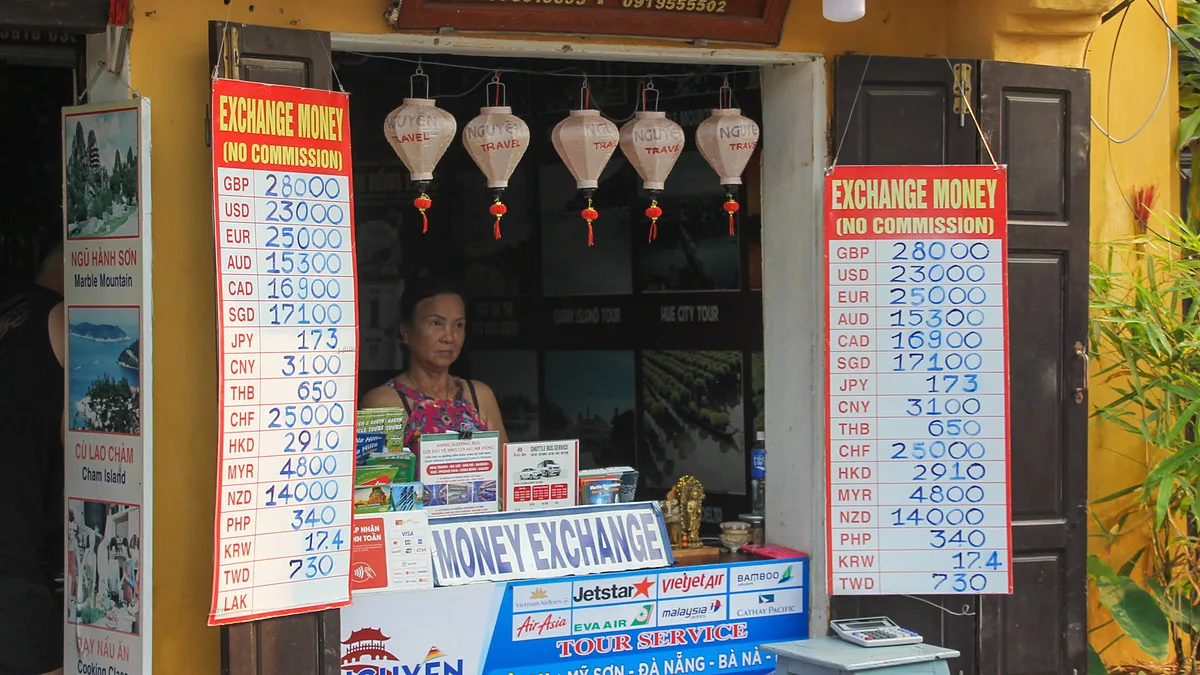
Gold shops (tiệm vàng), the small jewelry stores found on nearly every busy street, had long served as unofficial money changers. They often offered slightly better rates than banks, with no paperwork and no waiting. For years, this was simply how things worked. In 2026, that changed.
What Changed in 2026
On December 25, 2025, the Vietnamese government issued Decree 340/2025/NĐ-CP, which sets out administrative penalties in the monetary and banking sector. It took effect on February 9, 2026.
The decree clearly classifies buying or selling foreign currency between individuals, or at an unlicensed location, as a violation. Most gold shops are not licensed foreign-exchange agents, so exchanging money there now puts the customer, not just the shop, at legal risk.
Penalties are tiered according to the transaction amount:
| Amount exchanged | Penalty for the individual |
|---|---|
| Under USD 1,000 | Warning |
| USD 1,000 to under 10,000 | VND 10–20 million (about USD 400–800) |
| USD 10,000 to under 100,000 | VND 20–30 million (about USD 800–1,200) |
| USD 100,000 or more | VND 80–100 million (about USD 3,200–4,000) |
Penalty tiers under Decree 340/2025/NĐ-CP. USD figures are approximate.
On top of the fine, the money involved in the transaction may be confiscated. In other words, the “better rate” could end up costing you the entire amount you tried to exchange.
The impact has been visible. Media reports in spring 2026 noted that one of Ho Chi Minh City’s best-known gold-shop money changers near Ben Thanh Market had closed its storefront, a spot countless tourists and expats had used for years.
Let’s Do the Math
Here is why the old logic no longer holds. Say you want to exchange USD 2,000. A gold shop might have offered a rate about 0.5–1% better than a bank. That works out to a gain of roughly USD 10–20.
Now look at the downside. A USD 2,000 exchange falls in the USD 1,000–10,000 bracket, which means a possible fine of VND 10–20 million (USD 400–800), plus possible confiscation of the funds.
You would be risking hundreds or even thousands of dollars to save the cost of a nice dinner. From a cost-management perspective, and cost management is the whole point of this blog’s Cross-Border Money category, that trade makes no sense.
Where I Get My Cash Now
Here is how I actually handle cash in Vietnam today.
1. Straight from my own account, with no exchange at all. Most of the time, I send money from my U.S. bank to my Woori Bank account in Vietnam through a fintech service such as Remitly or WireBarley. It arrives already converted to VND. When I need cash, I withdraw it at a Woori ATM using a one-time code from the banking app, since my account came without a card (details in my previous article). No exchange counter, no cash-carrying across borders, and no legal gray areas.
2. A bank counter, when I have dollars in hand. Any commercial bank can exchange foreign currency legally. Bring your passport. The rate may be slightly less favorable than what gold shops once offered, but the transaction is legal, documented, and safe. At my Woori branch, it usually takes 10 to 20 minutes, depending on the line. Because of option 1, I only do this occasionally.
3. Licensed exchange points, with care. Some non-bank counters are licensed to buy foreign currency from individuals. If you use one, look for visible licensing documents and ask for an official receipt. If the shop cannot show a license or issue a receipt, walk away.
4. Converting VND back before departure. Under the current framework, converting leftover VND back to foreign currency is generally limited to banks and authorized counters, such as those at international airports. Plan ahead rather than looking for a street-side solution on your last day.
A Simple Checklist Before You Exchange
- Is this a bank, or can the business show a license to deal in foreign currency?
- Will I get an official receipt?
- Is my exchange amount over USD 1,000? If so, the penalty risk rises sharply.
- Could I skip the exchange entirely by using a local account, a QR payment, or a fintech transfer?
If the answer to either of the first two questions is “no,” don’t do it, no matter how good the rate looks.
Old Habits, New Rules
It’s worth understanding why gold shops became so popular in the first place. Vietnam has a strong cultural relationship with gold, and in a cash-heavy economy, gold shops naturally became informal financial hubs. Many locals and foreigners never saw anything wrong with exchanging money there, and enforcement was relatively light.
That tolerance is gone. The government’s goals are to strengthen control over foreign-currency flows, fight money laundering, and stabilize the financial system. Whether or not you agree with the approach, the practical conclusion for foreigners is clear: the informal route is no longer worth it.
The Bottom Line
Vietnam will keep running on cash for a while yet, so you will need dong in your pocket. The question is how you get it.
If you’re arriving in 2026 or later, ignore any advice that tells you to “just go to a gold shop.” That advice was written for a different era. Exchange at a bank, or better yet, set up a local bank account so your money arrives in dong and you rarely need to exchange at all.
A slightly worse exchange rate is a small, predictable cost. A fine plus confiscation is a large and entirely avoidable one.
This article is based on my personal experience and publicly reported information about Decree 340/2025/NĐ-CP as of September 2026. It is not legal or financial advice. Regulations and enforcement practices can change, so please confirm current rules with a Vietnamese bank or qualified professional before exchanging large amounts.