Comprehensive Guide to Claiming Foreign Priority at the USPTO: Procedures, Pitfalls, and Petitions

Last Updated: June 16, 2026 By Simon K., Borderless Founder & IP Professional
In the high-stakes world of intellectual property, time is arguably your most valuable asset. The exact date you file your patent application determines what existing technology (prior art) can be used against you and establishes who won the race to the patent office.
But what happens when you invent something in one country and want to protect it in the United States? You do not have to file everywhere all at once. Thanks to the Paris Convention for the Protection of Industrial Property – one of the first and most vital intellectual property treaties – innovators can file a patent application in a member country and subsequently file in the United States while retaining the original filing date.
This mechanism, known as “claiming foreign priority,” is incredibly powerful. However, the United States Patent and Trademark Office (USPTO) has strict procedural requirements. A single misstep can result in the loss of your priority date, potentially destroying the novelty of your invention. In my personal experience coordinating cross-border patent prosecution, I’ve seen how often this exact procedural trap catches otherwise brilliant global founders off guard.
Whether you are an independent inventor, a startup founder, or an IP manager, understanding the procedures, precautions, and petitions involved in claiming Paris Convention priority at the USPTO is essential. Here is the operational breakdown.
1. The Core Procedures: How to Claim Foreign Priority
Under 35 U.S.C. § 119, the USPTO allows a U.S. patent application to benefit from the filing date of a previously filed foreign application, provided that the foreign country affords similar privileges to U.S. citizens. Here are the steps required to secure that right.
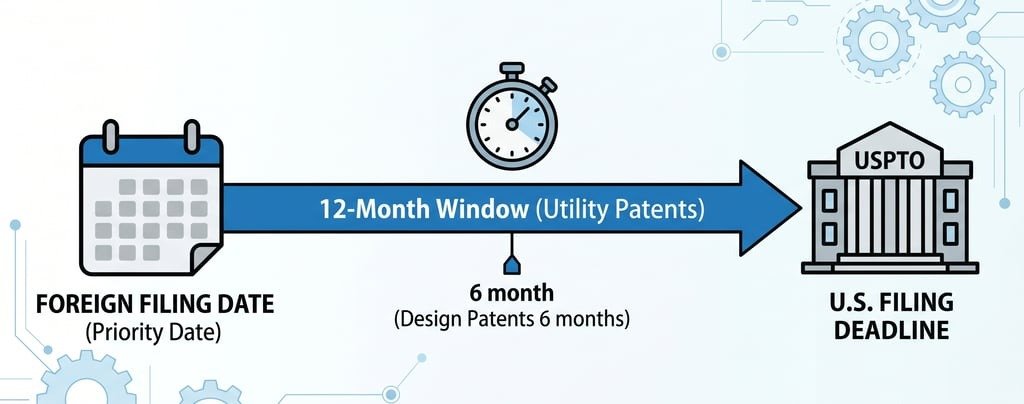
The Non-Negotiable 12-Month Window
The most critical procedural rule of the Paris Convention is the strict timeline. For utility patents, you must file your U.S. application within 12 months of the earliest filing date of the foreign application. (Note: For design patents and trademarks, this window is only 6 months).
This 12-month period is calculated from the very first application filed for that specific invention in any Paris Convention country. You cannot reset the clock by filing a subsequent application for the same invention in another foreign country.
The Application Data Sheet (ADS)
Claiming priority is not automatic; you must explicitly request it. The USPTO requires that the claim for foreign priority be presented in an Application Data Sheet (ADS) at the time of filing, or within a specific window (usually the later of four months from your U.S. filing date or sixteen months from the foreign priority date).
The ADS must specifically identify: the application number of the foreign application; the country or intellectual property authority where it was filed; and the exact day, month, and year of its filing.
Modernizing Proof: WIPO DAS
The USPTO needs proof that your foreign application actually exists and says what you claim it says. You are required to provide a certified copy of the original foreign application.
Historically, this meant ordering physical, ribbon-sealed paper copies from the foreign patent office and mailing them to the USPTO. Today, the process is heavily modernized thanks to the WIPO Digital Access Service (DAS). If the foreign patent office participates in DAS, you simply provide the USPTO with a secure alphanumeric access code. The USPTO will digitally retrieve the certified copy directly, saving you time and courier fees.
Translation Requirements
A common misconception is that if your foreign application is in a language other than English (e.g., Japanese, German, or Korean), you must supply a certified English translation immediately upon filing the U.S. application.
In a conventional Paris Convention filing at the USPTO, an English translation of the priority document is not strictly required at filing. You only need to provide a translation if: the examiner specifically requires it to overcome a prior art reference; and the application becomes involved in an interference or derivation proceeding.
However, the actual claims and specification submitted for your U.S. application must be drafted in English.
2. Critical Precautions: Avoiding Common Pitfalls
Even seasoned patent practitioners can stumble when dealing with foreign priority. Here are the crucial precautions you must take to ensure your U.S. patent remains robust.
The “Same Invention” Standard and New Matter
The most dangerous pitfall is assuming that your U.S. application can include entirely new features while still claiming the priority date of the foreign application for everything.
Under U.S. law, a priority claim is only valid to the extent that the foreign application provides adequate written description and enablement for the claims presented in the U.S. If you add “new matter”—such as an improved feature or a broader claim scope not supported by the original foreign filing—that specific new matter will only receive the actual filing date of the U.S. application.
This creates a split-priority situation where some claims are protected by the earlier date, while others are vulnerable to prior art that emerged during the 12-month window.
The Ongoing Duty of Disclosure (The IDS)
The USPTO imposes a strict “Duty of Candor and Good Faith” (37 CFR § 1.56). You must disclose any known information material to the patentability of your invention by filing an Information Disclosure Statement (IDS).
When claiming foreign priority, you must be hyper-vigilant about the parallel prosecution happening in the foreign patent office. If the foreign examiner issues an office action citing prior art, you must promptly disclose those references to the USPTO. Failing to submit prior art cited in a foreign counterpart can render your U.S. patent completely unenforceable due to “inequitable conduct.”
3. Rescue Operations: Petitions to Fix Mistakes
Despite best efforts, deadlines get missed. Fortunately, the USPTO provides mechanisms to forgive certain errors—provided you act quickly, pay a fee, and meet the legal standard of an “unintentional” delay.
Scenario A: You Filed on Time, but Forgot the Priority Claim
If you filed strictly within the 12-month window, but due to a clerical error, the ADS did not include the foreign priority claim (and the standard time limit to correct it has expired), you are not out of luck.
The Fix: You must file a Petition to Accept an Unintentionally Delayed Priority Claim under 37 CFR 1.55(e). This requires an updated ADS, a formal statement that the delay was unintentional, and the required petition fee.
Scenario B: You Missed the 12-Month Filing Deadline
Suppose the 12-month anniversary of your foreign filing was June 1st, but your team did not file the U.S. application until July 15th. The USPTO allows a highly scrutinized two-month “grace period.”
The Fix: If you file the U.S. application within 14 months of the foreign priority date, you can file a Petition to Restore the Right of Priority under 37 CFR 1.55(c). This requires a substantial petition fee and a rigorous statement proving the delay was unintentional (e.g., a docketing system failure, not a change of mind).
💡Strategize Your IP Budget: The petition fees required to fix missed deadlines or delayed priority claims can significantly inflate your prosecution costs. To forecast your baseline filing, maintenance, and potential surcharge fees, utilize our interactive tool:
Launch PCT U.S. National Stage Fee Estimator (Interactive Calculator)
The Verdict
Leveraging the Paris Convention is an indispensable strategy for securing global patent rights without exhausting your capital all at once. It buys you a critical 12 months to assess commercial viability, secure funding, and refine your U.S. patent strategy.
However, these privileges come with rigid procedural responsibilities. From tracking your 12-month deadline and structuring your ADS to maintaining a flawless IDS, attention to detail is paramount. While the USPTO offers petitions to rescue delayed claims, these are expensive emergency parachutes, not primary strategies.
About the Author & Editorial Policy
Written by Simon K., a Borderless Founder and IP Professional specializing in U.S. and international patent frameworks. He leverages his experience running a remote California S-Corporation to provide actionable intelligence for global founders.
Disclaimer: Simon K. is a patent law professional and consultant, not a licensed patent attorney or registered patent agent. All content is for informational purposes only and does not establish an attorney-client relationship.