Form vs. Function: Are You Protecting the Brain or the Beauty?
Last Updated: June 7, 2026 by Simon K., Borderless Founder & IP Professional
Imagine you have just invented a revolutionary new office chair. You spent three years engineering a complex, hidden lumbar-support mechanism that completely eliminates lower back pain. To top it off, you designed the exterior of the chair to look like a sleek, futuristic racecar seat. It is a masterpiece of both engineering and aesthetics.
You walk into a patent professional’s office, slam the prototype on the desk, and say, “I want to patent this chair.” The professional will look at you, smile, and ask the million-dollar question: “Do you want to protect how it works, or do you want to protect how it looks?”
This is the classic fork in the road for every inventor, startup, and major corporation. The United States Patent and Trademark Office (USPTO) does not just issue one generic “patent.” They divide the intellectual property universe into strict categories. The two most common—and the two most frequently confused by the general public—are Utility Patents and Design Patents.
Failing to understand the difference between these two can cost you thousands of dollars, or worse, leave your core invention completely vulnerable to corporate theft. Today, we are breaking down the “Brain vs. Beauty” dilemma.
Protecting the Brain: The Utility Patent
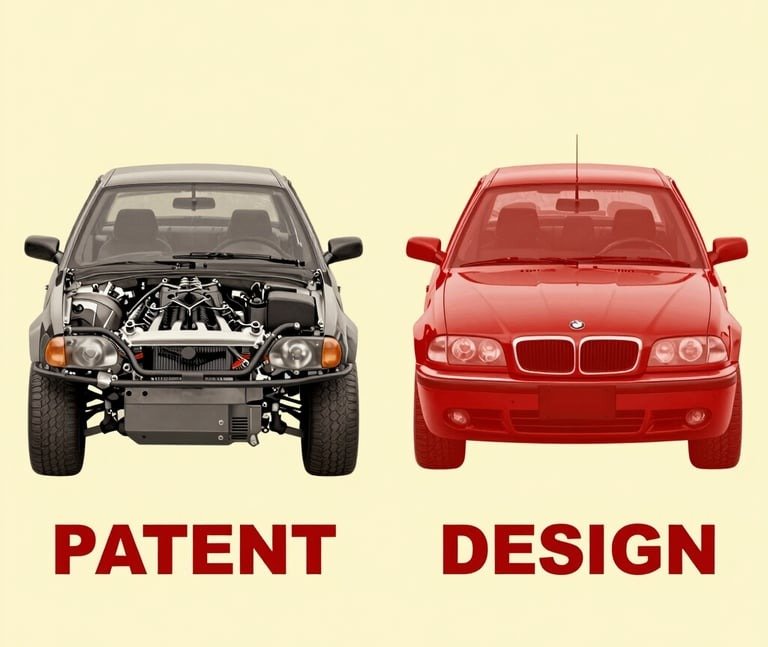
When most laymen use the word “patent,” they are actually thinking of a Utility Patent. A utility patent protects the function of an invention. It protects how a machine operates, how a chemical compound reacts, how a software algorithm processes data, or how a physical mechanism is structured. Returning to our office chair example, the utility patent would protect the complex, hidden lumbar-support mechanism inside the seat.
Utility patents are the heavy artillery of the intellectual property world. They are incredibly difficult to get, requiring you to prove to an examiner that your invention is novel, non-obvious, and fully enabled under 35 U.S.C. § 112. The examination process is rigorous, often taking two to four years, and requires dense, highly technical legal claims.
However, the reward is massive: you receive a powerful 20-year monopoly (from your filing date) that allows you to stop anyone else from making, using, or selling a product that functions like yours, regardless of what their product looks like on the outside.
Protecting the Beauty: The Design Patent
If a utility patent protects the brain, the Design Patent protects the beauty. Governed by 35 U.S.C. § 171, a design patent protects the novel, ornamental appearance of an article of manufacture. It does absolutely nothing to protect how the product works. If we look at our office chair, the design patent would protect the sleek, futuristic, racecar-seat shape of the exterior.
Design patents are generally faster, cheaper, and easier to obtain than utility patents because the examination is based entirely on visual comparisons. The examiner is not reading pages of technical specifications; they are looking at your technical drawings and comparing the lines, contours, and shapes to existing products.
If granted, you receive a 15-year monopoly (from the date of grant). You cannot stop a competitor from building a chair with a lumbar-support mechanism, but you can absolutely sue them if they make their chair look exactly like your futuristic racecar seat. Apple famously used design patents—protecting the specific rounded corners and icon grid of the iPhone—to secure massive legal victories against Samsung.
Terminology Bootcamp: Decoding the Applications
One of the main reasons laymen get so confused is the USPTO’s strict, specific naming conventions. Let’s clear the air and define exactly what these documents are called.
The Utility Side
If you want a utility patent, you are filing a Utility Patent Application. You have two distinct ways to start this process:
- The Provisional Application: This is your cheap, 12-month placeholder. It buys you time, but it is never examined.
- The Non-Provisional Application: This is the formal, heavy-duty document placed in the queue to be reviewed by a government examiner.
The Design Side
If you want to protect the appearance of your product, you file a Design Application. Here is the ultimate trap that catches amateur inventors: There is no such thing as a Provisional Design Application. The USPTO does not allow you to file a cheap, 12-month placeholder for a design. If you want a design patent, you must file the formal, complete, finalized design application on day one.
By the Numbers: The Army vs. The Elite Squad
To truly grasp how differently the USPTO treats these two categories, we only have to look at their internal workforce statistics.
- The Utility Goliath: The USPTO is fundamentally a utility-driven machine. Inventors file roughly 600,000 utility applications annually. To process this colossal mountain of complex engineering documents, the government employs a massive army of over 8,500 utility patent examiners, broken down into hundreds of hyper-specific “Art Units.”
- The Design David: Design applications have seen a massive surge in popularity, breaking records with over 53,000 filings annually. Yet, the USPTO handles this growing workload with a highly specialized, elite squad of just over 300 design examiners. Because design examination is purely visual, these few hundred examiners process tens of thousands of applications with incredible efficiency.
The Great Maintenance Fee Comedy
If you have read this far, you deserve a laugh, and the U.S. design patent system provides one of the rarest things in existence: a government freebie.
Usually, governments love to nickel-and-dime inventors. If you are granted a U.S. Utility Patent, the USPTO hits you with massive “Maintenance Fees” at exactly 3.5 years, 7.5 years, and 11.5 years after it issues. If you miss a payment, your utility patent instantly dies. Furthermore, if you file a registered design in almost any other country (e.g., the EU, the UK, or Japan), their IP offices will happily charge you recurring renewal fees just to keep your design rights alive.
But U.S. Design Patents? The USPTO apparently forgot to install a cash register at the exit. Once your U.S. Design Patent is granted, it is legally valid for its entire 15-year lifespan, and there are absolutely zero maintenance fees. It is a true “one-and-done” deal.
💡 Calculate Your Utility Liabilities: While your design patent enjoys a $0 upkeep cost, your utility patent requires strict financial planning. Forecast exactly how much the USPTO will charge you at the 3.5, 7.5, and 11.5-year marks using our interactive utility fee tool:
Launch the U.S. Patent Filing & Maintenance Fee Estimator (Interactive Calculator)
The Catch: The Brutal Standards of U.S. Design Drawings
If a 15-year maintenance-free monopoly sounds too good to be true, there is indeed a catch. The USPTO exacts its toll upfront by enforcing some of the most unforgiving design drawing standards in the world.
This creates a massive trap for global innovators. Often, an applicant will file a design in Korea, Japan, or China, and then use the Paris Convention to file in the United States within the 6-month deadline. Naturally, they attempt to save money by submitting their original domestic drawings to the USPTO.
In my cross-border practice, I consider it a professional duty to stop this. I routinely warn my foreign clients that submitting standard Asian-style line drawings to the USPTO is a near-guarantee for a rejection by the examiner. I heavily persuade them to invest in a complete redrawing by a U.S. draftsperson before filing.
The core issue is “surface shading” (hatching). In many Asian jurisdictions, simple line drawings are perfectly acceptable. But to a U.S. design examiner, an unshaded drawing is fatally ambiguous. For example, if you draw a simple circle on a surface, the USPTO will reject it: Is that circle a flat sticker? A concave indentation? A convex button? An empty hole? Under U.S. practice, you must use precise surface shading to define the exact 3D contour of that space.
The strictness extends to materials as well. If your product includes transparent glass, the USPTO requires very specific oblique hatching to denote transparency. Furthermore, any internal parts visible through that glass must be drawn with noticeably thinner lines to prove they are behind a surface.
You do not pay maintenance fees for 15 years, but the U.S. government demands an absolute masterclass in technical illustration in return. If you do not prepare your budget for U.S.-compliant drawings from day one, your beautiful design will die on the examiner’s desk.
The Takeaway: Building the Ultimate Moat
Smart startups do not choose between protecting the brain or the beauty; they strategically layer both to build an impenetrable moat around their product.
They file a provisional utility application to protect the complex internal gears of their new machine, and simultaneously file a fast, cheap design application to protect the sleek outer shell. If a competitor tries to steal the look, the design patent crushes them. If the competitor changes the look but tries to steal the internal mechanics, the utility patent destroys them.
By understanding the distinct differences between these applications, you can stop wasting money on the wrong filings and start protecting your company like a Fortune 500 powerhouse.
About the Author & Editorial Policy
Written by Simon K., a Borderless Founder and IP Professional specializing in U.S. and international patent frameworks. He leverages his experience running a remote California S-Corporation to provide actionable intelligence for global founders.
Disclaimer: Simon K. is a patent law professional and consultant, not a licensed patent attorney or registered patent agent. All content is for informational purposes only and does not establish an attorney-client relationship.