The Algorithmic Treasury: How Applied AI is Rewiring Global Finance
Last Update: August 9, 2026 by Simon K., Borderless Founder & IP Professional
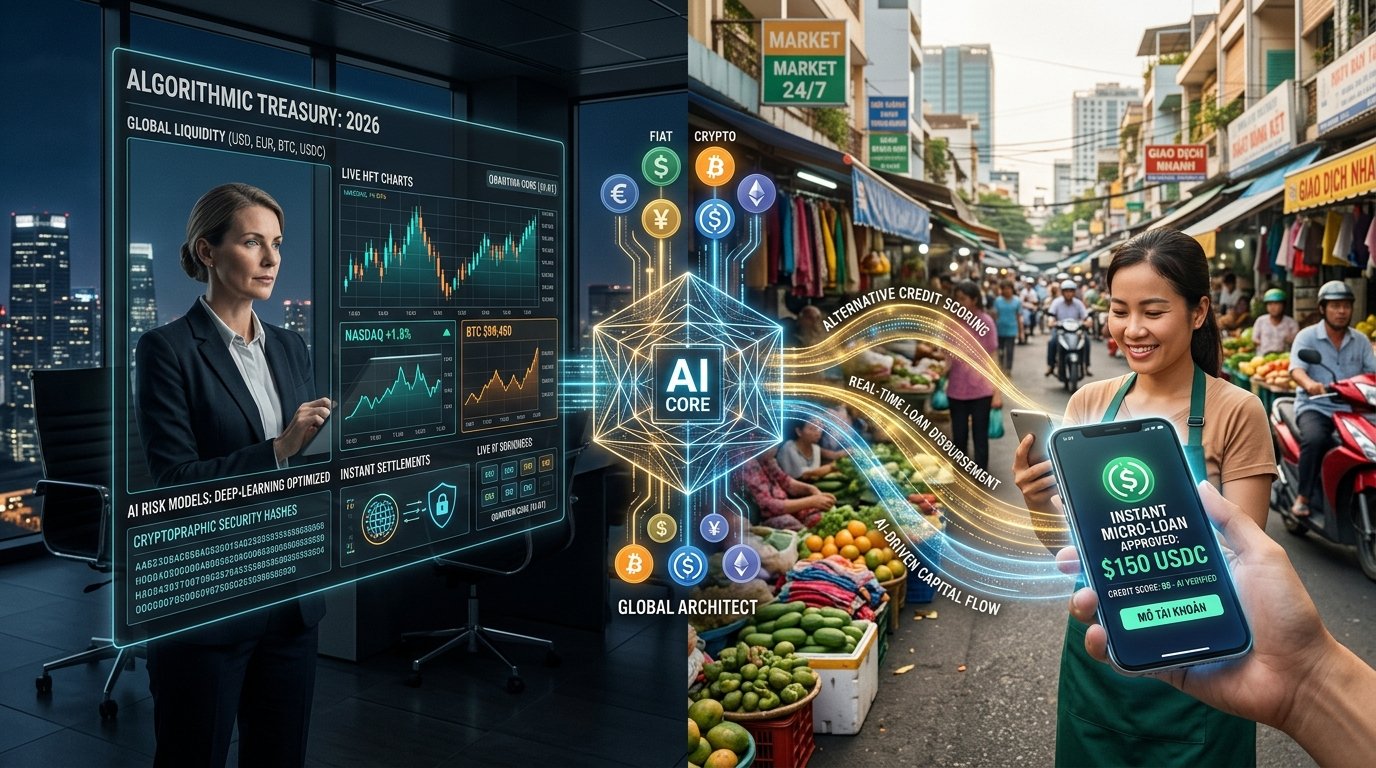
For centuries, the financial industry was built on a foundation of human intuition, historical relationships, and exclusive access to information. Today, that foundation is being reshaped by software. Applied AI is no longer just a backend tool for quantitative hedge funds; it is increasingly visible in traditional banking, the crypto ecosystem, and the financial lives of the developing world.
For the borderless operator and the global S-Corp founder, financial literacy in 2026 no longer means just knowing how to read a balance sheet — it means understanding how algorithms move your capital. Here is our analysis of the AI financial shift, its global impact, and how to think about positioning your corporate treasury.
The New Baseline: TradFi and the Crypto Ecosystem
The integration of AI in finance is not a future projection; industry reporting throughout 2026 describes it as a current operational baseline that is exposing the inefficiencies of legacy systems — though the pace and scope of adoption still varies significantly by institution and region.
Traditional Banking: From Reactive to Predictive
Major financial institutions have been reported deploying customized Large Language Models (LLMs) to synthesize macroeconomic reports, earnings calls, and geopolitical news far faster than manual analyst review allows.
- The Fraud Revolution: Legacy fraud detection relied on rigid, rules-based triggers. Newer AI systems use behavioral modeling — analyzing patterns like device handling, typing cadence, and typical geolocations — to authenticate transactions, with the stated goal of reducing false positives while catching more sophisticated fraud rings.
The Crypto Ecosystem: Autonomous Arbitrage
In the decentralized finance (DeFi) space, AI tooling is increasingly used for:
- Smart Contract Auditing: AI-assisted review can scan large volumes of Solidity code for known vulnerability patterns faster than manual review alone, though it does not replace a formal human security audit before deploying a contract handling real funds.
- Yield Optimization: Automated “agents” can monitor decentralized exchanges for arbitrage opportunities and rebalance liquidity between pools — a capability that also means yields compress quickly once a strategy becomes widely automated.
The Emerging Market Impact: Bypassing the Legacy Grid
Some of the most consequential effects of AI-driven finance are showing up in the developing economies of Southeast Asia, Africa, and Latin America.
- The Upside: Frictionless Inclusion. A large share of the global population remains “unbanked.” AI-driven alternative data scoring lets fintechs underwrite micro-loans using signals like utility payments and mobile money transfer history, extending credit access where traditional scoring models have little data to work with.
- The Downside: Algorithmic Redlining. The risk is “black box” bias. If a model is trained on historically biased economic data, it can scale that bias rather than correct for it — creating a real risk of systematically denying credit to specific demographics without a human ever reviewing the individual file.
Where the Real Money Moves: Cross-Border Payment Rails
This is the part of the AI-and-finance story that matters most directly for a borderless founder’s day-to-day cash flow: stablecoin-based settlement rails have moved from experimental to genuinely used in specific corridors during 2026, with major payment networks expanding stablecoin settlement pilots and remittance providers integrating blockchain rails alongside their traditional cash networks.
The World Bank’s Remittance Prices Worldwide database remains the most reliable independent benchmark for what cross-border transfers actually cost corridor by corridor — worth checking directly rather than relying on any single vendor’s marketing claim about “the cheapest way to send money.”
The Operational Reality: Pricing the Algorithmic Treasury
While deploying AI-assisted financial workflows is increasingly practical, operating these models requires real computational spend. For the borderless founder building or integrating AI workflows to track FX spreads, analyze market data, or automate S-Corp accounting, your new overhead is not traditional banking fees alone — it is API tokens.
If you fail to monitor your token consumption, the operational cost of running a heavy LLM can quietly erode any efficiency gain you’re chasing. To bridge this gap, we built the Advanced AI API Cost Estimator.
- Methodology: This simulator estimates your monthly computational burn rate. By inputting your expected input/output token payload and daily request volume, the tool compares current flagship-tier models (for example, Claude Opus 4.8 or GPT-5.6) against faster, cheaper tiers (for example, Claude Haiku 4.5 or Gemini’s Flash tier) using live provider pricing.
Launch the Advanced AI API Cost Estimator — Here (Interactive Calculator)
How to Prepare: Tips and Warnings for the Individual
As the financial tech stack evolves, your strategy should pivot from manual execution toward higher-level architecture and risk management.
- Elevate Your Skillset: Manually chasing micro-trends against automated systems is a losing game for most individual operators. Shift your focus to macro-economics, asset allocation, and systemic risk management — the layer where human judgment still clearly adds value.
- Embrace the API: Ensure your business accounts, crypto wallets, and brokerages have robust API integration capabilities so you can interface with the AI-assisted tools that are becoming standard in treasury management.
The Practitioner’s Reality: Anatomy of the AI-Crypto Scam Syndicate
As I openly confessed in my previous writings regarding the “Long Con,” my transition into a solo digital nomad following my divorce was financially devastating. I lost a significant portion of my assets to an embarrassing spectrum of scams. I share this not for sympathy, but to expose the exact “vulnerability matrix” that makes isolated, borderless founders the perfect targets for the dark side of algorithmic finance.
While banks use AI for predictive modeling, international syndicates have weaponized it for mass extraction. Today’s most dangerous scams operate on a deadly triad: AI provides the flawless camouflage (deepfake cloning), Crypto provides the untraceable getaway vehicle, and Social Media serves as the global hunting ground.
If you are operating in Southeast Asia, here is my definitive survival guide regarding your personal tech stack:
- The Social Media & Dating App Illusion: If a stunningly attractive woman or a Hollywood-caliber man suddenly slides into your DMs or matches with you online, the probability of it being a legitimate connection is zero. These are highly organized syndicates – often operating out of massive scam compounds in Cambodia or Myanmar – utilizing real-time AI voice, image, and video cloning.
- The Offline Imperative: Delete the dating apps and walk outside. While the physical street is certainly not scam-free, the probability of falling for a catastrophic, life-ruining financial trap in person is less than a tenth of what it is online. You can read a person’s true intentions far better over a coffee than through a screen.
- The “Too Good to be True” Heuristic: Whether it is a flawless romance or an algorithmic crypto investment guaranteeing an 8% daily yield, if it seems too good to be true, it is 100% a highly engineered trap.
Right at this very moment, syndicates are using spoofed VoIP numbers, generative AI personas, and untraceable stablecoin ledgers to hunt for vulnerable capital. Do not let the digital isolation of the nomad lifestyle compromise your operational security. The absolute best cybersecurity in the world is simply logging off and engaging with the real world.
About the Author & Editorial Policy
Written by Simon K., a Borderless Founder and IP Professional specializing in U.S. and international patent frameworks. He leverages his experience running a remote California S-Corporation to provide actionable intelligence for global founders.
Disclaimer: Simon K. is a patent law professional and consultant, not a licensed patent attorney or registered patent agent. All content is for informational purposes only and does not establish an attorney-client relationship.