The Intelligence Continuum: From Code to Cognition
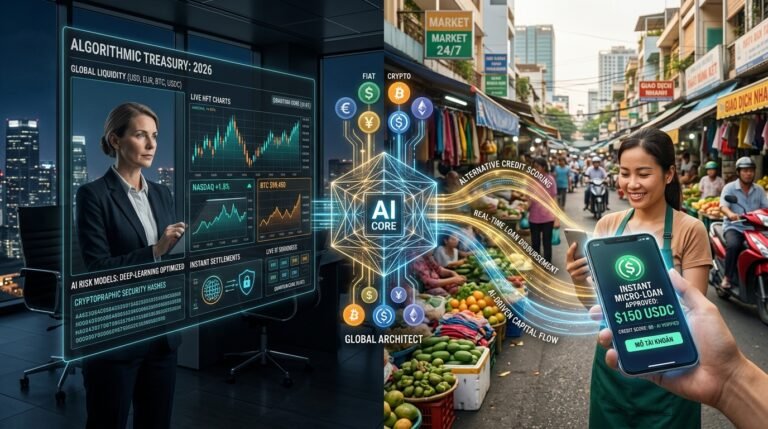
The history of Artificial Intelligence is the story of humanity building a mirror that slowly learned to look back. For seventy years, we built machines to reduce our physical labor; we are now in the final transitional decade of building machines that eliminate our cognitive friction. The future prospect is not a dystopian replacement of the human worker, but the elevation of the human from an operator to a “Global Architect.” As AI moves from generating text to orchestrating physical supply chains, the ultimate premium will be placed on human vision, empathy, and the biological intuition required to direct the algorithmic swarm.
Here is the condensed, analytic history of how we arrived at the 2026 reality, the current usage statistics, and the path to the ultimate frontier.
The Pre-Awakening: The Ages of AI (Pre-2016)
- The Symbolic Era (1950s–1980s): Hard-coding human logic into brittle, rules-based expert systems that ultimately failed at real-world nuance.
- The Statistical Winter (1990s–2000s): A quiet period of mathematical refinement, shifting from programmed logic to probability and pattern recognition.
- The Deep Learning Spring (2010s): The explosive collision of massive datasets and GPU compute, allowing neural networks to finally recognize images and translate speech.
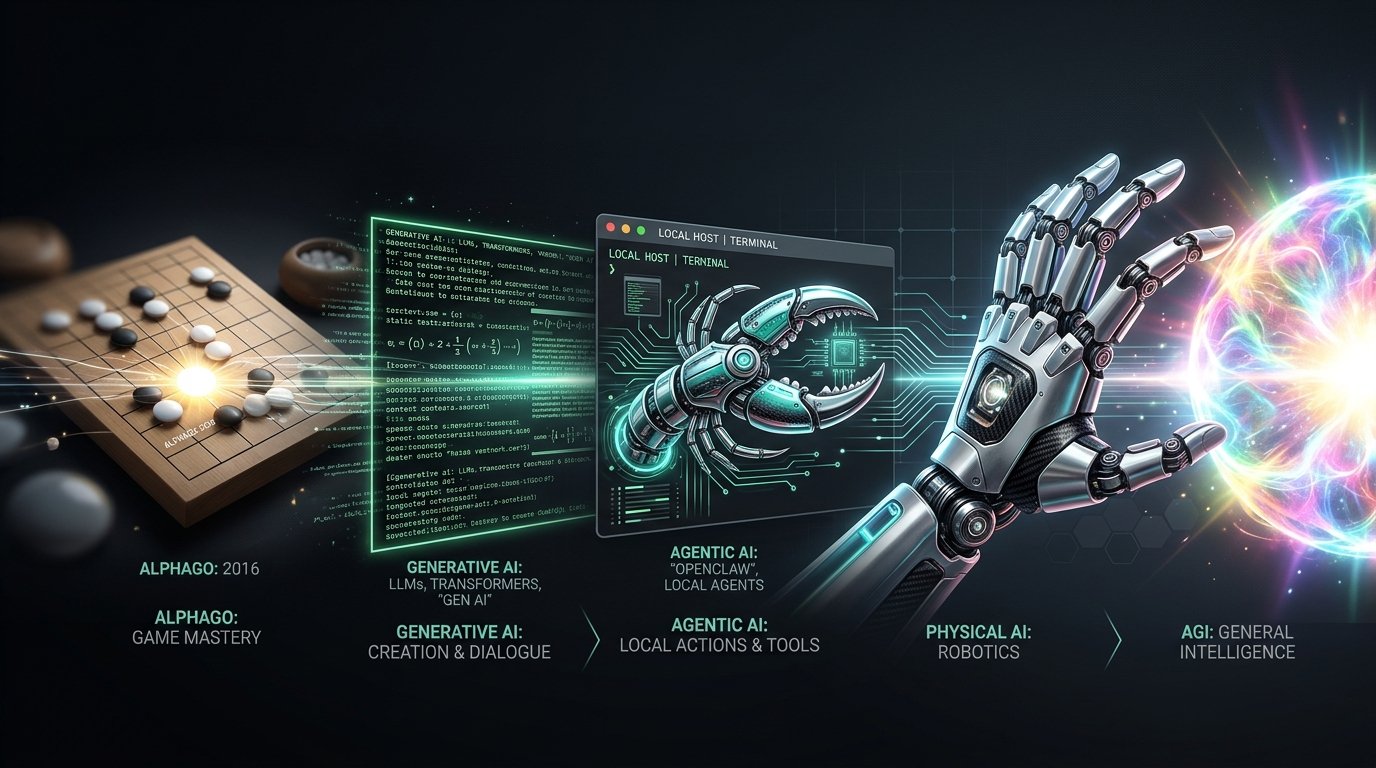
- The AlphaGo Singularity (2016): The exact moment mathematical probability synthesized “intuition” to defeat the reigning human champion in the world’s most complex board game.
The Autonomy Vector: 2022 to AGI
The past four years have seen more technological compression than the previous four decades. We are moving rapidly up the autonomy vector.
- Generative AI (2022 – ChatGPT): The democratization of the interface. This proved that large language models could synthesize and generate human-level text, sparking the mass consumer adoption wave and proving the commercial viability of neural networks.
- The Local Agent (2025/2026 – OpenClaw): The critical bridge to true autonomy. Platforms like the open-source OpenClaw shifted AI from a reactive chatbot in a corporate walled garden to a proactive, local operating system capable of executing terminal commands, managing personal files, and running 24/7 background workflows directly on a user’s hardware.
- Agentic AI (2026 – Present): The current enterprise frontier. Multi-agent architectures have stopped asking how to do a task and simply execute complex, multi-step goals autonomously across various software environments (like Claude Code executing massive percentages of global GitHub commits).
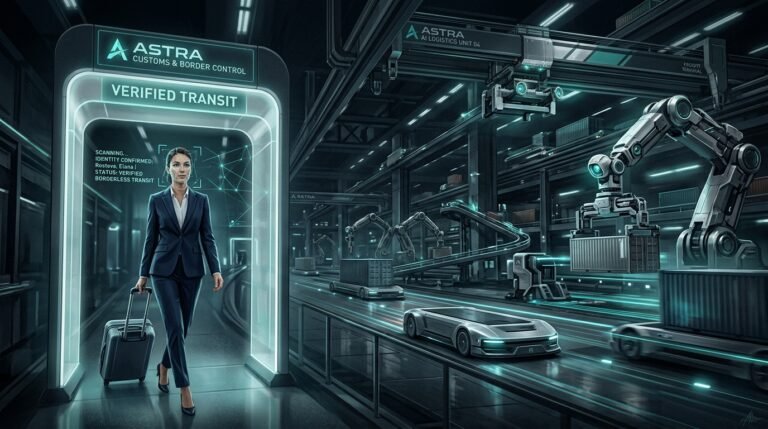
- Physical AI (Late 2020s): The imminent transition of Agentic AI into the kinetic layer—animating industrial robotics, autonomous logistics, and edge-computing devices to manipulate the physical world in real-time.
- AGI (The Horizon): Artificial General Intelligence. The theoretical, impending threshold where a synthetic system matches or exceeds human cognitive breadth across all economically valuable tasks.
The 2026 Ground Truth: Usage and Data Statistics
The debate over whether AI is a “fad” is definitively over. The 2026 statistics reveal deep, structural integration into the global economy.
- Corporate Saturation: Between 75% and 88% of global organizations report actively using AI in at least one core business function, moving aggressively from pilot programs into production environments.
- The Employee Baseline: For the first time, 50% of employed U.S. adults report using AI in their roles, with nearly 30% utilizing it multiple times a week to automate coding, synthesis, and administrative friction.
- The Global Divide: Global AI diffusion sits at roughly 17.8% of the working-age population. However, adoption is highly polarized. The UAE leads the world at a staggering 70.1% diffusion, while the U.S. hovers around 31.3%, highlighting a widening efficiency gap between proactive, tech-centric economies and legacy regulatory states.
The Major AI Taxonomy: Colors and Specialties
The AI ecosystem has consolidated into distinct “personalities,” each identifiable by their branding and technical edge.
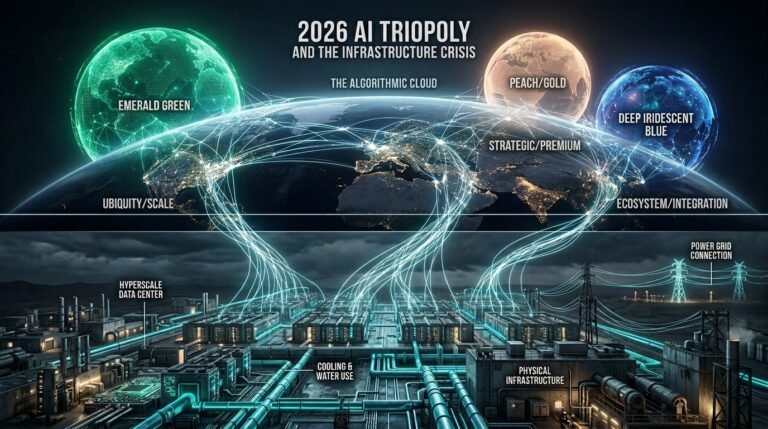
- OpenAI / ChatGPT (Black & Emerald Green): The ubiquitous pioneer. Specializing in mass-market accessibility, generalized reasoning, and standardizing the conversational interface for the general public.
- Anthropic / Claude (Warm Peach & Serif Typography): The enterprise and developer darling. Specializing in massive context windows, nuance, ethical alignment, and autonomous coding capabilities that dominate the B2B tech sector.
- Google / Gemini (Deep Blue & Iridescent Sparkle): The multimodal ecosystem. Specializing in seamless integration across search and mobile architecture, processing text, video, and audio natively without relying on external plugins.
- Meta / Llama (Minimalist Blue & White): The open-weights champion. Specializing in democratizing access, allowing developers and sovereign nations to build customized, highly efficient, and cost-effective local models.