India’s UPI Goes Global: What the Expansion Means for Borderless Founders (And My Remitly vs. WireBarley Playbook)
Last Updated: August 29, 2026 by Simon K., Borderless Founder & IP Professional
In plain English: UPI is India’s wildly popular instant-payment system — over 350 million people use it daily. It is now spreading beyond India’s borders into at least eight countries. For most global founders, this currently looks like a neat travel convenience, not a B2B business tool. But if you pay contractors, hire developers, or route money across Asia, it is a massive early signal of where the global financial plumbing is heading.
Here is a scenario worth imagining for a second: you are paying an overseas contractor for a rush job, you hit send on a traditional bank wire, and then… nothing. No update for two days. No explanation. Just silence, while your contractor politely asks if the payment “got stuck”. If that sounds familiar, you already understand why real-time cross-border settlement matters, even if it starts with something as mundane as scanning a QR code at a foreign coffee shop.
While Western financial markets spent the last few years aggressively debating stablecoin regulations and legacy banking infrastructure, India quietly exported one of the most robust real-time payment systems on the planet.
Where UPI Actually Works Today
As of early 2026, India’s government officially confirmed that UPI capabilities are live in eight countries: the UAE, Singapore, Bhutan, Nepal, Sri Lanka, France, Mauritius, and Qatar.
Industry press has since reported additional rollouts, including Cambodia, alongside pilot-stage merchant partnerships in a handful of other markets. However, coverage of exactly which newer markets count as “fully live” versus “early pilot” is genuinely inconsistent. Treat any count above the confirmed eight with a healthy pinch of caution until it shows up in an official government or NPCI (National Payments Corporation of India) statement.
The Practitioner’s Reality 1: The Invisible Indian Backend
To understand why UPI’s expansion is critical for Western founders, you have to acknowledge how deeply the Indian IT and BPO industry is embedded into the U.S. corporate ecosystem. The time-zone arbitrage is perfect: a U.S. founder can hand off a project at 5:00 PM in California, and an Indian contractor picks it up immediately at 5:30 AM IST, delivering the results by the time the founder wakes up.
This deep integration extends directly into the fintech tools we use every day. Consider Remitly, one of the most prominent U.S.-based remittance platforms. In my personal experience using Remitly’s international wire services heavily for over four years, I have had to call their customer service on multiple occasions to verify transfers or resolve holds. Without a single exception, every representative I have spoken to had an Indian accent.
This is not a coincidence. It is a reflection of the fact that the operational backbone of Western fintech heavily relies on Indian infrastructure and talent. As India continues to dominate the backend of global tech, their homegrown payment rails (like UPI) will inevitably push outward, demanding integration with the Western systems that currently rely on their labor.
The Practitioner’s Reality 2: The Remitly vs. WireBarley Arms Race
While UPI builds the public infrastructure of the future, today, borderless founders are forced to rely on private fintech apps battling for our margins.
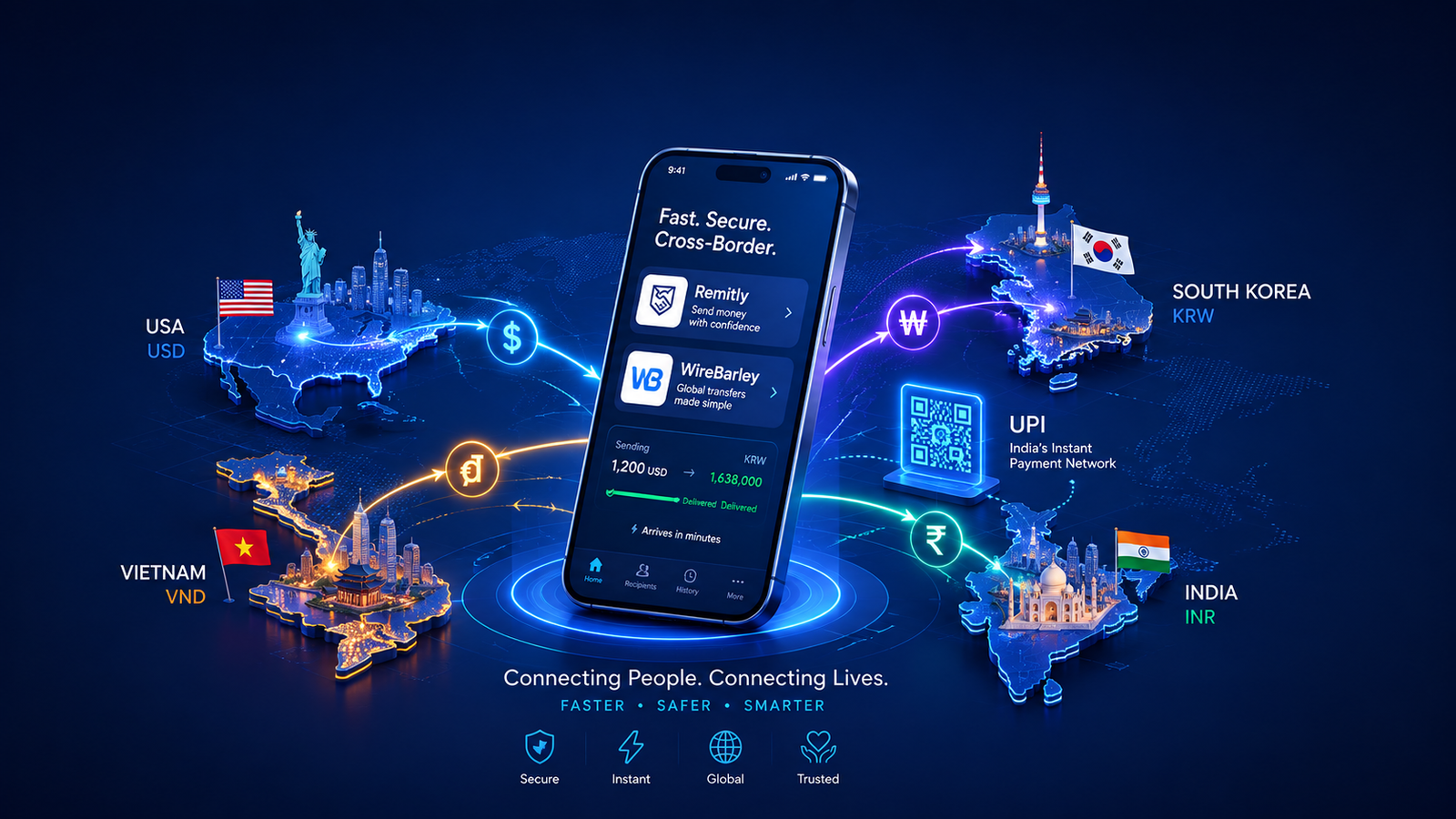
Recently, the competition between Remitly and its Asian-focused competitor, WireBarley, has created a massive advantage for digital nomads. Remitly seems acutely aware of WireBarley’s rising dominance in the Asian corridor. In response, they have optimized one of the most critical features for a solo founder: the “Wire to Self” (Send to yourself) option, coupled with aggressively upgraded transfer speeds.
Historically, I split my routing strictly by geography. I exclusively used Remitly to wire money from my U.S. account directly to my own South Korean bank account. Meanwhile, for sending funds from the U.S. to my local Vietnamese bank account, I relied entirely on WireBarley.
However, Remitly’s recent feature upgrades have completely shifted my playbook. Their routing into Vietnam has become extraordinarily fast. Just recently, I executed a “Wire to Self” from my U.S. account directly into my Vietnamese local bank account using Remitly, and the funds cleared in less than 60 seconds.
There is one critical caveat for expats: this sub-minute speed applies strictly to direct bank deposits. If you select the option to physically pick up cash at a local Vietnamese bank branch (a common requirement for new nomads without local accounts), the processing time is still significantly delayed. But for direct digital settlement, the gap between WireBarley and Remitly is vanishing rapidly.
What UPI Expansion Does Not Solve — Yet
- It is a retail rail, not a B2B rail: Scanning a QR code to pay a merchant is a fundamentally different regulatory and technical animal than settling a cross-border invoice between two corporations.
- Reliability varies sharply by country: On-the-ground reporting from travelers consistently describes a gap between press-release coverage and everyday merchant acceptance. It works beautifully in Singapore, but reportedly still fails half the time at merchants in some of the newer markets.
- Fragmented bilateral partnerships: Each country link is built with a different local partner (e.g., Mashreq Bank in the UAE, QNB in Qatar, PayNow in Singapore). Therefore, the user experience, transaction fees, and reliability are not perfectly uniform across the network.
A Few Questions Founders Actually Ask
“Can I use UPI to pay my Indian contractor’s invoice directly today?” Not in any standard, business-grade way. UPI’s international links are currently built around consumer QR payments and small peer-to-peer transfers, not invoiced B2B settlement. For now, traditional bank transfers or platforms built specifically for business payments remain the practical option.
“Should I change how I pay my India-based team because of this news?” Not yet. This is a macroeconomic trend worth bookmarking, not a reason to rebuild your current payroll architecture. For the record, a standard contractor in Bangalore still gets paid the boring way: an international transfer, invoiced and documented like any other.
“Why does India get this kind of payment infrastructure before Western countries?” Largely because UPI was built as a national public infrastructure from day one, run by a government-backed body (NPCI), rather than stitched together from competing private credit card networks. It is a structural head start that is genuinely worth understanding if you are tracking where real-time global payments are heading.
The UPI story is not a turnkey solution to your B2B payroll problem today. It is a preview of a direction — and for a borderless founder, previews are always worth watching closely without acting on them prematurely.
About the Author & Editorial Policy
Written by Simon K., a Borderless Founder and IP Professional specializing in U.S. and international patent frameworks. He leverages his experience running a remote California S-Corporation to provide actionable intelligence for global founders.
Disclaimer: Simon K. is a patent law professional and consultant, not a licensed patent attorney or registered patent agent. All content is for informational purposes only and does not establish an attorney-client relationship.