Managing Cross-Border Cash Flow: Mitigating True Remittance Costs for Distributed Founders
Last Updated: June 19, 2026 by Simon K., Borderless Founder & IP Professional
For the borderless S-Corp operator, revenue generation is only half the equation; the other half is liquidity preservation. Moving capital from a U.S. corporate account into the local economy of the Indochina peninsula introduces a hidden layer of operational overhead.
Banks and payment processors thrive on opacity. Between foreign exchange (FX) spreads, correspondent banking fees, and ATM withdrawal charges, a location-independent founder can easily bleed 3% to 5% of their gross income (a baseline frequently corroborated by World Bank remittance cost data) simply trying to pay for daily life.
Operating seamlessly between Los Angeles and Da Nang or Seoul requires a rigorous financial architecture. Here is the 2026 ground truth on managing cross-border cash flow, navigating local financial networks, and calculating the true cost of remittance.
The Ground Game: Local Accounts vs. The ATM Premium
When touching down in Southeast Asia, your immediate need is local fiat currency. The infrastructure here is heavily bifurcated between the high-end digital tier and the street-level cash/QR economy.
The Holy Grail – A Local Bank Account: In an ideal world, securing a local bank account (such as Bangkok Bank in Thailand or Vietcombank in Vietnam) is the ultimate operational advantage. It grants you access to the local QR-code payment networks (like PromptPay or MoMo), which are ubiquitous – used for everything from luxury dining to a $1 street coffee.
The Reality: As discussed regarding the DTV visa, securing a local account in 2026 without a long-term corporate work permit or specific residency visa is increasingly difficult. If you manage to secure one, your local financial friction drops to zero.
The ATM Premium: Without a local account, ATMs become your primary lifeline for cash. However, Southeast Asian ATMs are notoriously expensive for foreign cards.
- The Fees: Standard withdrawal fees in countries like Thailand range from $6 to $8 USD (approx. 220 THB) per transaction, not including the 1% to 3% foreign transaction fee your home bank might charge. This is compounded by a deliberately poor exchange rate if you accidentally accept the ATM’s “Dynamic Currency Conversion” (always decline this and be charged in the local currency).
- The Solution: U.S. operators absolutely must carry a card that refunds global ATM fees. The Charles Schwab High Yield Investor Checking® account remains the undisputed gold standard for U.S. expats, refunding all ATM fees globally at the end of the month and charging zero foreign transaction fees.
The Practitioner’s Reality: The Vietnam Banking Loophole
While securing a bank account in Thailand is nearly impossible even with a 5-year Digital Nomad Visa (DTV), Vietnam presents a highly practical operational loophole. Speaking from my own personal experience on the ground, you can absolutely open a functional local bank account in Vietnam using nothing more than a standard 90-day tourist visa.
While the massive, state-owned Vietnamese banks might turn you away, many commercial and foreign-operated branches are highly accommodating. For example, when I arrived in Vietnam two years ago, I successfully opened an account with Woori Bank. The only strict prerequisite was possessing an active local Vietnamese phone number to receive SMS authentication codes.
There is a slight regulatory catch, but it is easily bypassed: the bank will likely refuse to issue a physical plastic debit or ATM card to a tourist visa holder. However, this physical limitation is entirely irrelevant in the modern ecosystem. The local banking app allows you to execute flawless QR code payments (which are universally accepted across Vietnam, from high-end cafes to $1 street food carts) and even perform cardless cash withdrawals directly from their ATMs using your smartphone.
My personal, friction-free financial stack for Southeast Asia boils down to just two essential tools: my local Woori Bank account for daily QR micro-transactions, paired with a zero-foreign-transaction-fee Capital One Visa card for major expenses. If you can secure a local QR-enabled app and carry a true zero-fee Visa or Mastercard, you have permanently solved the cross-border cash flow puzzle.
The Credit Card Boundary
Credit card acceptance in the Indochina peninsula has expanded rapidly, but it is not universal. If you are operating in tier-one districts – paying for a high-rise coworking space in Bangkok, dining in District 1 of Ho Chi Minh City, or ordering rides via Grab or Gojek -your U.S. corporate travel cards (like Chase Sapphire or Amex Platinum) will work flawlessly.
However, you must be hyper-aware of the Merchant Surcharge. Many businesses in Southeast Asia pass the credit card processing fee directly to the consumer, legally adding a 2.5% to 3% surcharge (the standard Visa/Mastercard network fee) to your bill if you choose to pay with plastic instead of cash or local QR transfer. Over a year of daily expenses, this surcharge compounds into a significant financial drain.
The FinTech War: Unmasking Remittance Tech
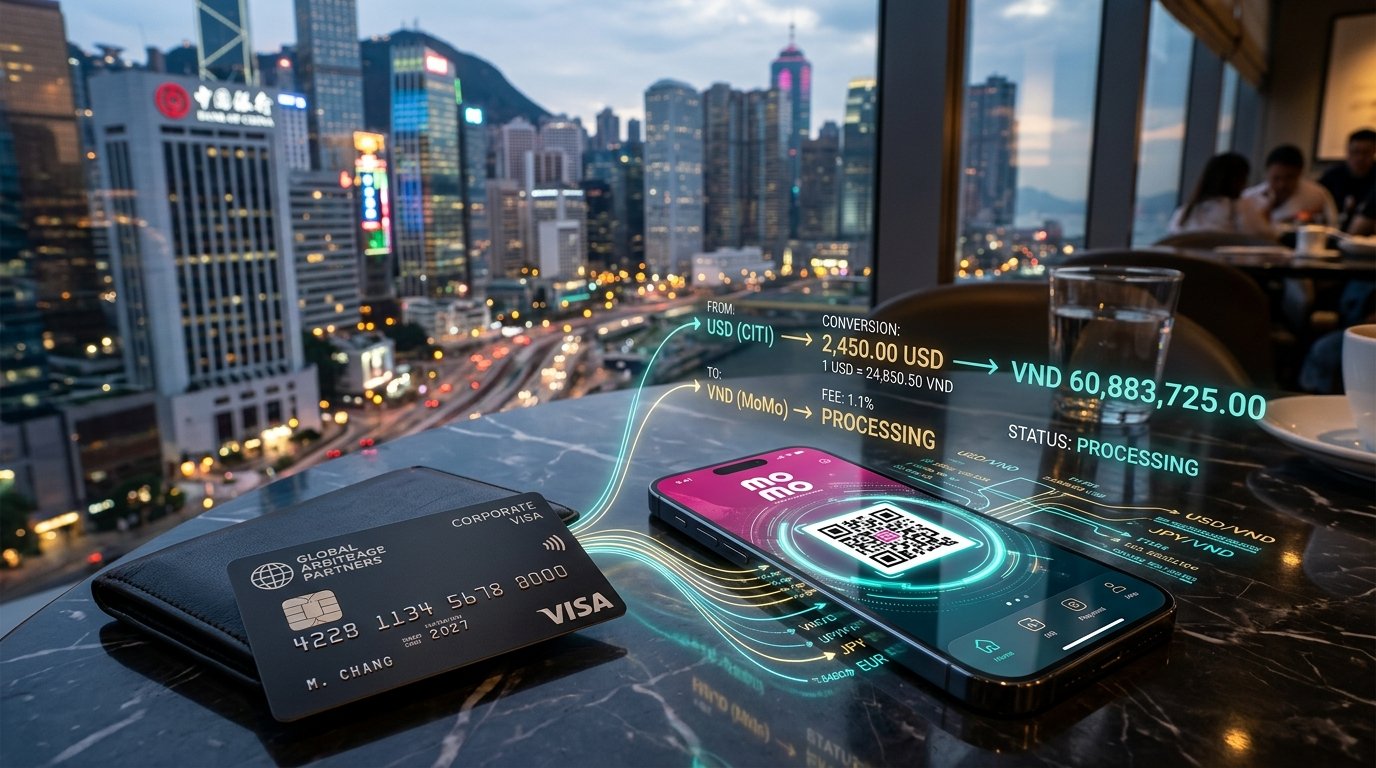
When you need to move larger sums of money – such as paying for a 6-month luxury condo lease or a local legal retainer – you must bypass the traditional SWIFT banking system. SWIFT is slow, routes through expensive intermediary banks, and offers terrible FX rates.
The remittance landscape is now dominated by FinTech platforms like Wise, Revolut, and Remitly.
How the Tech Actually Works: These platforms rarely move money across borders in the traditional sense. Instead, they use a system of local liquidity pools. When you send USD from Los Angeles to VND in Da Nang, your USD goes into Wise’s U.S. bank account. Almost instantly, Wise’s Vietnamese bank account releases the equivalent VND to your landlord. The money never actually crossed the ocean; the platform just balanced its internal ledgers.
This technology is what allows them to offer the “mid-market rate” (the true exchange rate you see on Google) and charge a transparent, upfront fee instead of hiding their profit in a marked-up exchange rate.
The “True Cost” Illusion & Our Solution
Despite the transparency of modern FinTech, calculating the actual cost of a cross-border transfer remains intentionally complex. Platform A might offer zero flat fees but a 1% markup on the FX spread. Platform B might offer the exact mid-market rate but charge a $15 flat fee and a 0.5% funding fee for using a debit card.
For the borderless founder, optimizing these transfers is a fiduciary duty to your own S-Corp. Relying on marketing copy is dangerous; you need hard data.
To permanently eliminate this guesswork, we developed the Cross-Border Remittance True Cost Calculator.
- Methodology: This tool dynamically compares the real-time mid-market exchange rate (your true baseline) against the actual marked-up rates and variable flat fees charged by various platforms. By inputting your exact transfer amount, the logic engine strips away the marketing, isolates the hidden FX spread, and calculates the definitive, lowest-cost routing for your capital.
Launch the Cross-Border Remittance True Cost Calculator Here (Interactive Simulator)
The Verdict
Cash flow management in 2026 is an exercise in operational discipline. Never rely on a single point of failure. The resilient global architect maintains a U.S. no-fee ATM card for local cash, a premium travel credit card for heavy digital infrastructure, and a rigorous, data-driven approach to FinTech remittances to ensure that the capital they earn remains their own.
About the Author & Editorial Policy
Written by Simon K., a Borderless Founder and IP Professional specializing in U.S. and international patent frameworks. He leverages his experience running a remote California S-Corporation to provide actionable intelligence for global founders.
Disclaimer: Simon K. is a patent law professional and consultant, not a licensed patent attorney or registered patent agent. All content is for informational purposes only and does not establish an attorney-client relationship.