Paying Overseas Contractors With Stablecoins: What It Actually Saves Over SWIFT and Payroll Platforms
Last Updated: August 13, 2026 by Simon K., Borderless Founder & IP Professional
Bottom line: Paying an overseas contractor by traditional wire often means a $35 fee, a bad exchange rate, and a three-day wait. Paying with a stablecoin can shrink the middle step to minutes and pennies — but there’s a real, often-ignored cost at the very last step (converting it back to local cash) that most comparisons never mention. This piece walks through how the payment actually moves, what it doesn’t fix, and a simple way to decide if it’s worth setting up.
$35 and three business days — that’s what it used to cost Noah just to get a single invoice paid, month after month, for two straight years.
Noah runs a small agency with five contractors spread across the Philippines, Vietnam, and Nigeria — another composite, built from a pattern this site sees constantly. He kept sending traditional wires long after he’d started grumbling about them, until one of his own contractors asked to be paid in USDC instead. That one request changed his whole approach to payroll — and forced him to actually sit down and work out, corridor by corridor, where the old rails were genuinely worth keeping and where they were just a habit he’d never questioned.
How the Payment Actually Moves
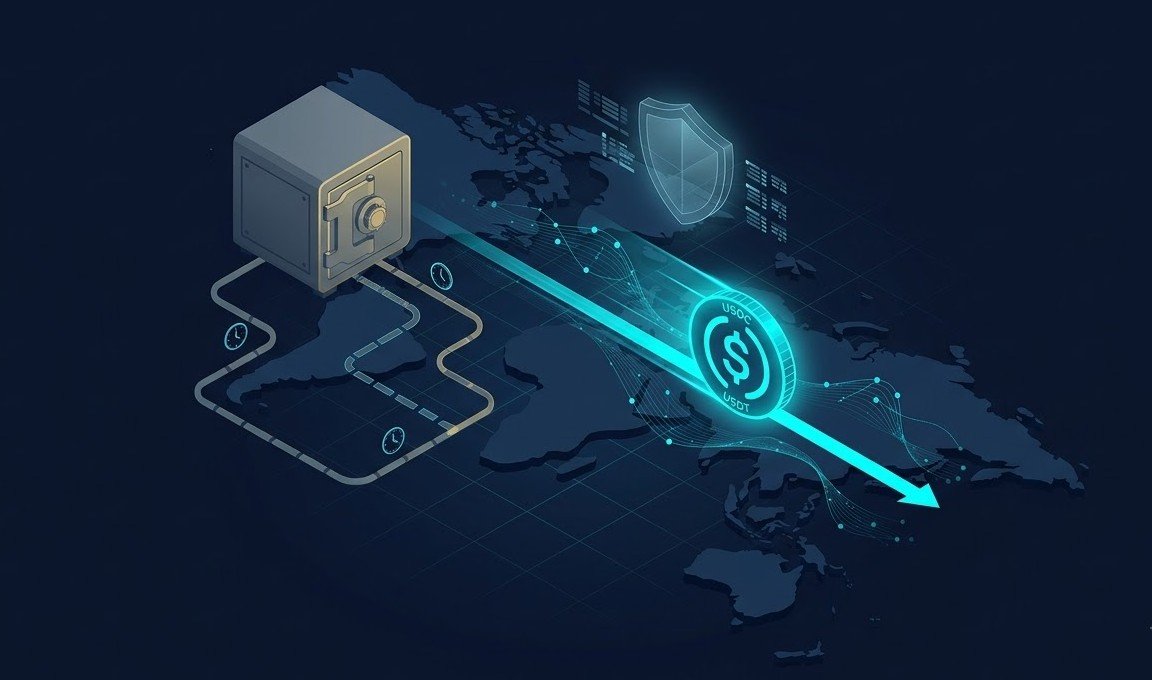
- You convert USD into a dollar-pegged stablecoin (most commonly USDC or USDT) through an exchange or a payment processor that has added stablecoin rails.
- The stablecoin transfers directly to the contractor’s wallet, or to their account on an exchange, typically settling in minutes rather than days, largely free of banking-hours cutoffs.
- The contractor then “off-ramps” — converts the stablecoin back into their local currency through a local exchange or fintech app.
That last step is the part almost every glowing comparison conveniently leaves out, and it’s exactly where Noah’s first attempt went sideways: his Vietnam-based contractor’s off-ramp charged a spread that quietly ate a third of the savings. The realistic win versus a traditional wire comes from the middle step being nearly free and instant — not from the entire chain being free.
Benjamin Franklin never sent a wire to Lagos, but “time is money” would have landed just as well coming from any contractor who’s ever waited three days to get paid.
Benchmarking Against the Old Rails
Before assuming stablecoin settlement is automatically cheaper on your specific corridor, benchmark it against what a traditional transfer actually costs on that exact route using the World Bank’s independent Remittance Prices Worldwide database, which tracks real corridor-by-corridor pricing rather than any single provider’s marketing page.
What This Does Not Solve
- Your compliance obligations don’t disappear. Contractor classification rules, 1099/W-8BEN documentation for U.S. tax purposes, and any local withholding requirements in the contractor’s country apply exactly as before — the payment rail changed, not the underlying tax and labor law.
- Stablecoin issuer regulation now matters more, not less. As covered in our analysis of the GENIUS Act, which stablecoins remain broadly usable over the next few years depends heavily on issuer licensing status.
- Volatility risk isn’t zero. Even a well-collateralized, dollar-pegged stablecoin can briefly de-peg during a stress event; holding large balances in stablecoins for extended periods carries a different risk profile than an insured bank deposit.
A Simple Framework for Deciding
Setting up a stablecoin payment workflow has real fixed overhead: choosing a compliant on/off-ramp, documenting the process for your accountant, and walking each contractor through how to receive and convert it. That overhead earns its keep if you’re making frequent, recurring payments into corridors with genuinely liquid local off-ramps. For an occasional one-off payment, or a corridor where the contractor’s local off-ramp options are thin, a traditional wire or an established remittance platform may still be the simpler, cheaper choice.
Noah eventually landed on a hybrid: stablecoins for his Philippines and Nigeria contractors, where the off-ramp liquidity was strong, and a traditional wire for the one contractor whose local exchange access was patchy. Not a purist’s answer, but a profitable one — which is really the only kind that matters.
Compare your specific corridor’s numbers directly:
Launch the Stablecoin vs. SWIFT Payout Calculator Here (Interactive Calculator)
The Practitioner’s Reality: The Fintech Baseline and the Scammer’s Playbook
Let’s be completely honest: I don’t know a single borderless founder or digital nomad today who relies exclusively on traditional SWIFT wires. Like most of my peers, my own default operational baseline relies heavily on agile Fintech platforms to move capital.
However, as stablecoin on-ramps and off-ramps become increasingly frictionless, maintaining a rigid, blind loyalty only to Fintech is a strategic mistake. My personal rule is to always keep a stablecoin payment infrastructure primed and ready. I constantly benchmark Fintech remittance fees against stablecoin routing (USDT/USDC). If the crypto route offers a better spread for a specific contractor’s corridor, I switch immediately. You have to remain platform-agnostic to protect your margins.
There is also a darker, yet highly practical, reason I force myself to master this setup. If you look at the global landscape, the most efficient and prolific adopters of stablecoins today are actually transnational scammers. They exploit these networks precisely because they are instant, borderless, and practically irreversible.
By actively using and understanding the exact mechanics of how a stablecoin transfer works—from wallet addresses to network fees—I am not just optimizing my payroll. I am actively upgrading my own financial literacy. Understanding exactly how this shadow money moves is the most effective psychological and operational armor you can build against the sophisticated digital scams targeting borderless operators today.
A Few Questions Founders Actually Ask
- “Which stablecoin should I actually use?” The two largest dollar-pegged options, USDC and USDT, dominate liquidity in most corridors, but local off-ramp support varies by country and can change quickly — check what your specific contractor’s local exchange actually supports before committing, rather than assuming the biggest name is automatically the most usable one where they live.
- “Is this legal?” Yes, in the vast majority of jurisdictions, treating a stablecoin payment for legitimate contractor work no differently from any other form of payment for tax and compliance purposes. The legal risk isn’t in using the rail; it’s in skipping the same documentation you’d need for a wire.
- “What if the contractor doesn’t want to be paid this way?” Then don’t force it. Nothing about this workflow requires universal adoption across your whole team — Noah runs a genuine hybrid, and most founders who use stablecoin payroll at all end up doing the same, corridor by corridor rather than company-wide.
- “How do I actually explain this to my accountant?” Treat each stablecoin payment exactly like a foreign currency payment for record-keeping purposes: date, USD-equivalent value at time of transfer, and purpose. The novelty is the rail, not the bookkeeping principle underneath it.
The honest summary is unglamorous: stablecoin payroll is a genuinely useful tool for a specific set of corridors and a specific payment pattern, not a universal replacement for every wire you’ll ever send. Noah’s business didn’t get dramatically cheaper the day he adopted it — it got a little cheaper, a little faster, in exactly the two corridors where it made sense, and stayed exactly the same everywhere else. That’s usually what a good financial tool actually looks like in practice: modest, specific, and boring in the best possible way.
If there’s a single takeaway worth carrying forward, it’s this: don’t evaluate a new payment rail by its best-case story. Evaluate it corridor by corridor, contractor by contractor, the same patient way Noah eventually did — and treat any comparison, including this one, as a starting point for your own math rather than a final answer.prised by it.
About the Author & Editorial Policy
Written by Simon K., a Borderless Founder and IP Professional specializing in U.S. and international patent frameworks. He leverages his experience running a remote California S-Corporation to provide actionable intelligence for global founders.
Disclaimer: Simon K. is a patent law professional and consultant, not a licensed patent attorney or registered patent agent. All content is for informational purposes only and does not establish an attorney-client relationship.