How South Korea Rewrote the Rules in 2026
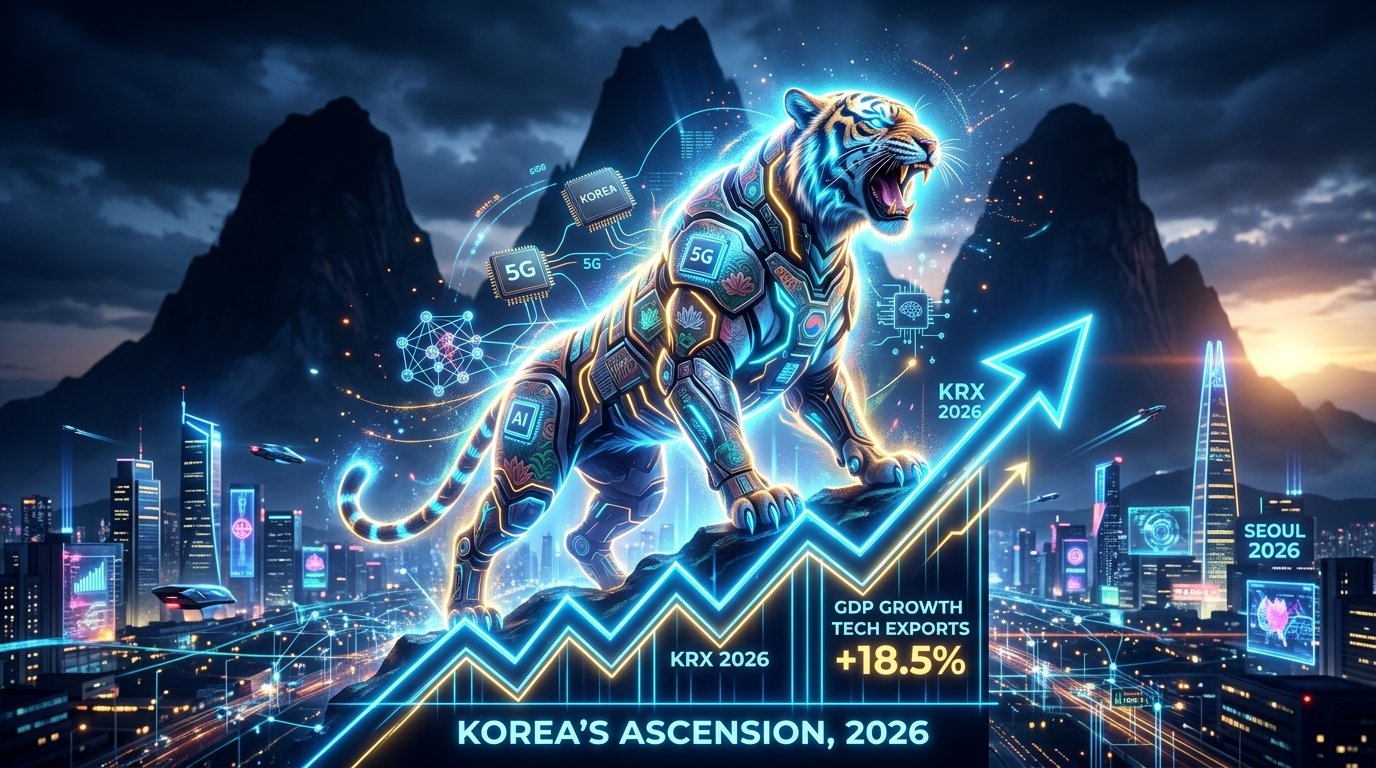
The year 2026 has been an unforgiving stress test for the global economy. With the ongoing US-Iran conflict rattling international supply chains and driving a sharp spike in energy prices, conventional economic wisdom predicted a widespread contraction, particularly for manufacturing-heavy nations reliant on imported oil. Yet, if you look at the macroeconomic data from the first quarter, one country didn’t just weather the storm—it fundamentally rewrote its position in the global pecking order.
Welcome to Nexus Analytics on sk-pulse.com. Today, we are breaking down the anomaly, the sheer grit, and the fascinating cultural DNA of South Korea in 2026: a nation that, against all geopolitical odds, has secured the world’s #1 economic growth rate and #1 stock market return, all while unseating its historic rival, Japan, in an unprecedented export reversal.
To understand how South Korea achieved this, we have to look past the spreadsheets. We need to examine a unique national psyche forged by centuries of geopolitical pressure, a hyper-dynamic tech culture, and an ancient philosophy that perfectly aligns with the AI-driven future.
The Reversal of the Century: Eclipsing Japan’s Export Machine
For 77 years, since the establishment of the modern South Korean government in 1948, the nation’s export volume has chased Japan’s—a seemingly insurmountable wall built by the Japanese automotive and advanced manufacturing sectors. By the end of 2025, that gap had narrowed to a historically low $29 billion. But in 2026, the dam finally broke.
Driven by a relentless semiconductor supercycle and an insatiable global appetite for AI infrastructure, South Korea’s exports surged. In January 2026, South Korea recorded $65.8 billion in exports, decisively outpacing Japan’s $58.6 billion. The momentum only accelerated from there. By March, South Korea shattered all previous ceilings, logging an all-time record of $86.1 billion in a single month.
When the first quarter closed, data from the Ministry of Trade, Industry and Energy revealed that South Korean exports had skyrocketed 37.8% year-on-year, reaching a staggering $219.9 billion. Semiconductors alone saw a 139% increase. Japan, heavily burdened by its 90% reliance on Middle Eastern crude oil and a sluggish transition to electric vehicles, faltered under the weight of the US-Iran conflict. South Korea, meanwhile, capitalized on its flagship tech sector, officially cementing 2026 as the “Year of the Great Reversal” and positioning itself as the world’s 5th-largest exporter.
#1 in Global Growth, #1 in Stock Market Returns
The export boom didn’t just alter trade rankings; it supercharged the domestic economy at a time when most developed nations were flatlining.
In Q1 2026, South Korea posted a Gross Domestic Product (GDP) growth rate of 1.7% quarter-on-quarter, translating to a massive 3.6% expansion in annual terms. This stands as the sharpest quarterly GDP growth globally for this period, eclipsing market expectations. Even more tellingly, the country’s Gross Domestic Income (GDI)—a more accurate measure of the public’s real purchasing power—rocketed by 7.5%.
This explosive growth triggered a historic bull run in the financial markets. Despite the geopolitical anxieties radiating from the Middle East, South Korea’s KOSPI index became the hottest market on the planet. Fueled by the memory chip supercycle led by titans like Samsung Electronics and SK Hynix, the KOSPI surged an astonishing 75% in the early months of the year. This unprecedented rally propelled the South Korean stock market past both the United Kingdom and Canada, officially making it the 7th largest stock market in the world by market capitalization.
How does a country with virtually no natural resources, navigating a severe global energy crisis, pull this off? The answer lies in a subversive, battle-hardened national temperament.
The “Poland of East Asia”: A Subversive, Egalitarian Psyche
Geopolitically speaking, South Korea has historically been the “Poland of East Asia”—a relatively small landmass sandwiched between sprawling empires and ambitious superpowers (China, Japan, and Russia). For centuries, it served as the bridge, the buffer, and tragically, the battleground.
However, instead of adopting a defeated or subservient mentality, this historical pressure cooker forged a remarkable and deeply egalitarian national psyche. Koreans developed a unique cultural mechanism of aggressively cutting giants down to size while staunchly refusing to punch down at the weak.
This spirit of defiant irreverence is baked into the vernacular. It is perhaps the only place in the world where locals, over a casual glass of soju, will use sassy, dismissive monikers for the globe’s most intimidating powers—calling Americans Yankee, the Japanese Waenom, and the Chinese Ttaenom. It is an instinctive refusal to be intimidated by size or military might. Yet, this same culture is fiercely protective of smaller, developing nations, readily extending aid, exporting infrastructure, and sharing technological know-how without the predatory strings often attached by larger superpowers. They respect hustle, they respect grit, but they absolutely do not bow to sheer bulk.
Early Adopters and the Top 3 AI Superpower
This audacious, underdog-turned-apex-predator spirit is the very engine of their modern dynamism. South Korea operates on a frequency of ppalli-ppalli (hurry, hurry)—a notorious impatience that makes them the ultimate early adopters.
While other nations debate the ethics and regulatory frameworks of emerging technologies for years, South Korea has already built the infrastructure, tested the use-cases, and mass-marketed the results. This aggressive forward momentum has firmly established the country as a Top 3 Global AI Superpower in 2026. They aren’t just manufacturing the memory chips that power global AI servers; they are rapidly integrating AI into their bio-pharma sectors, smart city grids, and robotics. South Korea treats the future as a product that needs to be beta-tested today.
The Heart of the Machine: Jeong and Hongik Ingan
Yet, it would be a mistake to view South Korea’s 2026 triumph as the product of cold, cutthroat capitalism. Beneath the hyper-competitive, high-tech exterior beats a heart governed by two ancient and profound concepts.
The first is Jeong (정)—a deep, invisible, and incredibly sticky web of collective affection, empathy, and social obligation. It is the communal glue that ensures that no matter how fiercely they compete during the day, there is a shared, unspoken bond of national solidarity when a crisis hits.
The second is Hongik Ingan (홍익인간), the founding philosophy of the Korean nation, which roughly translates to “devotion to the welfare of all humanity.” It is a stunningly progressive concept for an ancient creation myth. While other nations’ founding myths revolve around conquering enemies or achieving divine power, Korea’s myth is centered on benefiting humankind.
This philosophy bleeds into their modern technological ambitions. As South Korea leads the charge in AI and semiconductor development, there is an underlying cultural consensus that this technology should not merely be a tool for corporate monopolization, but a medium to elevate global living standards, cure diseases, and connect humanity.
Updating the Proverb
For hundreds of years, there was an old, somewhat tragic geopolitical proverb used to describe the Korean peninsula: “A shrimp whose back is broken in a fight between whales.”
As we analyze the data in 2026—the record-shattering exports, the world-beating GDP growth, the unstoppable stock market, and their ascension as an AI powerhouse—it is safe to say that the proverb is officially obsolete. The whales are still fighting, but the shrimp didn’t just survive the crossfire. It strapped on a jetpack, engineered a semiconductor shield, and evolved into a hyper-intelligent, tech-savvy Leviathan that is currently charting the course for the rest of the ocean.