Decoding the Examiner’s Mind – A Guide to Rejections, Objections, and Critical Deadlines
Last Updated: June 18, 2026 by Simon K., Borderless Founder & IP Professional
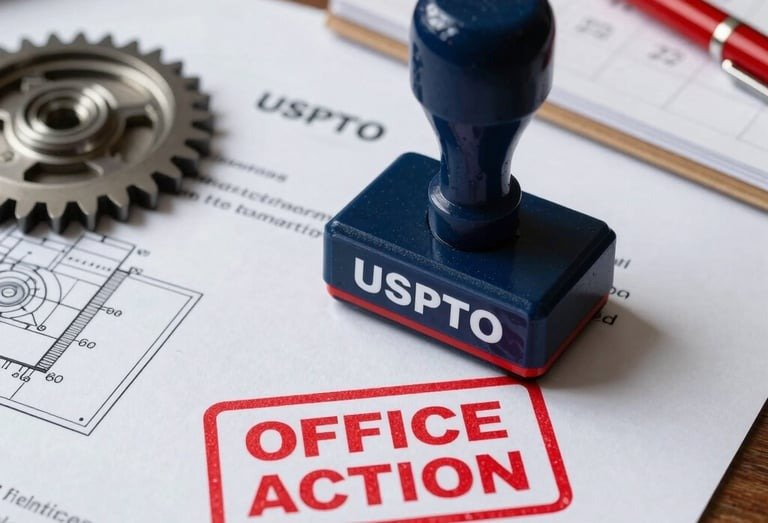
Have you ever opened an envelope from the United States Patent and Trademark Office (USPTO) only to find a thick stack of papers detailing exactly why your brilliant invention cannot be patented? For many independent creators and startup founders, receiving an “Office Action” can feel like a devastating blow.
But is a rejection truly the end of the road? In reality, receiving an Office Action is a standard, almost guaranteed rite of passage in the patent prosecution lifecycle. It is the beginning of a highly structured legal negotiation. However, to navigate this process, you must first understand the language of the examiner. Are they taking issue with the core novelty of your invention, or did you simply format your drawings incorrectly?
Before diving into the substantive law, practitioners must distinguish between two fundamental categories of USPTO pushback: objections and rejections. An objection is administrative; it is based on form, format, or drawing requirements. A rejection, on the other hand, is a substantive refusal to grant patent rights based on the legal merits of the invention itself. Let’s decode the most common statutory rejections, the procedural lifecycle of these actions, and the strict timelines that govern your survival.
The Substantive Minefield: Statutory Rejections
When an examiner substantively rejects a claim, they must cite a specific section of Title 35 of the United States Code (U.S.C.). Here are the heavy hitters:
1. Section 101: Patent Eligibility
Is your invention actually the kind of thing that can be patented? Under 35 U.S.C. § 101, a patent may only be granted for a “new and useful process, machine, manufacture, or composition of matter.” While this sounds broad, the courts have carved out explicit judicial exceptions. According to MPEP § 2106, examiners must reject claims directed to “abstract ideas, laws of nature, and natural phenomena” unless they include additional elements that amount to significantly more than the exception itself.
Example: You write a brilliant mathematical algorithm that predicts stock market fluctuations with 90% accuracy. You claim the math formula itself. The examiner will issue a § 101 rejection because a mathematical formula is considered an “abstract idea” and a fundamental truth of nature, neither of which is eligible for patent protection without being tied to a specific, transformative physical application.
The Practitioner’s Reality: The “Significantly More” Trap in High-Tech
In recent years, Section 101 has morphed into one of the most ruthless and strictly applied hurdles in patent prosecution, especially for high-tech startups. In my own practice, I frequently see this exact trap spring on advanced fields like drone technology, IoT, and AI integration.
Many founders assume that a 101 rejection only targets blatant “laws of nature” or purely philosophical “abstract ideas.” In reality, traditional rejections of that type are exceedingly rare today. Instead, the modern 101 rejection is almost entirely fought over a legal concept known as lacking “significantly more.”
When examining a high-tech application (e.g., a drone control system), the examiner will often dissect the claim, label the core algorithmic function as an “abstract idea,” and then evaluate the physical hardware. If the physical components—such as the drone’s rotors, cameras, or generic processors—are standard, well-known technologies, the examiner will argue that the invention simply applies an abstract idea using generic computer parts. They will conclude the claim lacks the “significantly more” required to transform it into a patent-eligible application. Overcoming this specific formulation of a 101 rejection is notoriously difficult and expensive.
Therefore, merely listing a combination of high-tech components and software functions is a guaranteed recipe for a fatal 101 rejection. To survive, you must clearly articulate in your specification exactly how your software technically improves the physical functioning of the hardware itself, rather than just using the hardware as a generic tool.
2. Section 102: Anticipation (Novelty)
Is your invention truly new? Under 35 U.S.C. § 102, an examiner will reject your claims for “anticipation” if a single, standalone piece of prior art describes your invention entirely. To maintain a Section 102 rejection, the examiner is bound by the “four corners” rule. MPEP § 2131 dictates that “each and every element as set forth in the claim is found… in a single prior art reference.”
Example: You claim a wooden chair with four legs, a high backrest, and a seat cushion filled with memory foam. The examiner finds a 2015 IKEA catalog showing a wooden chair with four legs and a high backrest, but the seat is bare wood. Because the “memory foam” element is missing from that single catalog page, the invention is not anticipated, and a Section 102 rejection fails.
3. Section 103: Obviousness
What if your invention isn’t perfectly described in a single document, but it is merely a trivial combination of existing technologies? This is where 35 U.S.C. § 103 comes into play, and it is the most common rejection in patent prosecution. An invention is unpatentable if the differences between the invention and the prior art would have been “obvious” to a Person Having Ordinary Skill in the Art (PHOSITA).
Example: You invent a bicycle with a lightweight carbon-fiber frame and attach a known aerodynamic disc wheel to it. The examiner finds Patent A (showing the carbon frame) and Patent B (showing the disc wheel). The examiner issues a § 103 rejection, articulating a clear “teaching, suggestion, or motivation” (TSM) that it would be obvious to combine them for speed.
4. Section 112: Specification and Definiteness
Did you describe your invention well enough, and are your legal boundaries clear? 35 U.S.C. § 112 ensures you have taught the public exactly how to make and use the invention (Enablement) and that your claims are clear and unambiguous (Definiteness).
Example: In your claims, you specify that a mechanical part must be “relatively heavy” and placed “near the edge.” The examiner will issue a § 112 rejection for indefiniteness. What does “relatively heavy” mean? Is it 10 pounds or 10,000 pounds? Without precise, objective boundaries, the claim is legally void.
The Procedural Lifecycle: Non-Final vs. Final
Understanding the nature of the rejection is only half the battle; you must also understand the stage of the negotiation.
- The Non-Final Rejection: When you receive your first substantive Office Action, it will almost always be designated as “Non-Final.” This is the opening bell. You have the absolute right to amend your claims and present new arguments.
- The Final Rejection: If the examiner deems your amendments or arguments unpersuasive, they will issue a “Final Rejection.” Do not let the word paralyze you; it rarely means the patent is dead. It simply cuts off your right to freely amend the claims. To keep the application alive, you must generally file a Notice of Appeal, or file a Request for Continued Examination (RCE) to reopen prosecution.
The Clock is Ticking: Response Durations
Patent prosecution is governed by unforgiving deadlines. Missing a deadline can result in the total abandonment of your application.
- Standard Office Action (Non-Final & Final): You are typically given a shortened statutory period of 3 months from the mailing date to file a response. However, you can buy extra time up to a maximum of 6 months total, provided you pay escalating extension-of-time (EOT) fees.
- Restriction Requirement: If an examiner decides you have claimed two completely independent inventions (e.g., a toaster and a car engine), they issue a Restriction Requirement. You are given a short window – 2 months – to simply choose which invention to pursue first.
💡 Forecast Your USPTO Overhead: Battling Office Actions is expensive. Buying Extensions of Time (EOT) or filing an RCE after a Final Rejection can consume thousands of dollars in government fees instantly. Model your exact prosecution budget liabilities using our interactive tool:
Launch the U.S. Patent Filing & Maintenance Fee Estimator (Interactive Calculator)
The “After-Final” Trap: The Advisory Action
What happens if you submit a quick amendment after receiving a Final Rejection, hoping to resolve the examiner’s concerns without paying the hefty fees for an RCE? The examiner will review your submission and, if it does not immediately place the application in condition for allowance, they will issue an “Advisory Action.” Here lies one of the most dangerous docketing traps in patent prosecution. Many inventors mistakenly believe that replying to a Final Rejection pauses the six-month statutory clock. It absolutely does not.
MPEP § 714.13 warns that the mailing of an Advisory Action “does not toll the period for reply” to the underlying Final Rejection.
The Trap: You receive a Final Rejection on January 1. You have a maximum statutory deadline of July 1 to save the application. On March 1, you file an after-final amendment. The examiner takes their time and mails an Advisory Action on May 15. Your absolute deadline is still July 1. If you mistakenly assume the Advisory Action gave you a fresh three months to respond, and you wait until August to file an RCE, your application has already died by operation of law.
The Verdict
Office Actions are standard procedural negotiations, separated into formal objections and substantive statutory rejections (§ 101, § 102, § 103, § 112). By understanding the legal framework of these rejections, distinguishing between Non-Final and Final statuses, and meticulously tracking your absolute 6-month drop-dead dates, applicants can strategically navigate the meat grinder and confidently move toward an allowable patent.
About the Author & Editorial Policy
Written by Simon K., a Borderless Founder and IP Professional specializing in U.S. and international patent frameworks. He leverages his experience running a remote California S-Corporation to provide actionable intelligence for global founders.
Disclaimer: Simon K. is a patent law professional and consultant, not a licensed patent attorney or registered patent agent. All content is for informational purposes only and does not establish an attorney-client relationship.