Thailand Said No, Vietnam Said Yes: How a Bank Account Decided Where I Work Remotely
Last Updated: September 23, 2026 by Simon K., Borderless Founder & IP Professional
Last year, I did what many remote workers in Asia were talking about: I applied online for Thailand’s Destination Thailand Visa (DTV) and received it in just four days. On paper, it looked like the perfect setup for someone like me who runs a U.S.-based business while spending long stretches in Asia. The DTV offers multiple entries over five years, stays of up to 180 days per entry (extendable once), and a legal framework designed specifically for remote workers.
Then I tried to open a bank account.
Over the following weeks, I visited three different banks in Udon Thani. The answer was always polite, and always the same: no. One bank said DTV holders simply were not eligible. Another asked for a work permit, which the DTV does not provide. The third suggested I come back “when the policy is clearer.” I eventually realized that holding a valid long-stay visa and being able to function financially in a country are two very different things.
That realization is why I now base myself in Vietnam instead.
Why a Local Bank Account Matters More Than You Think
When you plan a move abroad, you research visas, rent, internet speed, and coworking spaces. Banking rarely makes the list. It should, because without a local account, nearly every transaction comes with a cost.
Here is what life looks like without one:
International bank wires. Sending money from a home-country bank typically involves a sending fee, possible intermediary bank charges, and an exchange-rate spread built into the conversion. For a monthly transfer, these costs add up quickly.
Fintech transfers. Services like Remitly and Wise are far cheaper than traditional wires. But if you have no local account to receive the funds, you still end up withdrawing cash from ATMs with a foreign card, and that brings its own fees.
Foreign credit and debit cards. Many cards charge a foreign transaction fee, and local ATMs often add a per-withdrawal fee on top. Worse, many everyday merchants in Southeast Asia, such as small restaurants, landlords, and local shops, prefer cash or local QR payments over international cards.
Cash. Carrying large amounts of cash is risky. It also forces you into repeated currency exchanges, which, as I explain in a separate post, have become legally sensitive in Vietnam.
Let me put this in simple numbers. Suppose you spend about $2,500 a month abroad. If fees, spreads, and ATM charges take even 2–3% of that, you lose $50–75 every month, or roughly $600–900 a year. That is money spent on nothing but friction. For a long-term remote worker, a local account is not just a convenience. It is an essential cost-saving tool.
The Thailand Problem
Thai banks generally decide account eligibility based on their own internal policies. In my experience, and in the experiences shared by many other DTV holders, those policies often do not treat the DTV as sufficient. Banks commonly ask for a work permit, a different type of long-term non-immigrant visa, or supporting letters that a remote worker simply cannot produce.
Some people report success at a particular branch or with a specific officer. But I did not want my financial life to depend on luck. After weeks of trying, I decided to leave Thailand, even though I had already invested time and money in obtaining the visa.
What Was Different in Vietnam
Vietnam’s legal framework is more straightforward. Under the State Bank of Vietnam’s payment-account rules (Circular 17/2024, as amended by Circular 25/2025), a foreigner in Vietnam generally needs a valid passport plus a valid visa, an equivalent document, or proof of visa exemption to open a payment account. A work permit or residence card is not a legal prerequisite in itself.
That said, each bank applies its own internal procedures, and practices vary by bank and even by branch. Some banks limit the account or card validity to the length of your visa. Others may ask for additional documents.
In my case, I opened an account at Woori Bank, a Korean bank with a local subsidiary in Vietnam, at its Hanoi branch while holding a 90-day e-visa. I brought:
- My passport, with more than six months of validity remaining
- A screenshot of my e-visa
- A Vietnamese phone number (eSIM) registered in my name
- Proof of my temporary residence registration, which my landlord had filed for my stay
The whole process took less than half an hour, including biometric verification. There was one surprise: the bank did not issue me a debit card or any other card. Instead, I withdraw cash through the banking app. The app generates a temporary code, which I enter on the keypad of one of the bank’s own ATMs. It sounded strange at first, but in practice it works smoothly.
How My Daily Finances Changed
The difference was immediate.
Rent and bills. I now pay my landlord by instant bank transfer instead of withdrawing large amounts of cash every month.
QR payments everywhere. Vietnam’s VietQR system is accepted at cafés, markets, and even street vendors. With my banking app, I scan and pay in seconds, with no foreign transaction fee.
Transparent, low-cost inbound transfers. I send money from my U.S. account through a fintech service directly into my Vietnamese account in VND. I walk through a real example, with receipts, below.
No more exchange-counter trips. Because funds arrive already converted, I rarely need to exchange cash at all.
A Real Transfer, With Receipts
On August 25, 2026, I sent $300 from my Citibank account through Remitly and paid a flat $1.99 fee, for a total of $301.99. Within about 10 minutes, at 12:49 p.m. Vietnam time, 7,758,828 VND landed in my Woori Bank account.
One detail surprised me. My bank app did not list Remitly as the sender. The deposit arrived as a domestic transfer from VietinBank, and the memo carried the same reference number shown in my Remitly app. In other words, VietinBank acted as Remitly’s local payout partner. That explains the speed: once the money reached Vietnam, it moved through the local interbank network like any ordinary domestic transfer.
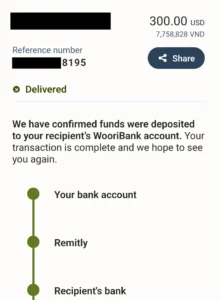
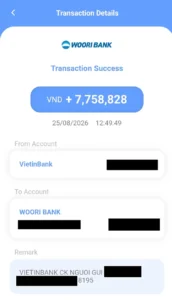
What did it actually cost? Remitly applied a rate of about 25,863 VND per dollar. The mid-market rate that day was about 26,113 VND per dollar. That gap, roughly 0.96% or about $2.87, is the margin built into the exchange rate. Adding the $1.99 fee, my total cost came to about $4.86, or 1.6% of what I spent, for an effective rate of about 25,692 VND per dollar.
| Item | Amount |
|---|---|
| Sent (including $1.99 fee) | $301.99 |
| Received | 7,758,828 VND |
| Remitly exchange rate | ≈ 25,863 VND per USD |
| Mid-market rate (Aug 25, 2026) | ≈ 26,113 VND per USD |
| Exchange-rate margin | ≈ 0.96% (≈ $2.87) |
| Total cost (fee + margin) | ≈ $4.86 (1.6%) |
| Effective rate | ≈ 25,692 VND per USD |
Mid-market rate source: exchange-rates.org. Figures are rounded.
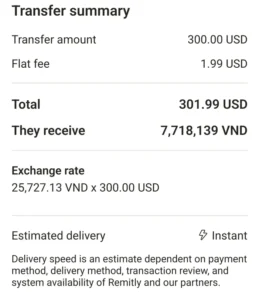
Rates are not fixed. On September 23, I checked a quote for the same $300 transfer. This time the app offered 25,727.13 VND per dollar, or 7,718,139 VND, about 40,700 VND less than in August. Part of that difference reflects the dong strengthening against the dollar in September. Part may reflect a slightly wider margin; based on a mid-market rate of about 26,025 a few days earlier, the margin looked closer to 1.1%. The lesson is simple: compare the offered rate with the mid-market rate every time you send, not just the first time.
Even so, 1.6% compares well with withdrawing the same $300 from a Vietnamese ATM with a U.S. card, where a foreign transaction fee of up to 3% (depending on the card), a local ATM fee, and sometimes a U.S. out-of-network fee can stack on top of each other. And because the $1.99 fee is fixed, larger transfers bring the percentage cost down even further.
A Few Honest Caveats
A Vietnamese account is not a full replacement for your home-country banking.
Outbound international transfers are restricted. Sending money out of Vietnam from a local account usually requires documentation such as an employment contract or tax records. Treat your Vietnamese account as a place to receive and spend, not a hub for moving money abroad.
You may not get a card. Without a debit card, some online purchases and card-only payments still require my U.S. card. Cash withdrawals are also limited to the bank’s own ATM network.
Account validity may be tied to your visa. When you extend or change your visa, you may need to update your information at the bank. My bank has not asked me to do so yet, but it is worth checking whenever your visa status changes.
Policies change. What worked for me at one branch may not work for you at another. Always call ahead or visit a central branch in a major city.
The Bottom Line
When choosing where to base yourself as a remote worker, look beyond the visa. Ask a simple question: Can I open a local bank account with this visa? In my case, the answer to that question determined which country I ended up living in.
Thailand offered me a great visa but no way to bank. Vietnam offered me a workable financial life. For someone who pays attention to where every dollar goes, that made the decision easy.
This article reflects my personal experience and publicly available information as of September 2026. It is not financial or legal advice. Bank policies and exchange rates change frequently, so please confirm current requirements directly with the bank or service provider before making plans.