Beyond the Border Run: A Strategic Founder’s Guide to Thailand’s DTV in 2026
Last Updated: June 1, 2026 by by Simon K., Borderless Founder & IP Professional
For decades, Thailand’s relationship with remote workers was defined by friction: perpetual tourist visas, gray-area immigration statuses, and exhausting “border runs” to neighboring countries. However, the introduction of the Destination Thailand Visa (DTV) in mid-2024 fundamentally altered the regulatory landscape.
As we navigate 2026, Thailand is no longer just a haven for transient backpackers; it has matured into a legitimate, strategic basecamp for high-earning digital nomads, S-Corp operators, and tech founders. But while the DTV provides unprecedented physical access to Southeast Asia, it also introduces complex new realities regarding tax compliance and banking infrastructure.
If you are a location-independent professional considering Thailand as a primary or secondary hub, here is the in-depth, procedural reality of operating under the DTV.
The Evolution: A 5-Year Framework for the Modern Operator
Prior to the DTV, founders seeking long-term stability in Thailand faced high barriers. The Long-Term Resident (LTR) Visa required a minimum income of $80,000 USD and complex corporate documentation, while the Thailand Privilege Card required sinking upwards of $25,000 USD into a non-refundable membership fee.
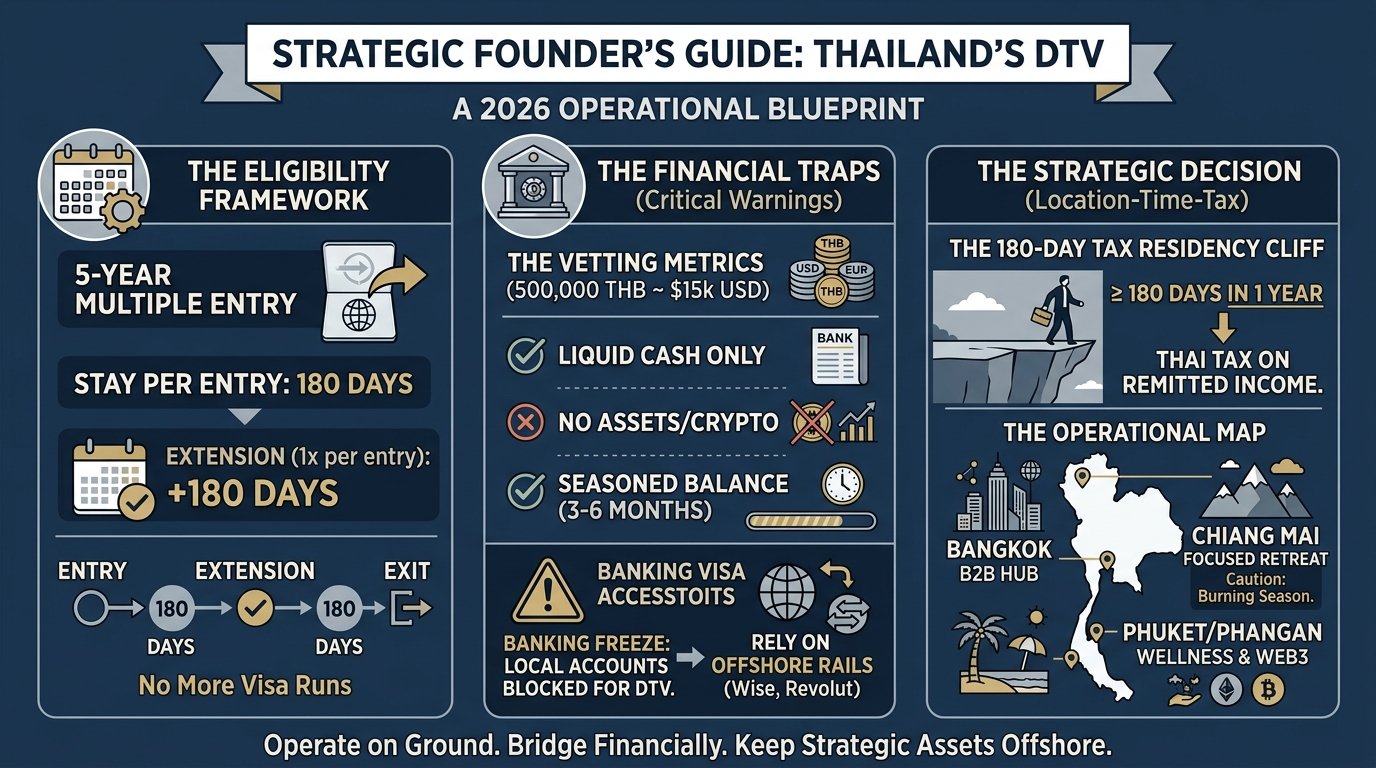
The DTV perfectly bridged this gap. For a relatively nominal fee (roughly 10,000 THB or $300 USD), it grants a 5-year multiple-entry visa. Crucially, each entry allows a stay of up to 180 days, which can be extended in-country for an additional 180 days.
- The Demographic Shift: This visa successfully triggered a demographic shift. Data from 2025 and 2026 indicates the average DTV applicant is no longer a 20-something freelancer, but a mid-career professional (aged 35–45). The highest volume of successful applicants originates from the United States, the UK, Germany, and Russia. Rather than hopping cities every month, these professionals are signing 6-to-12-month luxury condo leases, treating Thailand as a true operational headquarters.
The 500,000 THB Liquidity Requirement: A Strict Metric
To qualify for the “Workcation” (remote worker) category of the DTV, you must prove you are working for clients or an entity strictly outside of Thailand.
The primary barrier to entry is financial compliance: you must demonstrate proof of at least 500,000 THB (approximately $14,500 to $15,000 USD). As embassies (including regional hubs like Ho Chi Minh City, where many expats apply) have tightened their vetting processes going into 2026, they have become exceptionally strict regarding this metric.
- Liquid Cash Only: Cryptocurrency portfolios, stock market brokerage accounts, and available credit limits are universally rejected.
- The “Seasoning” Rule: Most embassies now require this 500,000 THB equivalent to have been sitting consistently in a standard checking or savings account for a minimum of 3 to 6 months prior to your application.
The Practitioner’s Reality: A Seamless Entry, A Financial Wall
To put these strict requirements into perspective, I personally secured my 5-year DTV in September of 2025. Because of my age, I easily qualified for Thailand’s traditional retirement visa (available for those over 50). However, from a pure cost-benefit and operational flexibility standpoint, the DTV is undeniably the superior legal instrument if you meet the baseline criteria.
The acquisition itself was incredibly frictionless. I submitted my application online while operating out of Da Nang, designating the Thai Embassy in Ho Chi Minh City for processing. The government fee was roughly $300. Assuming your tax filings are pristine and your home-country bank balances are adequately seasoned, the approval process is an absolute breeze. I was able to download my digital visa in exactly four days without ever needing to visit the embassy in person. Upon landing in Thailand, clearing customs took perhaps two seconds—a quick scan of the DTV QR code, and I was officially in.
But here is the critical operational catch: the friction begins the moment you try to integrate locally. When I visited, the single most frustrating bottleneck was the absolute impossibility of opening a local Thai bank account. After navigating endless bureaucratic roadblocks, I simply gave up. It is a stark contrast to Vietnam, where a foreign operator can easily open a local bank account even on a standard 90-day tourist visa.
This exact friction leads us to the most dangerous aspect of the DTV: managing your money without a local safety net.
The 2026 Banking & Tax Reality (The S-Corp Warning)
This is where global founders must exercise extreme caution. Having the legal right to live in Thailand does not automatically grant you frictionless financial integration.
1. The Banking Freeze for DTV Holders
As of late 2025 and 2026, Thailand’s major financial institutions (including Bangkok Bank, KBank, and SCB) have severely tightened Anti-Money Laundering (AML) compliance. Major Thai banks generally will not open local bank accounts for DTV holders. They require a Non-Immigrant B (Business) Visa with a local work permit or an LTR Visa.
Because you cannot easily open a local account, you are forced to rely on foreign debit cards, ATM withdrawals, and cross-border payment rails to pay for daily living expenses and rent.
2. The 180-Day Tax Trap
Relying on foreign cards and remittances introduces a significant tax liability. In January 2024, the[Thai Revenue Department (TRD) enforced a massive shift in tax policy.
Currently, if you stay in Thailand for 180 days or more in a single calendar year, you become a Thai Tax Resident. Under the new rules, any foreign-sourced income that you remit (transfer or spend) into Thailand during that tax year is subject to Thai personal income tax—regardless of when you originally earned it.
- The Procedural Reality: Legally, every time you swipe your U.S. corporate card to pay for a coworking space, or withdraw cash from an ATM to pay rent, you are creating a “taxable event” by bringing foreign income into the Thai economy. For a U.S. citizen already navigating the Foreign Earned Income Exclusion (FEIE) and self-employment taxes, this dual-taxation risk requires aggressive, meticulous bookkeeping and strategic consultation with a cross-border CPA.
Calculating the True Cost of the Thai Basecamp
If you navigate the financial compliance, the operational environment in hubs like Bangkok (the corporate bridge), Chiang Mai (the focused retreat), or Phuket (the high-net-worth playground) is exceptional.
However, because you are locked out of the local banking system, your operational overhead will be heavily impacted by international transfer fees, ATM surcharges, and FX spreads every time you move capital from your U.S. accounts to pay your Thai landlord.
Before committing to a long-term lease under the DTV, forecast your exact capital leakage. Use our Cross-Border Remittance True Cost Calculator to analyze how much of your U.S. revenue you will lose to banking friction when funding your life in Thailand.
Launch the Remittance True Cost Calculator Here
The Verdict for the Global Architect
The Destination Thailand Visa is a masterpiece of immigration policy for the modern distributed worker. It provides the legal peace of mind that border runs never could.
However, it is a visa designed for residence, not for local financial integration. If your goal is to execute a deep-work sprint for a few months while managing a U.S. team, it is flawless. But if you intend to stay for 180+ days a year and truly embed yourself in the local economy, the DTV’s banking limits and tax implications require a heavily calculated strategy. Treat Thailand as your physical campus, but keep your financial architecture firmly rooted offshore.
About the Author & Editorial Policy
Written by Simon K., a Borderless Founder and IP Professional specializing in U.S. and international patent frameworks. He leverages his experience running a remote California S-Corporation to provide actionable intelligence for global founders.
Disclaimer: Simon K. is a patent law professional and consultant, not a licensed patent attorney or registered patent agent. All content is for informational purposes only and does not establish an attorney-client relationship.