The Babel Algorithm: How AI Translation is Rewiring Global Communication
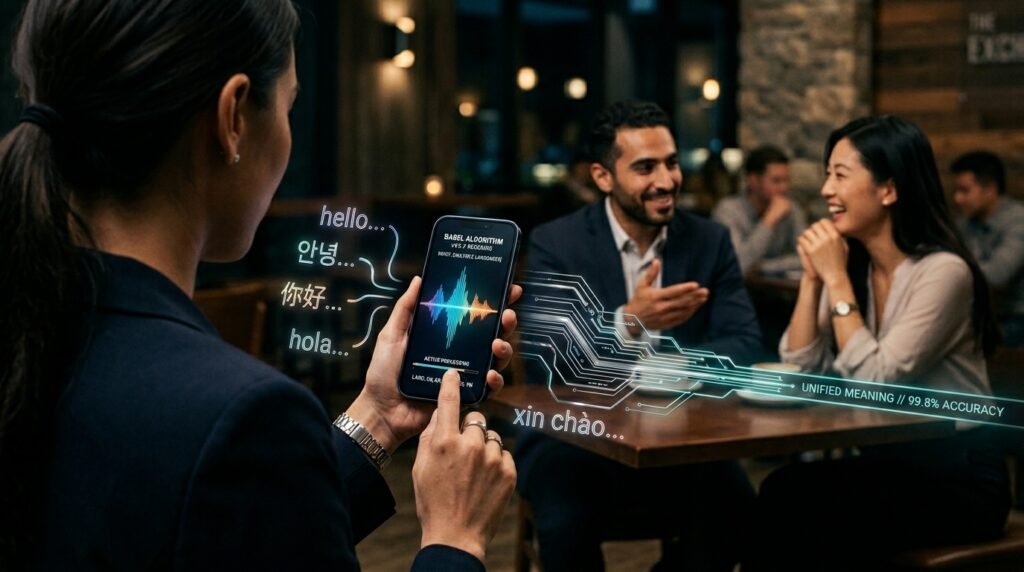
For decades, the concept of a “universal translator” was relegated to science fiction. Today, it is quietly operating in the background of our daily lives. From the auto-generated, multi-language closed captions on YouTube to the localized dubbing on Netflix, and the real-time voice translation apps sitting in our pockets, AI has fundamentally dismantled the transactional language barrier.
However, the proliferation of large language models (LLMs) has triggered a complex cascade of consequences. It is reshaping global media consumption, triggering an existential crisis in modern education, and silently creating a new, polarized linguistic divide.
If your borderless business relies on global communication, understanding the current trajectory of AI translation is critical. Here is the analytic breakdown of the global translation tech stack, the reality of the linguistic divide, and the future of human communication in an AI-dominated world.
The Seamless Media Engine
The most visible impact of AI translation is in global media distribution. Historically, penetrating a foreign market required a massive capital investment in human translators and voice actors.
Today, platforms like YouTube and Netflix utilize AI to automate this pipeline at scale.
- Dynamic Subtitling: High-fidelity speech-to-text models instantly transcribe and translate video content into dozens of languages with near-human accuracy, automatically adjusting for timing and context.
- Synthetic Dubbing: The cutting edge of this technology is “voice cloning.” AI can now analyze an actor’s voice and generate a dubbed track in a foreign language that maintains the original speaker’s exact tone, pitch, and emotional cadence.
This has completely democratized content distribution. A solo creator broadcasting from Seoul can instantly monetize an audience in Latin America without speaking a word of Spanish.
The Babel Reality: The Linguistic Divide
Despite the illusion of universal translation, the global reality is starkly polarized.
There are approximately 7,168 living languages in the world today. Yet, the vast majority of AI translation capabilities are concentrated on a tiny fraction of them. AI models are trained on data, and they suffer heavily from the “High-Resource vs. Low-Resource” data divide.
The AI Competency Ranking:
- Tier 1 (The Hyper-Connected): English, Mandarin, Spanish, French, German, and Korean. These languages possess massive, digitized data sets. AI can translate between these with nuance, capturing slang, idioms, and complex legal phrasing.
- Tier 2 (The Functional): Languages like Vietnamese, Thai, or Arabic. AI performs well for transactional communication (ordering food, basic business emails) but struggles with high-level contextual nuance or regional dialects.
- Tier 3 (The Digitally Isolated): Thousands of indigenous or regional languages (particularly in parts of Africa, South America, and Oceania) have very little digitized text. AI models simply cannot learn them.
The Polarization Effect: This dynamic is polarizing the world. If you speak a Tier 1 language, AI grants you frictionless access to the global economy. If you speak a Tier 3 language, the digital revolution is effectively bypassing you. Rather than preserving global diversity, AI translation is accelerating the economic necessity for the world to consolidate around the top ten dominant languages.
The Educational Crisis: The “Calculator Effect”
Perhaps the most disruptive impact of AI translation is occurring in classrooms. Educators worldwide are reporting a massive drop in student motivation regarding foreign language acquisition.
The logic of a modern student is brutally pragmatic: Why should I spend four years memorizing verb conjugations and syntax when the device in my pocket can instantly translate a fluent conversation in real-time?
Language education is facing its “calculator moment.” Just as the invention of the scientific calculator forced mathematics to pivot from rote arithmetic to high-level problem-solving, language education must fundamentally evolve.
When an app can flawlessly translate a cross-border contract, the motivation to spend years rote-learning grammar plummets. Yet, this exposes a fundamental misunderstanding of why we communicate. A machine can translate a transaction, but it cannot mentor a child. It cannot replicate the genuine, unspoken respect earned by speaking to a partner’s family in their native tongue, whether you are operating in Southeast Asia or East Asia.
As transactional translation is outsourced to silicon, the human effort of learning a language will pivot entirely toward building trust, conveying empathy, and forming cross-generational bonds—elements an algorithm can never synthesize.
The Next Frontier: What to Watch
For a global architect, the translation landscape is moving rapidly. Here are the trends dominating the edge of the tech stack:
- Real-Time Acoustic Translation: The transition from screen-based translation to hardware integration. The near-future standard will be wireless earbuds that process conversational audio locally (on the edge), feeding translated audio into your ear with sub-second latency. The “tourist barrier” will completely evaporate.
- Context-Aware B2B AI: Current models translate word-for-word. The next generation of enterprise AI will translate intent. If an American founder negotiates with a Japanese vendor, the AI will not just translate the words; it will automatically adjust the phrasing to match appropriate cultural hierarchies and business etiquette, preventing accidental offense.
- The Premium on Unmediated Human Connection: As AI-generated communication (emails, videos, calls) becomes ubiquitous, its perceived value will drop to zero. The ultimate luxury in business and life will be verifiable, unmediated, face-to-face human interaction.
The Verdict
AI has solved the mathematics of language, but it has not solved the humanity of it. The borderless operators who will thrive in the coming decade will use AI to ruthlessly automate their transactional communications, saving their cognitive bandwidth to learn the nuances, culture, and deep linguistic connections that forge real relationships and build enduring empires.