Secrets of the Masters: Why Some Billion-Dollar Inventions Were Never Patented
Last Updated: June 11, 2026 by Simon K., Borderless Founder & IP Professional
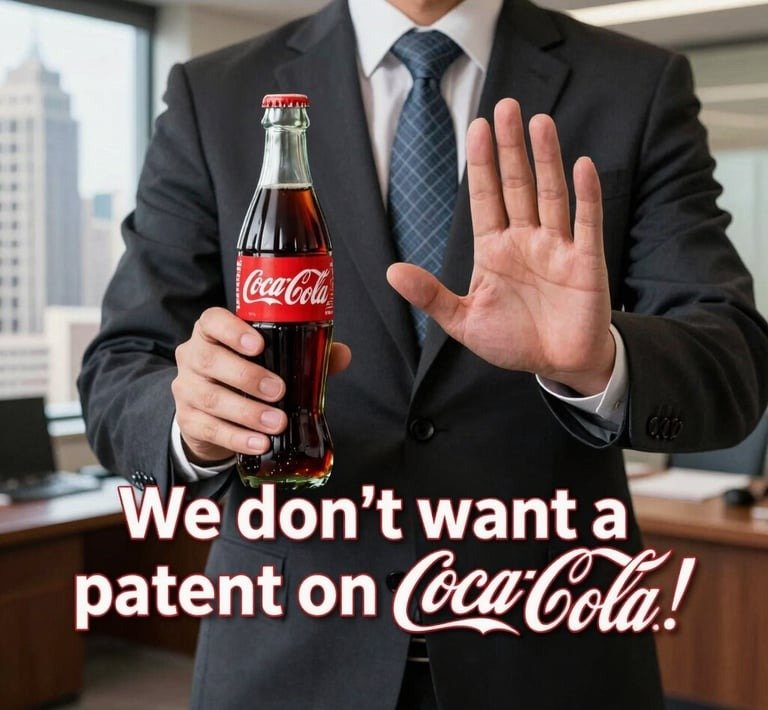
Why did Coca-Cola never patent its billion-dollar formula? Because the USPTO’s 18-month disclosure rule and the hard 20-year expiration date can permanently destroy your monopoly.
We often frame patents as the ultimate triumph of an inventor. In previous analyses, we discussed the grueling examination process and the high-stakes game of post-grant proceedings required to defend that beautiful, ribbon-sealed certificate. We are taught that the path to innovation wealth is paved with patents.
But what if, for certain inventions, filing a patent application is the worst business decision you could possibly make?
Today, we explore the fascinating strategic framework known as the “Patent Bargain,” the terrifying 18-month publication rule, and why icons like Coca-Cola deliberately chose silence over government protection.
The Patent Bargain: Exclusivity for 20 Years
To understand why a corporation would actively avoid patenting an invention, you first have to understand the fundamental deal the government offers inventors. It is known as the “patent quid pro quo”—this for that.
The inventor gets a highly valuable asset: a temporary monopoly to prevent others from making, using, or selling their invention. The Manual of Patent Examining Procedure (MPEP), the definitive guide to USPTO rules, provides the precise term.
According toMPEP § 2701: “A U.S. patent is generally granted for a term which begins with the date of the grant and ends twenty years from the date of filing of the application for the patent…”
For twenty years from the moment you file that initial application, you legally own that technology in the U.S. No one can touch it without your permission. It sounds like an unbeatable deal.
The Cost of Admission: Complete Disclosure
But the government gives nothing for free. In return for that 20-year monopoly, the inventor must pay the price of complete transparency.
You must completely and totally reveal exactly how your invention works. You must lay your recipe, your source code, your manufacturing process, or your blueprint out on the table for all the world—including your fiercest competitors—to see. The logic is that after your 20 years are up, the invention falls into the public domain, allowing humanity to build upon your knowledge.
The “18-Month Trap”: When Disclosing Becomes Dangerous
This is where the bargain gets incredibly risky. Many laymen assume that their invention stays safely hidden until the patent is finally granted. This is a common and dangerous misconception. In my personal experience, the vast majority of applicants operate under a dangerous misconception: they mistakenly believe that if they simply abandon their application or fail the examination process, their invention will safely remain a secret.
In reality, under 35 U.S.C. § 122(b), the USPTO generally publishes your pending patent application eighteen months after you file it. This means your competitors can read the detailed description of your unguaranteed invention while it is still waiting in a backlog for an examiner to review it.
MPEP § 1120makes this requirement extremely clear: “…each application for patent, except for an application for a design patent… shall be published promptly after the expiration of a period of 18 months from the earliest filing date for which a benefit is sought…”
Furthermore, the manual details the ultimate price of disclosure before any rights are even granted:
“No application will be published if it is abandoned… provided that an application will be published if the abandonment is not timely to prevent publication.”
This is the scariest part of the patent bargain: if you file your application, and the examiner eventually decides your invention is not patentable, you will still have disclosed all your technology at the 18-month mark. If you try to abandon the application too late, you have failed to get the 20-year monopoly, and you have simultaneously taught your competitors exactly how your machine works.
💡 Calculate Your Exposure: Are you willing to risk the 18-month publication trap while also paying thousands in USPTO fees? Before committing to the patent bargain, forecast your exact filing, search, and examination costs using our interactive tool:
Launch the U.S. Patent Filing & Maintenance Fee Estimator (Interactive Calculator)
Choosing Silence: The Masters of Trade Secrets
For certain inventions, the risk of publication at 18 months and the definitive expiration after 20 years are unacceptable. For these inventions, global operators choose the path of Trade Secrets.
Protected under U.S. federal law via the Defend Trade Secrets Act (DTSA), a trade secret can protect an invention indefinitely—provided you have the operational discipline to keep it a secret. Here are the masters of the unpatented formula.
The Coca-Cola Formula (Invented 1886)
This is the ultimate textbook case of strategic silence. Coca-Cola has never patented the unique combination of ingredients and flavorings known as “Merchandise 7X.” Why?
Think about the math. If John Pemberton had successfully patented the formula in 1886, that patent would have expired around 1906. By 1907, any competitor could have legally reverse-engineered the exact recipe and started making identical “True-Cola.”
Instead, by keeping the formula a complete secret for over 130 years—hiding the original copy in an elaborate vault in Atlanta—they have maintained their unique brand monopoly indefinitely. They chose the risk of being discovered over the absolute guarantee of expiration.
The Humble Unpatented Post-it Note Adhesive
While some modern Post-it products are patented, the exact microsphere adhesive developed by Dr. Spencer Silver was not originally patented for the consumer product we know today. He struggled for years to find a commercial use for the “failed” glue.
If 3M had patented the “glue that doesn’t stick well” in the late 1960s, that patent would have expired in the late 1980s. But Post-it Notes didn’t become a massive global phenomenon until the 1980s. When they finally took off, 3M dominated the market not with a patent, but with decades of trade secret manufacturing know-how. By the time competitors could figure out the precise polymer process, 3M had built an insurmountable brand.
The Takeaway: It’s All Strategy
Your intellectual property is not just a stack of documents you get from the government; it is a high-stakes business decision. You must always calculate the cost.
- When to Patent: If your invention is something that is easily reverse-engineered in a few weeks (like a new gear shape or a simple circuit), you must patent it immediately, because anyone who buys one can legally copy it.
- When to Hide: If your invention is something that can be hidden behind closed doors (like a backend software algorithm, a manufacturing catalyst, or a complex recipe), a trade secret may be the far superior choice. It lets you avoid the 18-month disclosure trap and offers the potential for infinite value.
When you decide to file a patent, you are giving up secrecy for twenty years of security. Choose wisely.
About the Author & Editorial Policy
Written by Simon K., a Borderless Founder and IP Professional specializing in U.S. and international patent frameworks. He leverages his experience running a remote California S-Corporation to provide actionable intelligence for global founders.
Disclaimer: Simon K. is a patent law professional and consultant, not a licensed patent attorney or registered patent agent. All content is for informational purposes only and does not establish an attorney-client relationship.