Navigating the Fast Track: US Bypass Applications, Track One, and PPH Strategies for Unpublished PCTs
Last Updated: June 19, 2026 by Simon K., Borderless Founder & IP Professional
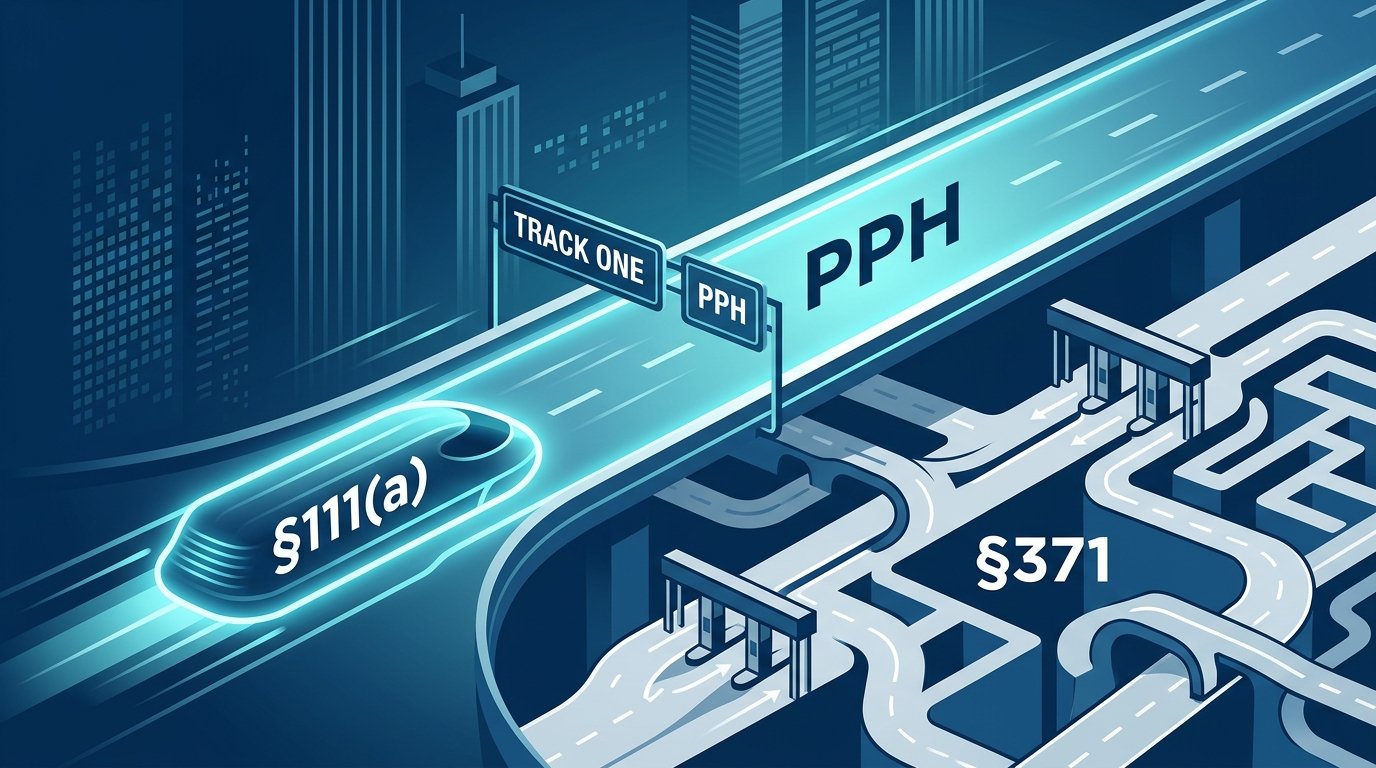
For patent practitioners and global innovators, speed to allowance in the United States Patent and Trademark Office (USPTO) is a critical objective. While standard national phase entry under 35 U.S.C. § 371 is the traditional path for PCT applications, the 35 U.S.C. § 111(a) “bypass” application offers a potent alternative—especially when paired with accelerated examination frameworks like Track One and the Patent Prosecution Highway (PPH).
However, leveraging these tools requires navigating a complex matrix of federal rules, priority claims, and international work products. The strategy becomes particularly nuanced for applicants from jurisdictions like South Korea, Japan, or Europe, where rapid domestic prosecution might yield allowed claims before the intermediate PCT application has even published.
This guide provides a comprehensive breakdown of how to maximize prosecution speed using bypass applications, dissects the intersection of Track One and PPH, and provides a definitive answer to a complex scenario: utilizing PPH based on priority country claims when the PCT remains unpublished and lacks an International Search Report (ISR).
The Practitioner’s Protocol: The Cost of Unexplained Options
Patent prosecution is a labyrinth of complex procedures, and attempting to correct a single inadvertent mistake later in the process requires a massive financial toll. Because of this administrative heavy lifting, there is a common tendency among some practitioners to spoon-feed clients only the bare minimum information required to move a case forward.
I firmly believe this is a disservice. When it comes to strategic filing options, exhaustive client education is an absolute necessity. A frequent and painful scenario in the IP industry occurs when a founder discovers an alternative strategic route too late, leading to the inevitable and justified complaint: “If I had known that option existed from the start, I would have taken it.”
For example, as a standard rule in my own practice, when managing a PCT National Stage entry, I thoroughly analyze the claim structure upfront. If it is highly probable that the USPTO will issue a Restriction Requirement (due to multiple distinct inventions in the claims), I proactively explain the mechanics and costs of filing a Divisional Application well before we even draft the restriction response.
Giving founders complete visibility into all their strategic maneuvers – whether it involves preparing for future divisional filings, choosing a Bypass route over a standard 371 entry, or utilizing Track One – is the only way to prevent costly buyer’s remorse and ensure their business objectives are fully protected.
The Fundamentals: What Is a Bypass Application?
A bypass application is fundamentally a continuation or a continuation-in-part (CIP) filed under 35 U.S.C. § 111(a) that claims priority to a pending PCT application under 35 U.S.C. §§ 120 and 365(c). This is done instead of entering the U.S. national stage via the conventional § 371 route.
By taking this route, the application “bypasses” the specific statutory and regulatory entry requirements of § 371 while successfully capturing and retaining the original PCT filing date. Because it is procedurally treated as a standard domestic filing, it inherits all the tactical flexibilities associated with U.S. continuations, including the right to freely amend claims upon filing.
Route 1: Track One Prioritized Examination
The Track One program governed by 37 C.F.R. § 1.102(e) is designed to provide a final disposition within 12 months. Because a bypass application is fully a § 111(a) application by definition, it qualifies for Track One with no exceptions or additional administrative hurdles relative to any other continuation filing.
📋 USPTO Track One Prioritized Examination: Core Requirements & Fee Summary
| Requirement Category | Core Requirements & Associated Regulations |
| Statutory Regulation | 37 C.F.R. § 1.102(e) |
| Target Pendency | To reach a final disposition (Notice of Allowance or Final Rejection) within 12 months of the petition grant date. |
| Eligible Application Types | Formal nonprovisional utility or plant patent applications filed under 35 U.S.C. § 111(a). (※ Available for § 111(a) PCT Bypass Continuations; explicitly unavailable for standard 35 U.S.C. § 371 National Stage entries) |
| Claim Count Limitations | • Independent Claims: Maximum of 4 • Total Claims: Maximum of 30 • Multiple Dependent Claims: Strictly prohibited |
| Filing Timing | The Track One request must be filed concurrently with the initial day-one U.S. application setup (No retroactive filing permitted). |
| Annual Cap Restrictions | The USPTO enforces a hard statutory cap of 12,000 granted petitions per fiscal year. |
| USPTO Government Fees (2026) | • Large Entity: Approximately $4,515 • Small Entity: Qualifies for a 60% statutory fee reduction • Micro Entity: Qualifies for an 80% statutory fee reduction |
To successfully utilize Track One in a U.S. bypass application, the procedural parameters are absolute:
- Application Type: Must be a formal § 111(a) nonprovisional utility or plant application.
- Claim Count Thresholds: The application is strictly restricted to a maximum of 4 independent claims and 30 total claims. Furthermore, it cannot contain any multiple dependent claims.
- Timing Restrictions: The formal Track One request must be made concurrently with the day-one filing of the application.
- Volume Limits: The USPTO enforces a hard industry cap of 12,000 granted Track One petitions per fiscal year.
💡 Forecast Your Upfront Acceleration Capital: As of May 2026, the baseline federal fee for a Track One request stands at $4,515 for large corporate entities. However, small and micro entities qualify for steep 60% and 80% statutory reductions. Calculate your exact upfront U.S. filing and acceleration costs using our interactive tool:
Launch the U.S. Patent Filing & Maintenance Fee Estimator (Interactive Calculator)
Route 2: The Patent Prosecution Highway (PPH)
Unlike Track One, which is purely fee-driven, the PPH leverages the substantive work already performed by another intellectual property office to accelerate U.S. prosecution. A § 111(a) bypass application can seamlessly qualify for PPH via two distinct pathways.
1. The Standard PCT-PPH Pathway
For a typical bypass application, the USPTO acts as the Office of Second Filing (OSF). To trigger PCT-PPH, the practitioner requires a positive international work product from the PCT phase. This means a favorable Written Opinion of the ISA (WO-ISA), or a favorable International Preliminary Report on Patentability (IPRP) under Chapter I or II, where at least one pending U.S. claim sufficiently corresponds to the allowed international claims.
2. The Bilateral / National Phase PPH Pathway
Alternatively, PPH can be anchored by national work products. If a counterpart application in a bilateral PPH partner office—such as the EPO, JPO, KIPO, or CNIPA—has had at least one claim allowed, that specific work product can serve as the basis for a PPH request in the U.S. bypass application, bypass application priority requirements remaining identical.
Crucial PPH Procedural Guardrails:
- The priority date of the bypass application (inherited from the PCT filing) must match the Office of First Filing (OFF) application.
- The PPH request must be filed before the first Office Action on the merits is issued by the USPTO.
- Unlike Track One, the PPH framework carries absolutely zero government fee at the USPTO.
The Core Complexity: PPH for Unpublished PCTs Without an ISR
While the standard routes are well-documented, a highly nuanced scenario frequently arises for international applicants: Can you use PPH via priority country allowed claims for a PCT Bypass application when the PCT is unpublished and has no International Search Report (ISR)? This situation is common for applicants in fast-moving jurisdictions (like KIPO or JPO) who file PCT bypasses while their domestic national prosecution concludes rapidly.
To answer this, we must separate the mechanics of the two PPH streams:
- PCT-PPH: Requires a positive WO-ISA or IPRP. Because the WO-ISA is the companion document to the ISR, an unpublished PCT with no ISR effectively means PCT-PPH is unavailable.
- National/Bilateral PPH: Requires allowed or allowable claims from a national bilateral partner office. It does not require PCT publication, nor does it require an ISR.
The Verdict: Yes, the national/bilateral route remains entirely viable. The fact that the intermediate PCT application lacks an ISR or remains unpublished does not foreclose PPH acceleration at the USPTO.
Understanding the Priority Chain
The mechanics of this strategy rely entirely on tracing the priority correctly. To understand why an unpublished PCT does not block your PPH request, look at the structural flowchart below:
| OFFICE OF FIRST FILING (OFF) | THE INTERMEDIATE LINK | OFFICE OF SECOND FILING (OSF) |
| Country X National Application | PCT International Application | U.S. § 111(a) Bypass Application |
| Role: The PPH Anchor | Role: The Legal Bridge | Role: The Fast-Track Target |
| • Establishes the Earliest Priority Date. • Generates the Allowed Claims used for the PPH request. | • Claims priority to Country X. • Unpublished & No ISR. • Serves only to connect the filing dates. | • Claims § 120 continuation priority to the PCT. • Inherits the Country X priority date. • Files the PPH Request. |
The Strategic Takeaway: The earliest claimed priority date of the U.S. bypass application traces all the way back through the PCT to the Country X national filing date. It does not start at the PCT filing date. Because the U.S. bypass application and the Country X application share this foundational priority date, the unbroken timeline satisfies the core statutory requirement for any bilateral PPH request.
Nowhere in the USPTO’s Global or bilateral PPH requirements is there a condition stating the intermediate PCT application must be published or possess an International Search Report (ISR). The PCT application is simply a vital legal link in the priority chain, not the source of the PPH work product itself.
The Documentation Burden
Because the priority chain runs through an unpublished application, the applicant bears a heavier documentation burden. You must explicitly provide:
- A copy of the Country X national application, plus a certified English translation if applicable.
- The formal PCT filing receipt or application number to prove the PCT exists and properly claims priority to Country X. A filing receipt is sufficient even before publication; the full unpublished PCT text does not need to be produced.
- A copy of the U.S. bypass application’s priority claim fields under §§ 120 and 365(c).
- The formal Office Action and allowed claims from Country X, accompanied by English translations.
- A comprehensive claim correspondence table proving U.S. claims are of the same or narrower scope.
Strategy Summary: Track One vs. PPH
| Strategic Feature | Track One Prioritized Examination | Patent Prosecution Highway (PPH) |
|---|---|---|
| Available to § 111(a) Bypass? | Yes | Yes (Bilateral/Global pathway conditions apply) |
| USPTO Government Fee | Yes (~$4,515 for Large Entities) | $0 (Completely Fee-Free) |
| Prerequisite Work Product | None Required | Yes (Positive WO/IPRP or foreign allowed claims) |
| Claim Count Restrictions | Strict Cap (≤ 4 Independent / ≤ 30 Total) | No hard federal cap (Must sufficiently correspond) |
Can They Be Combined?
Yes. Track One and PPH are not mutually exclusive. Strategic practitioners frequently layer both requests simultaneously in a U.S. bypass application. While Track One alone guarantees a rapid ~6-month timeline to final disposition, layering PPH adds monumental value. Strong international examination results narrow the U.S. examiner’s required search, drastically improving the likelihood of a clean First-Action Allowance.
Ultimately, utilizing national PPH through an unpublished PCT link is a highly legitimate, yet underutilized route that can save significant time and money for global innovators navigating cross-border supply chains.
About the Author & Editorial Policy
Written by Simon K., a Borderless Founder and IP Professional specializing in U.S. and international patent frameworks. He leverages his experience running a remote California S-Corporation to provide actionable intelligence for global founders.
Disclaimer: Simon K. is a patent law professional and consultant, not a licensed patent attorney or registered patent agent. All content is for informational purposes only and does not establish an attorney-client relationship.