The Post-Quantum Horizon: Defending the Borderless Enterprise Against “Harvest Now, Decrypt Later”
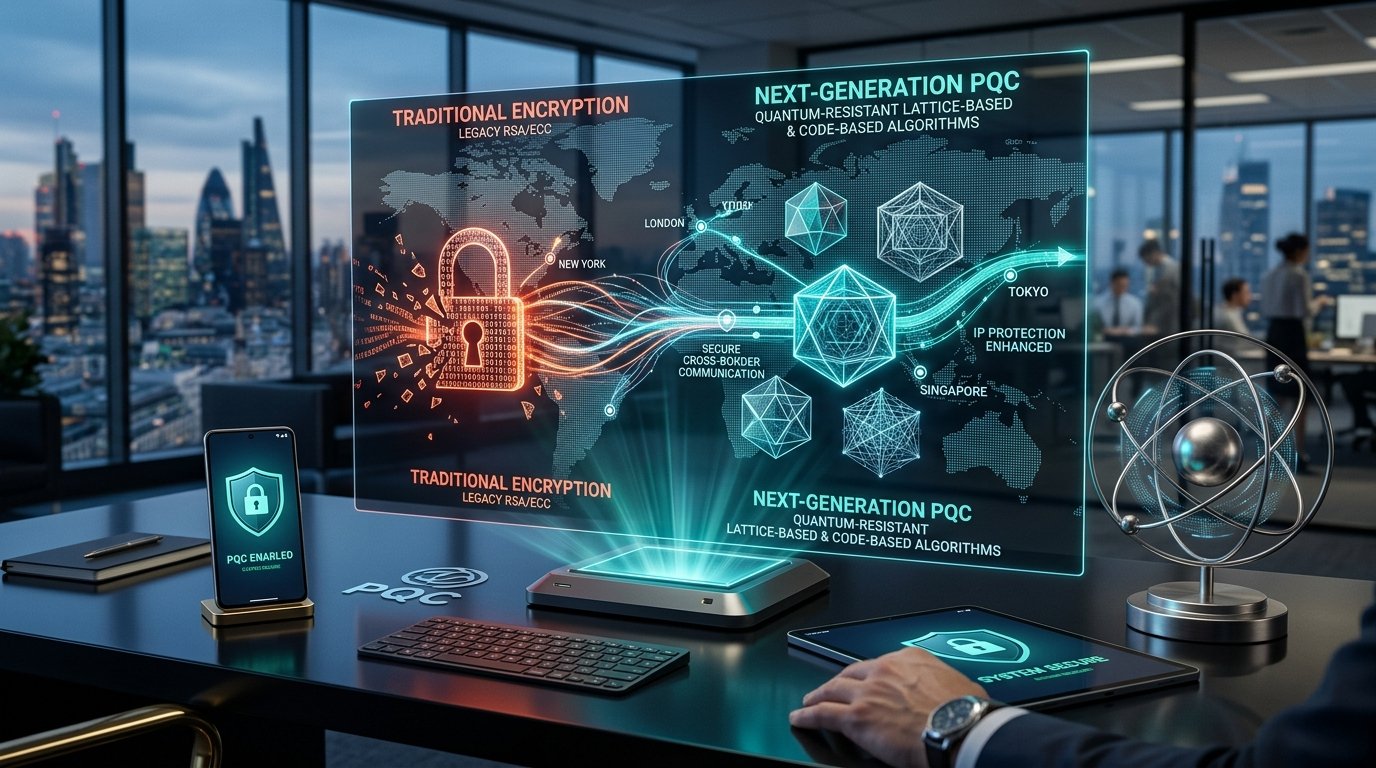
Every time you hit “send” on a highly sensitive document—whether it is a finalized patent draft, your S-Corp financial returns, or a cross-border consulting contract—you are placing absolute faith in a mathematical illusion.
We trust the little padlock icon in our web browsers. We trust that the encryption scrambling our data into unreadable gibberish is unbreakable. And for the last few decades, we have been right. The encryption protocols securing the modern internet (like RSA) are built on complex math puzzles. For a traditional, classical computer to solve these puzzles and break the encryption, it would take millions of years of guessing.
But the foundation of global digital security is about to experience an earthquake. The threat is no longer theoretical; it is a rapidly approaching reality known as Quantum Computing. And it has given rise to the most insidious cyber threat of the decade: the “Harvest Now, Decrypt Later” strategy.
If you operate a borderless business, understanding this shift in layman’s terms is no longer an IT luxury; it is a core fiduciary duty to your clients and your own intellectual property.
The Maze Analogy: Classical vs. Quantum
To understand the threat, you do not need a degree in quantum physics. You just need a simple analogy.
Imagine current encryption as a massive, impossibly complex maze. When a classical computer (like your smartphone or a massive server farm) tries to break into your data, it has to physically walk down every single path in the maze until it finds the exit. Because the maze is so large, this brute-force approach takes an eternity. You are safe.
A quantum computer fundamentally rewrites the rules of the game. Instead of walking the maze one path at a time, a quantum computer can theoretically look at all the paths simultaneously. It views the maze from above, instantly identifying the exit.
When fully realized, quantum computers will shatter the encryption protecting the world’s banking systems, crypto wallets, and secure communications in a matter of hours.
The Silent Heist: “Harvest Now, Decrypt Later”
You might be thinking, “True quantum computers that powerful are still years away. I don’t need to worry about this today.”
This is the most dangerous assumption a founder can make. Cybercriminal syndicates and adversarial nation-states know that quantum computers are coming. They also know that digital storage is incredibly cheap.
This has birthed the “Harvest Now, Decrypt Later” (HNDL) strategy.
Right now, bad actors are actively vacuuming up massive amounts of encrypted data moving across the internet. If you transmit a confidential patent strategy from a cafe in Seoul to a client in Los Angeles, they might intercept it. They cannot read it today. It looks like garbage data. But they don’t care.
They simply take that encrypted file and put it in a digital warehouse. They are creating a time capsule of stolen secrets. They will patiently wait five to ten years until they possess a viable quantum computer, at which point they will use it to instantly unlock everything they harvested back in 2026.
Does Your Data Have a Shelf Life?
The critical question for your business is this: Does your data still have value in five or ten years?
If someone steals your credit card number, it will be canceled and useless by the time a quantum computer decrypts it. But what about your business assets?
- Intellectual Property: A draft for a novel piece of semiconductor tech or an applied AI patent is incredibly valuable. If a competitor decrypts your foundational research in five years, it could destroy your market advantage.
- Trade Secrets: Client lists, proprietary workflows, and unfiled corporate strategies retain their value for decades.
- Digital Assets: Cryptocurrency seed phrases and private keys do not expire. If harvested today and decrypted tomorrow, your digital wealth vanishes.
The Cure: Post-Quantum Cryptography (PQC)
Fortunately, the cybersecurity world is not waiting around to be defeated. The defense against this threat is already rolling out globally, known as Post-Quantum Cryptography (PQC).
If classical encryption is a maze, PQC is a completely different type of puzzle—one that is mathematically designed to be incredibly difficult for both classical and quantum computers to solve. Global organizations, like the U.S. National Institute of Standards and Technology (NIST), have recently finalized the official PQC algorithms that will become the new global standard.
The 2026 Defense Plan for the Solo Operator
You do not need to learn how to code PQC algorithms yourself to protect your borderless business. You simply need to become an educated consumer and audit your current tech stack.
- Audit Your Communications: Stop using legacy SMS or basic email for highly sensitive IP transfers. Switch to platforms that have already integrated Post-Quantum protections. For example, the secure messaging app Signal recently upgraded its protocol (the PQXDH upgrade) specifically to defend against “Harvest Now, Decrypt Later” attacks.
- Check Your VPN: Operating on public Wi-Fi globally requires a Virtual Private Network. Check with your VPN provider to ensure they are actively rolling out quantum-resistant encryption protocols.
- Cloud Storage Vigilance: If you store sensitive client documents in the cloud, review your provider’s security roadmap. Major players (like Google Workspace and Microsoft Azure) are in the process of migrating to PQC standards, but you must ensure your specific configurations are updated.
The era of absolute digital trust is over. Operating a global consulting firm today means recognizing that the internet is a hostile environment. By ensuring your digital tools are quantum-resistant today, you guarantee that the secrets you send across the Pacific remain secrets for the rest of your life.