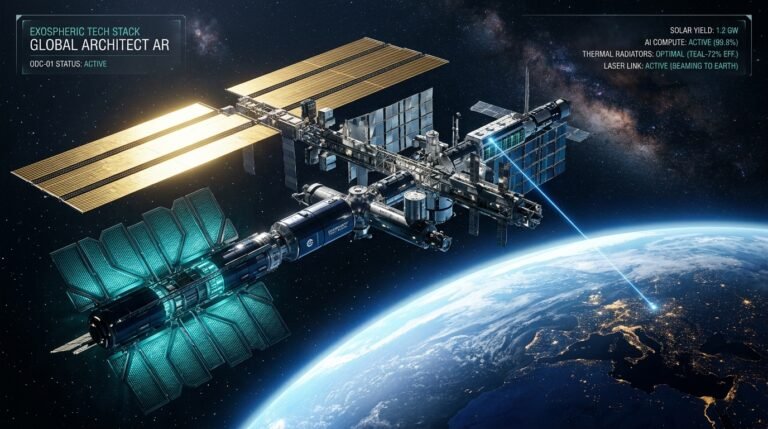
The Orbital Tech Stack: From State Secrets to the Global Wi-Fi Mesh
For the modern digital nomad or borderless founder, the “Tech Stack” usually implies cloud hosting, payment gateways, and API integrations. But the most critical layer of our global infrastructure doesn’t sit in a server farm in Virginia—it orbits 300 miles above our heads.
The evolution of satellite technology is the story of how space transitioned from a classified military theater into the ultimate commercial utility. We have moved from launching car-sized titanium spheres for geopolitical bragging rights to deploying autonomous, mass-produced orbital routers that bathe the planet in high-speed broadband.
If you want to understand the infrastructure that makes a borderless business possible in 2026, you must look up. Here is the analytic breakdown of the orbital tech stack, the economics of modern launch capabilities, and the high-stakes satellite cold war unfolding in Low Earth Orbit (LEO).
Phase 1: The Sovereign Era (Observation & Paranoia)
For the first four decades of the space age, the barrier to entry was so astronomically high that only superpowers could play. Satellites were bespoke, billion-dollar masterpieces built to do two things: predict the weather and spy on adversaries.
Early programs, like the U.S. Corona project in the 1960s, literally ejected canisters of exposed photographic film out of orbit to be caught mid-air by military planes. Space was a government monopoly, characterized by Geostationary (GEO) satellites—massive machines parked 22,000 miles away, moving at the exact rotation of the Earth to stare at a single hemisphere. They were expensive, slow to build, and entirely disconnected from the civilian economy.
Phase 2: The GPS Revolution (The Invisible Utility)
The first major paradigm shift occurred when military navigation was opened to civilian use. The Global Positioning System (GPS), originally a U.S. Department of Defense project designed to guide nuclear submarines, was gradually unlocked for public use in the 1980s and 90s.
This was the moment satellite tech became an invisible economic baseline. Today, GPS does not just tell your smartphone where you are; it provides the ultra-precise atomic timing required to synchronize global cellular networks, route internet traffic, and timestamp high-frequency stock trades.
- The Economic Reality: It is estimated that GPS technology generates over $1 billion per day in economic value for the U.S. economy alone. Without this orbital timing mesh, global logistics, ride-sharing, and digital banking would instantly collapse.
Phase 3: The LEO Constellation Era (The Commercial Mesh)
We are currently living through the third, and most disruptive, phase: the commercialization of Low Earth Orbit (LEO).
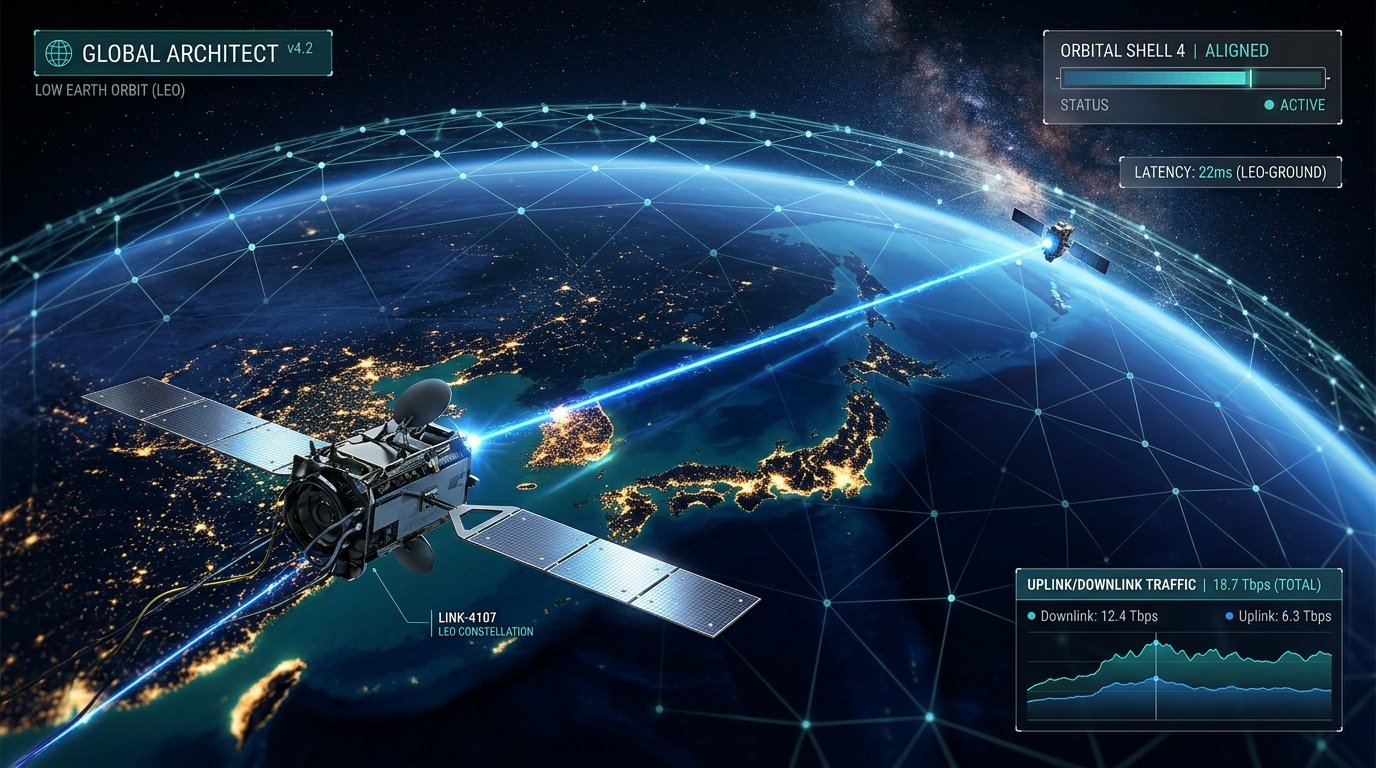
The old model involved launching one massive satellite into deep space. The new model, pioneered by SpaceX’s Starlink, involves launching thousands of small, cheap, mass-produced satellites into orbits just 300 miles above the Earth. Because they are so close, the latency (data delay) drops from 600 milliseconds to 20 milliseconds—making satellite internet functionally identical to ground-based fiber optics.
- The Private Pivot: This revolution was not driven by NASA; it was driven by private venture capital and reusable rockets. By landing and reusing orbital boosters, SpaceX fundamentally broke the economics of spaceflight, dropping the cost to launch a kilogram into orbit from roughly $18,500 in the Space Shuttle era to under $1,500 today.
- The Statistical Dominance: In 2023, SpaceX alone accounted for roughly 80% of the total mass launched into orbit globally. Space is no longer a government domain; it is a privately managed logistics network.
The Exclusive “Lift” Club
Despite the commercial boom, gravity remains a tyrant. True orbital launch capability—the ability to build a rocket, ignite it, and successfully place a payload into orbit—is an incredibly exclusive club.
As of 2026, only about a dozen nations possess independent, proven orbital launch capabilities.
- The Legacy Powers: The U.S., Russia, China, and the European Space Agency (France).
- The Rising Powers: India, Japan.
- The Niche/Emerging Players: Israel, Iran, North Korea, and recently, South Korea (with its Nuri rocket program).
However, possessing the capability is different from possessing the capacity. While Europe and Japan struggle to field competitive next-generation rockets, the global launch market has essentially condensed into a duopoly between U.S. private enterprise and the Chinese state.
The LEO Real Estate War: U.S. vs. China
The space race of the 2020s is not about planting a flag on the moon; it is a ruthless land grab for orbital real estate and radio spectrum rights.
Low Earth Orbit is finite. Satellites must be spaced out to avoid catastrophic collisions, and there are only so many radio frequencies available to beam data back to Earth. The International Telecommunication Union (ITU) allocates these orbital slots on a “first-come, first-served” basis.
- The Starlink Advantage: By rapidly launching over 5,000 satellites, American private enterprise essentially claimed the best orbital shells and spectrum frequencies before competitors could react.
- The Chinese Counter-Move: Viewing U.S. dominance of orbital internet as an unacceptable national security threat, China has accelerated its own mega-constellations. State-backed projects like “Guowang” (GW) and “G60 Starlink” aim to launch upwards of 25,000 satellites combined in the coming years.
The Dark Side of the Mesh: This commercial rivalry has a severe military undercurrent. In the event of a geopolitical conflict (such as a Taiwan Strait crisis), taking out an adversary’s satellite communication is step one. Both the U.S. and China are actively developing advanced “counter-space” capabilities. This includes ground-based lasers to blind optics, cyber-warfare to hijack control systems, and “co-orbital” satellites—machines designed to sneak up on enemy satellites and physically disable them or drag them out of orbit.
The Verdict
For the global founder, the evolution of the orbital tech stack represents the ultimate democratization of access. We are rapidly approaching a reality where a high-speed, uncensorable internet connection is available on every square inch of the planet, entirely bypassing local telecommunications monopolies and authoritarian firewalls. The borderless business of 2026 does not just operate across international lines; it operates from the thermosphere down.