The “Wetware” Stack: AI-Driven Synthetic Biology and the Next Great IP War
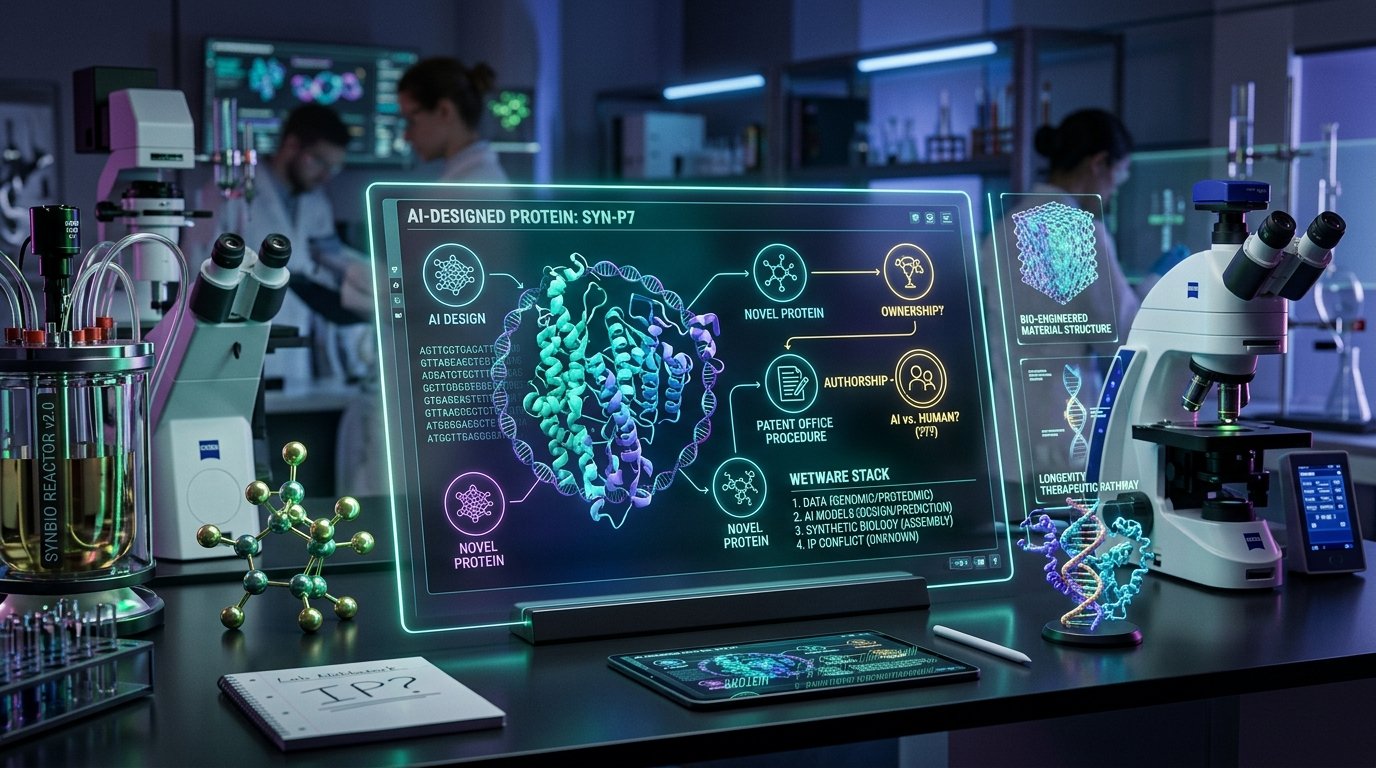
The boundaries of the “Tech Stack” are no longer confined to silicon and code; they have aggressively expanded into carbon and biology, creating the nascent but explosively growing field of Synthetic Biology, or the “Wetware Stack.” In this paradigm shift, biology is transitioning from a discipline of observation to one of design and engineering. This acceleration is almost entirely fueled by advanced artificial intelligence, specifically the revolutionary cracking of the protein folding problem. Large computational models can now accurately predict 3D protein structures from amino acid sequences (e.g., DeepMind’s AlphaFold, Baker Lab’s RoseTTAFold), effectively decoding the fundamental building blocks of life and allowing scientists and engineers to design novel, non-natural proteins, materials, and even synthetic organisms with specific, desired functions in days rather than decades.
Applications and Impacts:
Synthetic biology allows us to manufacture rather than extract resources, rewriting global supply chains.
- Biomanufacturing: Startups are using engineered microbes and bioprocesses to “brew” everything from sustainable textiles, carbon-negative materials, and meat alternatives to complex pharmaceuticals and critical chemicals, bypassing traditional resource-intensive extraction or chemical synthesis.
- Longevity Economy: Significant venture capital is pouring into cellular reprogramming, regenerative medicine, and novel diagnostics, aiming to extend human healthspan and lifespan—sectors where AI-driven protein design is foundational.
- Next-Gen Materials: The ability to design novel materials with specific mechanical, electrical, or thermal properties holds immense promise for everything from electronics to aerospace.
The Looming IP Crisis (The Procedural War):
This convergence of AI and biology has created an unprecedented and chaotic crisis in intellectual property law, perfectly within your area of expertise. Traditional patent systems are fundamentally built on the assumption that inventors are human. They struggle to accommodate creations largely generated by AI algorithms.
- Who is the Inventor? If an AI generates a completely novel synthetic organism, a complex protein sequence, or a breakthrough material design without direct human instruction, who owns it? Is it the AI creator, the user of the AI, the owner of the training data, or is it unpatentable altogether? This question is triggering frantic procedural debates and legal challenges at the USPTO and global patent offices as they grapple with how to define “inventorship” in the AI age.
- Protectability Ambiguity: Current ambiguity creates significant uncertainty and risk for founders built around synthetic biology or AI-generated IP. How do you protect your core technology and attract investment when ownership isn’t clear, and global jurisdictions may adopt diverging approaches? This is where your deep procedural knowledge is invaluable, guiding founders through this complex legal fog, exploring alternative protection strategies (e.g., trade secrets, carefully crafted contractual agreements), and staying abreast of rapidly evolving global precedents.
Strategic Action:
The Wetware Stack is not a speculative future; it is actively reshaping critical industries. Global founders must understand the profound supply chain implications of biomanufacturing and carefully structure their IP portfolios to account for the unique ownership and protectability challenges of AI-generated designs, leveraging expert guidance to navigate this intricate regulatory landscape and secure their competitive advantage in the bio-economies of tomorrow.