The Kinetic Layer: AI’s Physical Manifestation in Global Infrastructure
We have spent the last few years mesmerized by “Generative AI”—algorithms that manipulate pixels, text, and code. But for the borderless operator and global supply chain strategist, the true revolution of 2026 is occurring in the “Kinetic Layer.” This is Applied AI moving from the screen into the physical world, manipulating steel, logistics, and human transit.
The integration of AI into autonomous vehicles, border control, and precision manufacturing is not a linear upgrade; it is a fundamental rewiring of physical infrastructure. The nations that dominate this Kinetic Layer are rapidly decoupling their economic output from their demographic decline.
Here is an analytic, unvarnished look at the physical AI stack, the harsh pros and cons of deployment, and the geopolitical race to automate the physical world.
1. The Sovereign Border: Algorithmic Customs and Biometric Transit
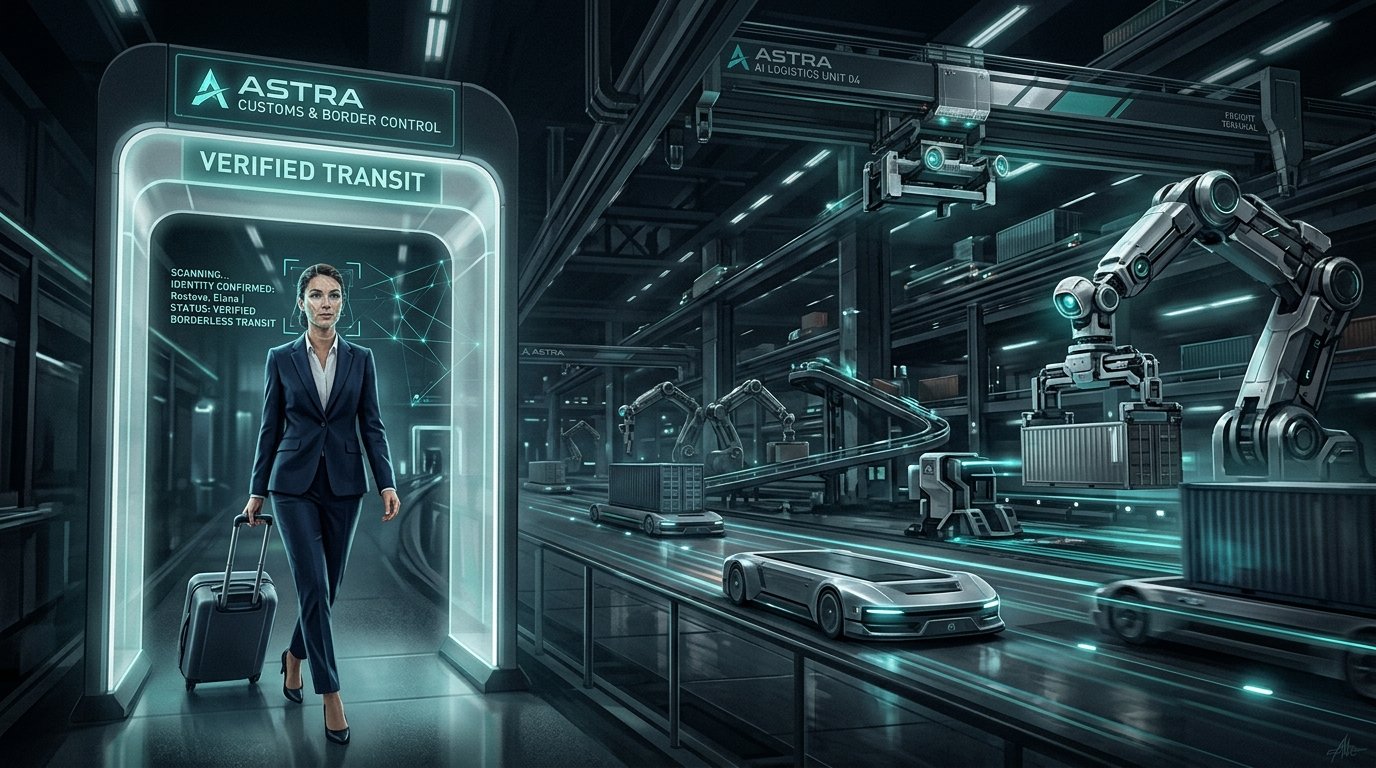
The concept of a physical passport is rapidly becoming a legacy artifact. Advanced AI facial recognition and multi-modal biometrics have transformed international border control from a human-operated bottleneck into a frictionless, algorithmic gateway.
The Tech Reality: Modern customs AI does not just match a 2D photo. It uses 3D infrared depth-mapping, micro-expression analysis, and iris scanning, cross-referenced in real-time against global Interpol and domestic security databases.
- The Adoption Leaders: Singapore and the United Arab Emirates (Dubai). In Singapore’s Changi Airport, the “Seamless Travel” initiative has effectively eliminated the need to present a passport from bag drop to boarding for registered travelers, relying entirely on AI biometric clearance.
- The Pros: Absolute friction removal. Processing times drop from minutes to seconds, allowing mega-hubs to increase passenger throughput by 30% without expanding physical terminal space. It also drastically reduces human-error-based security breaches.
- The Cons: The creation of “Biometric Honeypots.” Centralized databases holding the high-fidelity biometric signatures of millions of global citizens are the ultimate target for state-sponsored cyberattacks. Unlike a stolen credit card, you cannot reissue your face. Furthermore, it normalizes an architecture of absolute surveillance that can easily be weaponized by authoritarian regimes.
2. Autonomous Mobility: The “Middle-Mile” Takeover
The media obsession with consumer “self-driving cars” (robo-taxis) misses the actual macroeconomic shift. The real money and highest adoption rates are found in “Middle-Mile Autonomy”—the movement of freight between logistics hubs via autonomous trucking.
The Tech Reality: Operating a 40-ton semi-truck at 70 mph requires an AI model to process terabytes of LiDAR, radar, and optical data per hour. However, highway driving (the middle-mile) is structurally much simpler for an AI than chaotic urban streets.
- The Adoption Leaders: China and the United States. China’s Baidu and Pony.ai have aggressive, state-backed mandates to automate freight corridors. In the U.S., the “Texas Autonomous Triangle” (Dallas, Houston, Austin, San Antonio) has become the global proving ground, with autonomous trucking companies moving commercial freight daily, initially with safety drivers, but increasingly transitioning to fully driverless operations.
- The Pros: Supply chain resilience. AI trucks do not need sleep, are immune to the global truck driver shortage, and optimize fuel consumption through algorithmic drafting and braking, cutting logistics costs by an estimated 20-30%.
- The Cons: The “Edge Case” fatality. AI models struggle with novel, unpredictable scenarios (e.g., an irregularly shaped object falling from a bridge, combined with extreme weather). When an 80,000-pound kinetic algorithm makes a mistake, the physical and legal liabilities are catastrophic.
3. “Lights-Out” Manufacturing & Precision Assembly
The factory floor of 2026 looks nothing like the assembly lines of the 20th century. We have entered the era of “Lights-Out Manufacturing”—facilities fully operated by autonomous robotics that literally do not require lighting or climate control because no humans are present.
The Tech Reality: Historically, robots were “blind” machines executing repetitive, pre-programmed motions in safety cages. Today’s industrial AI uses Reinforcement Learning and advanced machine vision. These “Cobots” (Collaborative Robots) can “see” an irregularly shaped component, adjust their grip dynamically, and execute micro-precision assembly (critical in semiconductor fabrication and biotech devices) with tolerances measured in nanometers.
- The Adoption Leaders: South Korea, Japan, and Germany. South Korea operates with the highest “robot density” in the world—routinely exceeding 1,000 robots per 10,000 manufacturing employees. They rely on this automation to offset a rapidly aging population and maintain dominance in electronics and shipbuilding.
- The Pros: Hyper-scaling with zero-defect tolerance. AI robotics ensure absolute consistency in high-stakes manufacturing (like aerospace or medical hardware) where a human microscopic error costs millions. It allows high-wage nations to re-shore manufacturing previously lost to cheap labor markets.
- The Cons: Extreme capital expenditure and rigidity. While highly efficient, outfitting a factory with AI robotics costs billions. If market demand shifts suddenly, humans can be retrained in days; reprogramming an entire physical robotic pipeline takes months of engineering. It also accelerates the deskilling of the human blue-collar workforce.
The Global Adoption Matrix: Who Wins?
The rapid adoption of Kinetic AI requires a specific environment: robust 5G infrastructure, massive capital, and a regulatory environment willing to tolerate the friction of implementation.
Nations with top-down, state-directed economies (like China and Gulf States) are integrating physical AI the fastest, as they can bypass the protracted legal and privacy debates that slow deployment in the West. However, nations combining aggressive private venture capital with deep engineering heritage (like the U.S. and South Korea) are developing the most advanced underlying algorithms and precision hardware.
The Verdict
For the global architect, understanding the Kinetic Layer is vital for anticipating supply chain shifts, logistics costs, and regional security protocols. Applied AI is no longer just processing the data of the world; it is actively moving the world. The borderless business of the future will rely on autonomous freight to move its physical products, facial recognition to cross borders, and robotic precision to manufacture its hardware.