
The Liquid Tech Stack: Desalination, AI Data Centers, and the 2026 Global Water Matrix
When we discuss the “Tech Stack” in 2026, the conversation is almost exclusively dominated by cloud architecture, LLM parameter counts, and semiconductor fabrication. However, the foundational layer of the global technological infrastructure is not silicon; it is water.
The global drinkable water supply is fundamentally unbalanced. While the earth is covered in water, only about 3% is fresh, and the vast majority of that is locked in glaciers or deep underground aquifers. Today, over 1.1 billion people live in water-stressed regions. Simultaneously, the explosion of generative AI has created an unprecedented industrial thirst.
We are entering an era where data processing and freshwater production are inextricably linked. Understanding the future of global tech infrastructure requires a deep dive into the desalination technology market—a sector projected to surge from roughly $20 billion in 2025 to over $42 billion by 2033 at a staggering 10% compound annual growth rate (CAGR).
Here is an analytic review of the desalination tech edge, the Middle Eastern monopoly on its deployment, and why cooling the AI revolution depends entirely on mastering the ocean.
The Evolution: From Thermal Brute Force to Membrane Precision
Desalination is not a new concept, but its historical iterations were characterized by massive inefficiency.
The Thermal Era (MSF & MED): For decades, the industry relied on Multi-Stage Flash (MSF) and Multi-Effect Distillation (MED) technologies. These processes essentially boil seawater and capture the condensation. While effective, they are brutally energy-intensive. Historically, these plants were tethered to fossil fuel power stations, effectively trading carbon emissions for fresh water.
The Membrane Revolution: The technological shift that changed the economic viability of desalination was the refinement of Reverse Osmosis (RO). By using high-pressure pumps to force seawater through semi-permeable polymer membranes, RO separates salt at the molecular level without requiring a phase change (boiling).
As of 2026, Reverse Osmosis dominates the industry, holding nearly a 70% market share. It is drastically more efficient, generating roughly four-and-a-half times fewer greenhouse gas emissions than legacy thermal technologies.
The Current Tech Edge
The technological frontier in 2026 is no longer just about making the membranes tighter; it is about systemic energy optimization.
- Energy Recovery Devices (ERDs): Modern RO plants deploy advanced pressure exchangers that capture the hydraulic energy from the high-pressure brine exhaust and recycle it back into the feed water. This dramatically lowers the electrical load required to run the pumps.
- Renewable Integration: The most significant trend today is decoupling desalination from the carbon grid. Mega-projects are increasingly operating on hybrid models, utilizing dedicated solar farms to power the RO pumps during peak daylight hours.
- Modular Desalination: Instead of massive, multi-billion-dollar coastal plants, there is a rising deployment of small-scale, containerized desalination units that can be rapidly deployed to water-stressed industrial sites.
The Middle East: The Epicenter of the Water Economy
If you want to see the future of municipal and industrial water tech, you do not look to Silicon Valley; you look to the Arabian Peninsula.
The Middle East and Africa (MEA) region currently controls over 50% of the global desalination market share. Driven by absolute natural scarcity and immense capital, nations like Saudi Arabia, the UAE, and Qatar have transformed water production into a core pillar of state security. The MEA desalination equipment market alone is projected to exceed $21 billion by 2033.
The Middle East is no longer just buying desalination tech; they are exporting the operational blueprints. As climate change induces water stress in historically secure regions (like the American Southwest and Southern Europe), the Middle Eastern model of large-scale, highly optimized RO infrastructure is becoming the global standard.
The AI Thirst: Why Data Centers Need the Ocean
The most aggressive new demand vector for desalination technology is not municipal drinking water; it is the artificial intelligence sector.
AI models require hyperscale data centers (often exceeding 100 MW of power). To prevent these massive server clusters from melting, operators rely on evaporative cooling systems. Water cools servers far more efficiently than air, but the tradeoff is permanent consumption. Up to 85% of the water used in data center cooling evaporates and is permanently removed from the local watershed.
The Statistical Reality:
- A typical large data center can consume up to 5 million gallons of water a day.
- In recent disclosures, major tech players revealed massive consumption spikes. For example, Google reported its data center water consumption increased to roughly 6.1 billion gallons in 2024.
- Projections indicate that by 2027, global data centers could consume roughly 5 billion cubic meters of water annually.
Tech giants are realizing that they cannot build hyperscale AI infrastructure in regions like Arizona, Nevada, or Spain without directly competing with local populations for dwindling freshwater.
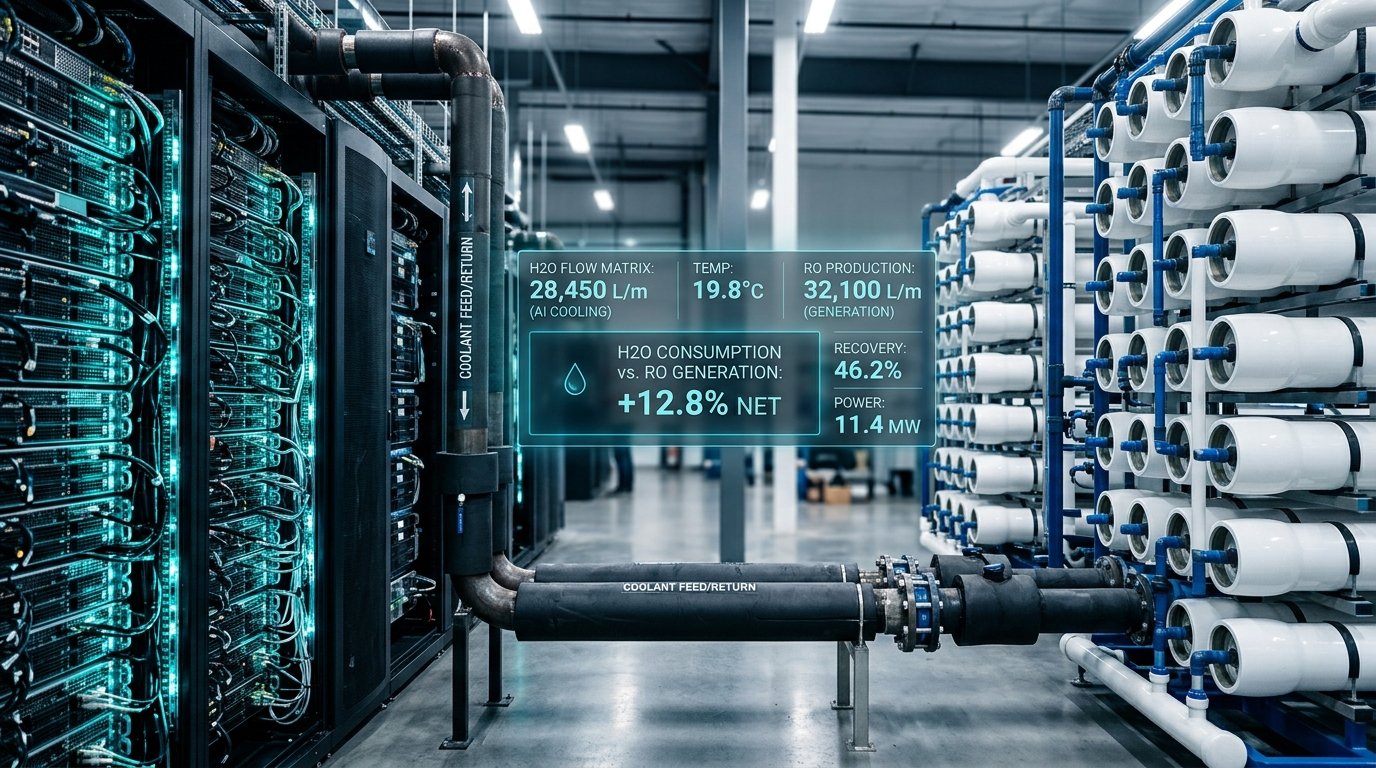
The Desalination Solution: To secure the “license to operate,” tech conglomerates are increasingly forced to integrate desalination into their infrastructure pipelines. Instead of drawing from municipal reservoirs, future hyperscale data centers in coastal regions will likely co-locate with, or directly fund, dedicated RO desalination plants. Furthermore, cutting-edge research in 2026 is exploring how the massive waste heat generated by AI servers could actually be repurposed to power thermal desalination processes—potentially turning data centers from massive water consumers into net-positive water producers.
The Verdict
The global water matrix is being aggressively rewired. Desalination has transitioned from an expensive municipal safety net into a critical, high-growth technology sector. For founders, infrastructure investors, and tech professionals, understanding the mechanics of reverse osmosis is just as important as understanding cloud compute. You cannot scale the digital future without first manufacturing the water to cool it down.