The Biopharma Horizon: Algorithmic Discovery, Sovereign Supply Chains, and the 2026 Patent Cliff
For decades, the global pharmaceutical industry operated on a high-risk, high-reward model of chemical trial and error. You synthesized tens of thousands of compounds, pushed them through a decade of clinical trials, and prayed for a single “blockbuster” drug to clear the FDA.
In 2026, that legacy model is dead.
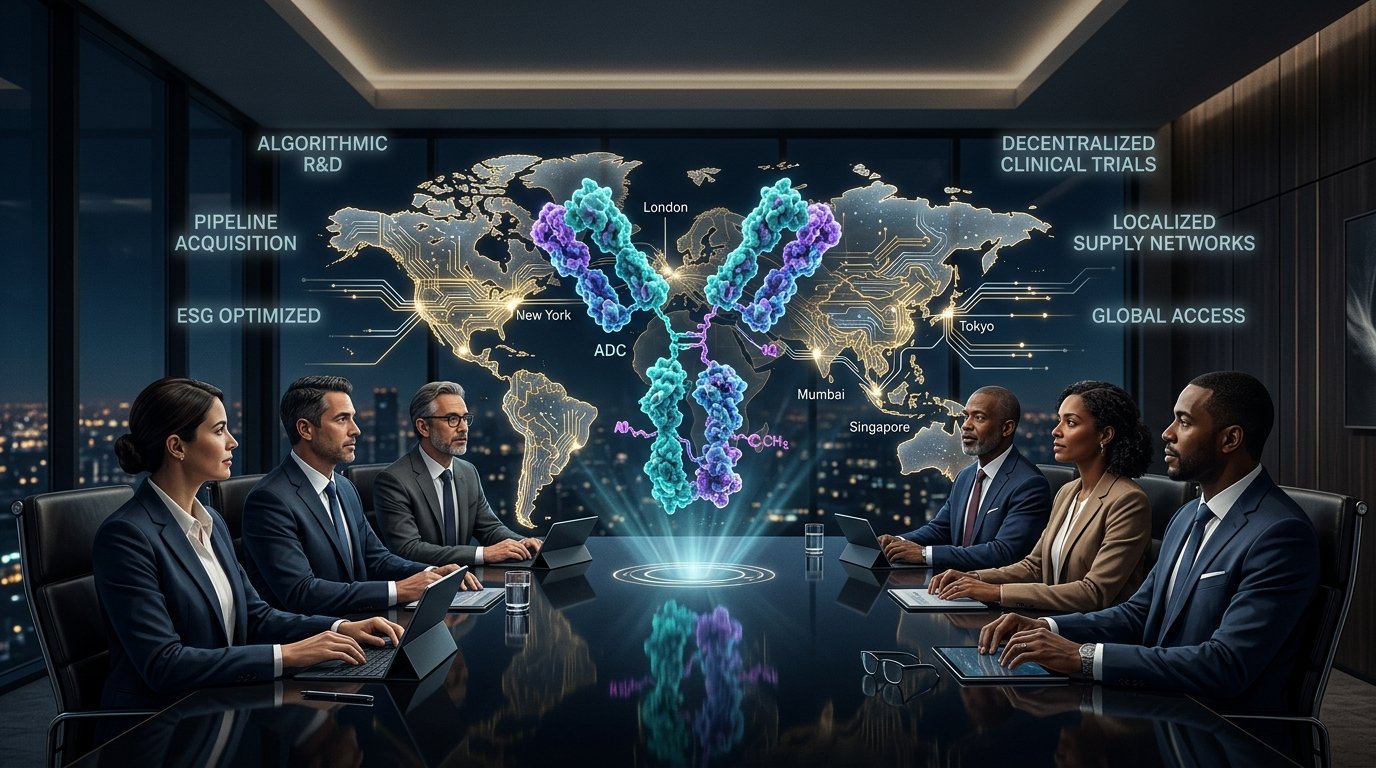
The modern pharmaceutical industry has fundamentally transitioned from a chemistry discipline into a data science and logistics discipline. Driven by the integration of Artificial Intelligence and forced into evolution by severe geopolitical shocks, the “Big Picture” of global pharma is now defined by algorithmic precision, localized manufacturing, and ruthless strategic consolidation.
For the global strategist or healthcare investor, here is the streamlined, macro-analytic view of the pharmaceutical ecosystem in 2026.
The R&D Engine: Computational Biology and Precision
The era of the “small molecule” pill designed to treat a broad population with varying degrees of success is fading. The 2026 pipeline is heavily weighted toward highly complex, premium therapeutics: biologics, Antibody-Drug Conjugates (ADCs), and individualized cell and gene therapies.
This shift is entirely enabled by Artificial Intelligence.
- Algorithmic Discovery: AI is no longer a buzzword; it is the core engine of preclinical R&D. By utilizing generative AI to predict biological responses and protein folding, companies are bypassing years of physical lab work. They are computationally engineering complex molecules that act as guided missiles, delivering therapeutics directly to diseased cells while sparing healthy tissue.
- The Decentralized Trial: The clinical trial process has been completely rewired. Instead of forcing patients to travel to centralized research hospitals, 2026 relies on decentralized, hybrid models. Companies ingest massive streams of Real-World Data (RWD) and digital biomarkers directly from patient wearables, drastically reducing trial times and ensuring highly patient-centric research data.
The Sovereign Supply Chain
The most significant operational shift in global pharma is the death of the hyper-globalized, single-point-of-failure supply chain. The days of relying on a single factory in a distant time zone for a critical active pharmaceutical ingredient (API) are over.
- Predictive Localization: Reacting to recent tariff fluctuations and geopolitical bottlenecks, massive pharmaceutical conglomerates are aggressively rebalancing their manufacturing footprints. They are shifting from reactive logistics to “intelligent, predictive networks,” actively nearshoring and localizing manufacturing facilities to be closer to their regional end-markets (e.g., building European facilities for EU markets, and North American facilities for US markets).
- The Green Mandate: This supply chain overhaul is tightly coupled with rigorous ESG (Environmental, Social, and Governance) mandates. Next-generation facilities are optimized for minimal carbon emissions, utilizing green chemistry, predictive energy consumption, and sustainable packaging as non-negotiable strategic priorities.
The Strategic Battlefield: The Patent Cliff and M&A
Hanging over this technological renaissance is a brutal financial reality: The Patent Cliff.
As we move through 2026, the patents granting market exclusivity to several of the world’s most lucrative blockbuster drugs are expiring, opening the floodgates for cheap biosimilars and generics. This threatens to wipe billions of dollars in revenue off the balance sheets of legacy pharmaceutical giants.
- The M&A Frenzy: To survive the cliff, large cap pharma companies are not relying solely on their internal R&D. They are weaponizing their massive cash reserves, executing aggressive Mergers and Acquisitions (M&A). They are actively buying up agile, AI-native biotech startups that possess the next-generation therapeutics needed to replenish their pipelines.
- The Geopolitical Pricing War: Beyond the lab, the role of a pharmaceutical CEO has become deeply political. Navigating industrial policies, international export controls, and aggressive government drug-pricing negotiations are now top-level strategic priorities, dictating where capital is deployed and which markets are prioritized.
The Verdict
The 2026 global pharmaceutical industry is a high-stakes convergence of tech, biology, and national security. The companies that will dominate the remainder of the decade are those capable of utilizing AI to compress their R&D timelines, building sovereign, resilient manufacturing networks, and successfully buying or building their way out of the patent cliff. It is no longer just about making the drug; it is about engineering the entire global architecture required to deliver it.