The Commoditization of the Battery: The 2026 EV Price Wars and the Mass-Market Pivot
For the first half of this decade, the electric vehicle was a luxury status symbol—a virtue-signaling tech gadget reserved for early adopters in California or Norway. In 2026, the halo effect has completely evaporated. The global electric vehicle market is now a brutal, hyper-commoditized arena defined by aggressive price wars, shifting geopolitical leverage, and a relentless pivot toward the mass market.
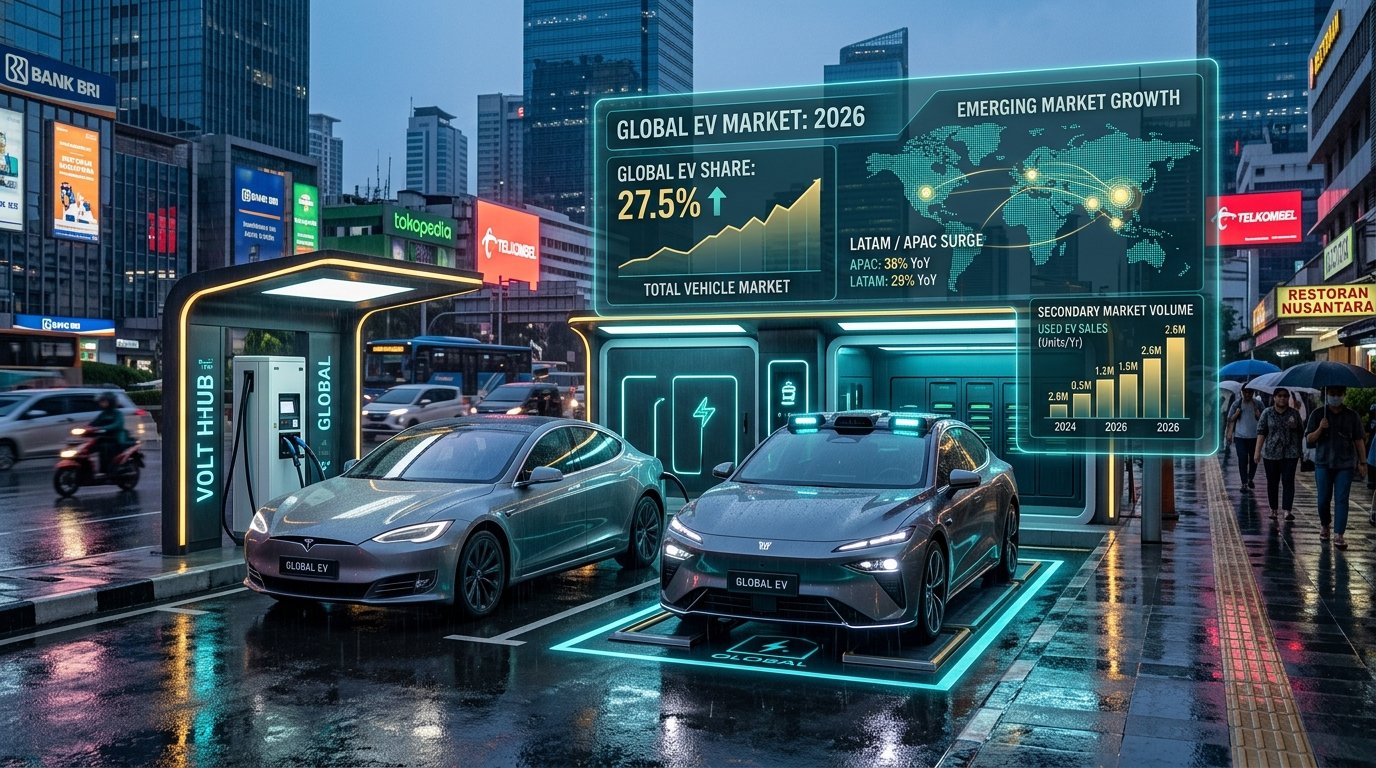
With global EV market share officially crossing the 27.5% threshold, the combustion engine is no longer the default; it is a legacy technology in decline. However, the victors of this transition are not who legacy automakers expected.
For the global strategist, here is the unvarnished reality of the 2026 EV landscape, the explosion of emerging markets, and the new hierarchy of automotive power.
The Death of the Premium: Price Wars and the Secondary Market
The most defining trend of 2026 is the collapse of the EV premium. Consumers are no longer willing to pay a $15,000 markup simply because a car has a battery instead of a gas tank.
This reality has been forced upon the market by two distinct pressures:
- The Chinese Hardware Arbitrage: Chinese manufacturers have achieved a level of vertical integration in battery production that Western legacy automakers simply cannot match. By controlling the refining of rare earths and the manufacturing of the cells, they are aggressively cutting global prices to capture market share, forcing Western legacy brands into a defensive race to the bottom.
- The Used EV Surge: 2026 marks the first year of a truly robust, mature secondary EV market. Millions of fleet vehicles and early-adopter leases are hitting the used lots. This widespread availability of second-hand EVs has given buyers immense leverage, providing affordable entry points and forcing manufacturers to aggressively price their new entry-level models to compete with their own used inventory.
The Emerging Market Flashpoint
The battleground has shifted. While China remains the absolute anchor for volume and pricing, the explosive growth vectors are now the Asia-Pacific (APAC) and Latin American regions.
Emerging markets outside of China are aggressively expanding their annual sales share. These regions are bypassing the expensive, long-range luxury EV trend and directly adopting affordable, utilitarian electric transit. Chinese automakers are spearheading this expansion, exporting highly capable, sub-$20,000 EVs to markets that legacy Western automakers have largely ignored or priced themselves out of.
The UK Microcosm: Meanwhile, adoption in Europe continues to accelerate past the tipping point. In the UK alone, March 2026 saw a record 86,120 new electric cars registered, capturing an impressive 22.4% of the total new car market. The infrastructure anxiety is fading, replaced by sheer economic utility.
The 2026 Global Boardroom: The New Hierarchy
The competitive landscape is a multi-front war, with the leaderboard shifting wildly depending on the geographic region.
- Tesla: The Defending Champion. Tesla has successfully reclaimed its single-brand throne as the top-selling global EV manufacturer. However, its overall global market share is under severe, constant pressure. Tesla’s primary challenge is no longer scaling production, but defending its margins against a flood of cheaper Chinese and subsidized European competitors.
- BYD: The Volume Leviathan. While Tesla wins the pure-battery (BEV) brand race, China’s BYD vastly outscales them on a broader New Energy Vehicle (NEV) level. BYD is executing a dual-pronged assault: dominating emerging markets with extreme volume and affordability, while simultaneously pushing a highly aggressive, premium global strategy to challenge Western luxury brands on their home turf.
- Volkswagen Group: Fortress Europe. The legacy giant has found its footing. VW maintains a strong, commanding grip on the European market, expertly navigating the EU’s strict regulatory target frameworks. Having recently surpassed the 5-million milestone for electric drive units produced globally, they are proving that traditional manufacturing scale still matters.
- Hyundai Motor Group (Hyundai & Kia): The Design Vanguard. The Korean giant continues to expand its global footprint by consistently out-designing the competition. Backed by the highly praised, futuristic aesthetics of the Kia EV series and the incredibly efficient E-GMP charging architecture, Hyundai has positioned itself as the premium, reliable alternative for buyers suffering from “Tesla fatigue.”
- The Tech Invasions (Xiaomi, NIO, XPeng, Li Auto): The definition of an automaker is changing. Tech giants like Xiaomi are proving that a car is now just a smartphone on wheels. Meanwhile, brands like NIO and XPeng are rapidly gaining global traction beyond China by pushing the absolute boundaries of autonomous driving and normalizing high-speed, automated battery-swapping infrastructure, completely eliminating range anxiety for their users.
The Verdict
The global EV industry in 2026 is an exercise in extreme industrial Darwinism. The companies that will survive the next five years are not those with the longest range or the fastest acceleration; they are the companies that command sovereign supply chains, integrate seamlessly into the digital lives of their users, and can profitably build a car for the global middle class.