The Silicon Collar: A 2026 Reality Report on the Humanoid Workforce
For the first half of this decade, humanoid robots were little more than viral marketing stunts—choreographed lab demonstrations designed to inflate venture capital valuations. In 2026, the era of the “demo video” is officially over. We have entered the era of the balance sheet.
Driven by breakthroughs in Physical AI—where end-to-end neural networks allow machines to learn physical tasks through observation rather than rigid, line-by-line coding—humanoid robots are actively deploying into the global workforce.
For the global strategist or supply chain operator, the humanoid market is no longer science fiction; it is a critical variable in labor economics. Here is the unvarnished reality report on the top performers, the brutal hardware price wars, the transition pipeline, and the undeniable competitive threat emerging from China.
The Evolution Pipeline: From Lab to Living Room
The deployment of humanoids is not happening all at once. It is following a strict, four-step evolutionary pipeline, defined by the level of “environmental chaos” the robot can handle.
- Step 1: Structured Logistics (Completed 2024-2025): The earliest deployments happened in highly controlled environments. Robots like Agility’s Digit were placed in Amazon and GXO Logistics warehouses. Their tasks were binary and repetitive: moving empty plastic totes from a shelf to a conveyor belt. The environment was mapped, and human interaction was strictly partitioned.
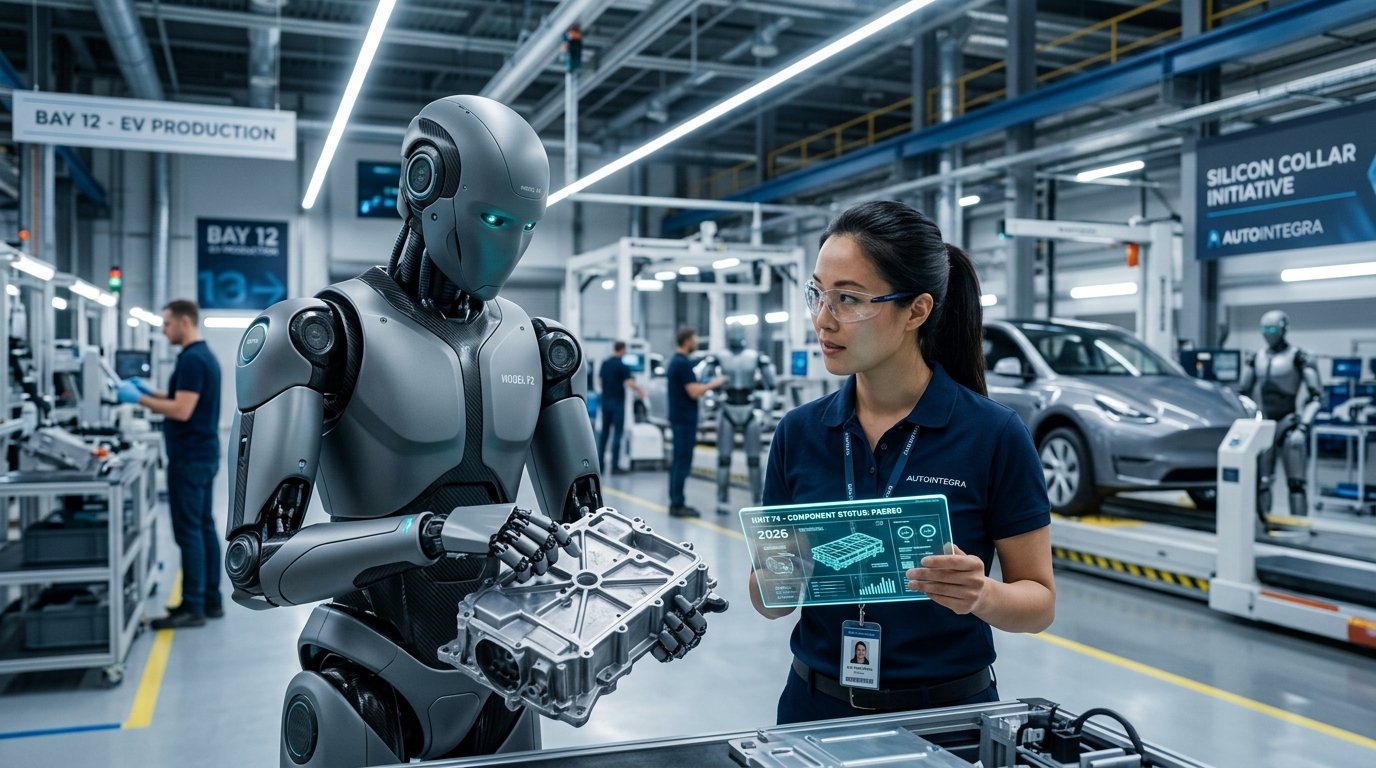
- Step 2: Dynamic Manufacturing (Current – Mid 2026): We are currently in the thick of Step 2. Humanoids are entering automotive plants. Figure AI is actively testing in BMW facilities, and Apptronik is in Mercedes-Benz plants. The robots are performing complex, dexterous tasks like inserting sheet metal into presses or aligning chassis components.
- Step 3: “Brownfield” Human Collaboration (Late 2026 – 2027): The hardest industrial leap is “Brownfield” deployment—dropping a robot into a messy, pre-existing factory where it must seamlessly navigate around unpredictable human workers, forklifts, and changing floor plans without safety cages. This relies entirely on real-time spatial AI processing.
- Step 4: The Domestic Frontier (2028 and Beyond): The ultimate goal is the household. However, a living room with scattered toys, pets, and fragile dishes is infinitely more complex than a factory floor. While companies are showcasing robots folding laundry, reliable, un-teleoperated commercial deployment for complex household tasks remains a few years out.
The 2026 Commercial Roster & The Price War
The hardware market has rapidly matured from multi-million-dollar R&D prototypes to commercially viable, mass-produced units. The 2026 landscape is defined by a massive plunge in unit economics.
The Top Tier Performers:
- Figure AI (Figure 02/03): The current Western darling, heavily backed by OpenAI. Known for its hyper-advanced conversational reasoning (it can explain why it is performing a physical task) and fluid dexterity.
- Estimated Price: $70,000 – $90,000 (Primarily leased).
- Agility Robotics (Digit): The logistics workhorse. Not a true “humanoid” (it has backward-bending legs and rudimentary hands), but it is the most battle-tested commercial unit in the world, rolling out of their “RoboFab” mass-manufacturing facility in Oregon.
- Estimated Price: $250,000+ per unit, but exclusively deployed via RaaS (Robots as a Service) for roughly $10-$15/hour.
- Tesla (Optimus Gen 3): The wildcard. Benefiting from Tesla’s massive battery and electric motor supply chain, Optimus is actively deployed inside Tesla’s own Gigafactories. Tesla’s primary advantage is its manufacturing scale, allowing them to iterate hardware faster than traditional robotics firms.
- Estimated Target Price: Elon Musk continues to target a sub-$25,000 price point at scale, though external commercial availability remains tightly restricted.
- Boston Dynamics (Atlas – Electric): Having retired their famous hydraulic model, the new electric Atlas is the most physically capable, acrobatic, and durable robot on the market, currently transitioning from pure R&D into Hyundai’s automotive manufacturing pipeline.
- Estimated Price: $100,000+ (Enterprise tier).
The China Factor: The Disruptive Foundry
If the U.S. is leading in the underlying foundation models (the “brain”), China is ruthlessly dominating the hardware and the pricing (the “body”).
China views humanoid robotics as a critical state imperative to offset its shrinking working-age population. The Chinese robotics ecosystem is doing to humanoids what DJI did to consumer drones: destroying Western pricing models through unmatched supply chain integration.
- Unitree Robotics: The ultimate market disruptor. Unitree shocked the industry with the G1 Humanoid, officially priced starting at an astonishing $16,000. While it lacks the sheer strength and payload capacity of a Figure 02, it democratized access for global researchers and mid-tier factories. Their heavier H1 model (approx. $90,000) was the first humanoid to achieve a standing backflip without hydraulics.
- UBTECH (Walker S): Actively deployed on the assembly lines of NIO (a massive Chinese EV manufacturer), performing quality inspections, logo application, and seatbelt testing.
- Global Competitiveness: Chinese humanoids are not cheap knock-offs; they feature world-class actuators and joint mechanisms. Because they are iterating hardware at a fraction of the cost of Silicon Valley, they are rapidly exporting these units to Southeast Asia and the Middle East, establishing a dominant physical footprint before Western companies can scale.
Late 2026 Trends: The RaaS Model and Data Moats
As we move toward the end of 2026, the industry will pivot away from hardware sales entirely.
- Robotics as a Service (RaaS): No automotive plant wants to spend $100 million on depreciating robotic hardware that will be obsolete in 18 months. The 2026 model is RaaS. You do not buy the robot; you hire it. Companies are “employing” Figure or Digit robots for $12 to $18 an hour. If a robot breaks, the manufacturer swaps it out.
- The Physical Data Moat: The competitive moat in late 2026 is no longer the motors; it is the teleoperation data. Companies are hiring humans to wear VR suits and remotely pilot humanoids to perform factory tasks. This movement data is recorded and fed into the AI neural network until the robot learns to do it autonomously. The company that logs the most hours of physical world interaction will win the intelligence race.
The Verdict
The humanoid robot is no longer a futuristic novelty; it is a piece of industrial capital equipment. For the global founder or supply chain consultant, ignoring the integration of Physical AI is akin to ignoring the internet in 1998. The workforce of the next decade will be fundamentally hybrid, and the nations—and businesses—that learn to manage the “Silicon Collar” workforce first will capture an insurmountable economic advantage.