
Eyeing the Future: The 2026 Smart Glasses War and the New Face of Big Tech
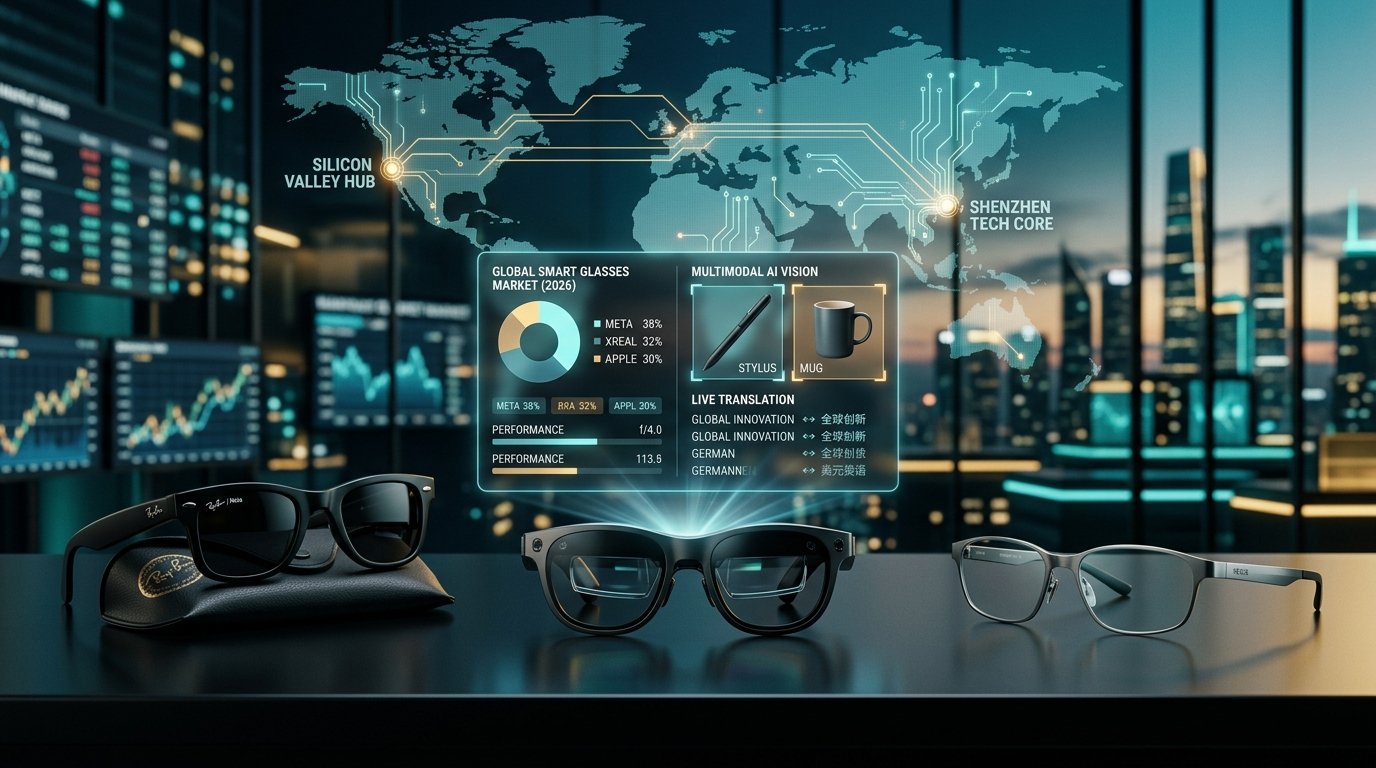
For the past decade, the tech industry has been obsessed with putting a screen on your face. Until recently, the results were either socially awkward “cyborg” headsets or overly expensive enterprise tools. But in 2026, the market has reached a massive inflection point. Driven by the miniaturization of waveguide optics and the explosion of multimodal Artificial Intelligence, smart glasses have transitioned from experimental gadgets into mainstream wearable computing.
We are currently witnessing the most aggressive hardware war since the birth of the smartphone. The battleground is no longer the pocket; it is the bridge of the nose. Here is an in-depth analysis of the 2026 smart glasses landscape, the price wars, the formidable challenge from Chinese manufacturers, and how AI is fundamentally rewiring consumer reality.
The Big Tech Ecosystem: Who Controls the Face?
The 2026 market is defined by a race to build the ultimate “Facial OS”—the operating system that mediates how we see and hear the physical world.
1. The Reigning Champion: Meta Platforms
Meta currently dominates the consumer volume market. By partnering with EssilorLuxottica (Ray-Ban), Meta solved the hardest problem in wearables: social acceptance. In 2025, Ray-Ban Meta glasses sold an estimated 6.5 million units, and in a historic shift, Meta’s smart glasses revenue eclipsed its Quest VR headset revenue.
- The 2026 Move: Meta is no longer just doing audio and cameras. They have successfully bridged into the AR display tier with the Meta Ray-Ban Display (priced around $799), featuring full-color waveguide optics that project digital overlays directly onto the lens without compromising the classic Wayfarer silhouette.
2. The Android XR Alliance: Google & Samsung
Refusing to cede the next hardware platform to Meta, the Android ecosystem has formed a unified front. In early 2026, Samsung and Google officially launched the Android XR smart glasses platform powered by Qualcomm’s Snapdragon AR1 silicon.
- The Strategy: Deep ecosystem integration. By partnering with eyewear brands like Warby Parker and Gentle Monster, and embedding Google’s Gemini AI natively into the hardware, they are creating a direct, high-end alternative to the Meta ecosystem.
3. The Looming Shadow: Apple (Project N50)
While Apple currently fields the ultra-premium $3,499 Vision Pro, they recognize the volume is in lightweight, everyday wear. Apple is heavily targeting a late 2026 to early 2027 release for their display-less, AI-first smart glasses. Designed to act as an immediate, wearable node for Siri and Apple Intelligence, their entry will legitimize the category for the remaining holdout demographics.
The China Challenge: High-Spec Disruption
The most severe pressure on Western tech giants is coming from the East. China is not just a manufacturing hub for these devices; it is aggressively iterating its own domestic brands, often delivering superior optical specifications at brutal price points.
- The “Four Rising Stars”: Companies like XREAL, Rokid, RayNeo (TCL), and INMO are pushing the boundaries of AR displays. XREAL continues to dominate the “virtual monitor” space, allowing digital nomads to carry a 120-inch AR workspace in their pocket.
- Huawei’s AI Entry: Huawei recently launched its proprietary AI glasses powered by a self-developed chip. Starting at roughly 2,499 RMB (approx. $350), these glasses feature touch controls, multimodal camera capabilities capable of instant nutritional analysis of food, and real-time translation.
- The Price/Software Arbitrage: Chinese brands like Rokid are launching global models (e.g., Rokid AI Glasses at $299) that cleverly tap into a multi-LLM stack, utilizing both Western models like ChatGPT and Chinese models like DeepSeek to offer highly competitive, localized AI assistance.
Price Comparison & Consumer Tiers
The market has fractured into three distinct pricing and functional tiers:
- Tier 1: AI-Only (The Mainstream) | $199 – $350
- Examples: Ray-Ban Meta (Base), Rokid AI, Solos, Huawei AI.
- Features: No display. Built-in cameras, open-ear audio, and voice-activated AI. They look exactly like standard eyewear.
- Tier 2: AR Display (The Frontier) | $400 – $800
- Examples: Meta Ray-Ban Display, XREAL One, RayNeo X2.
- Features: Transparent waveguide displays providing digital overlays (navigation, notifications, live translation text) superimposed over the real world.
- Tier 3: XR/Spatial Computing | $1,500 – $3,500+
- Examples: Apple Vision Pro, Meta Orion (dev kits).
- Features: Full spatial tracking, high field-of-view, capable of running heavy productivity apps entirely spatially.
Consumer Response and the AI Integration
The consumer response in 2026 has been overwhelmingly positive, driven almost entirely by the immersion of Multimodal AI.
Consumers are not buying smart glasses to check text messages; they are buying them for “Contextual AI.” Because the glasses have a camera facing outward, the AI finally sees what you see.
- Live Translation: You can look at a menu in Tokyo, and the glasses will either whisper the translation into your ear or project the English text over the Japanese characters via AR.
- Proactive Assistance: If you are assembling furniture or fixing an engine, the AI can visually track your hands and provide step-by-step audio guidance, warning you if you reach for the wrong bolt.
- The End of the Smartphone Gaze: The social friction of staring down at a screen is being eliminated. By shifting the digital interface to eye level, users remain present in their physical environment while maintaining absolute digital connectivity.
Late 2026 Market Predictions
As we move toward the end of 2026, the global smart glasses market (estimated at roughly $2.9 Billion in 2025) is surging toward a projected 24% CAGR.
Expect severe market consolidation. Smaller hardware startups without a proprietary AI model or a massive manufacturing supply chain will be acquired or crushed by the Meta/Google/Apple triad. Furthermore, we will see the rise of “Algorithmic Gatekeeping.” As consumers become reliant on smart glasses for daily navigation and information, the company that controls the lenses controls the user’s perception of reality, raising massive new questions regarding data privacy, targeted advertising, and physical-world ad blocking.