The Memory Monopoly: South Korea’s AI Imperative and the Global Silicon War
When analysts discuss the artificial intelligence boom, the conversation reflexively defaults to the United States—to the algorithmic genius of OpenAI or the architectural dominance of Nvidia. But this narrative ignores a brutal, physical reality: an AI processor is effectively useless without the memory bandwidth to feed it data.
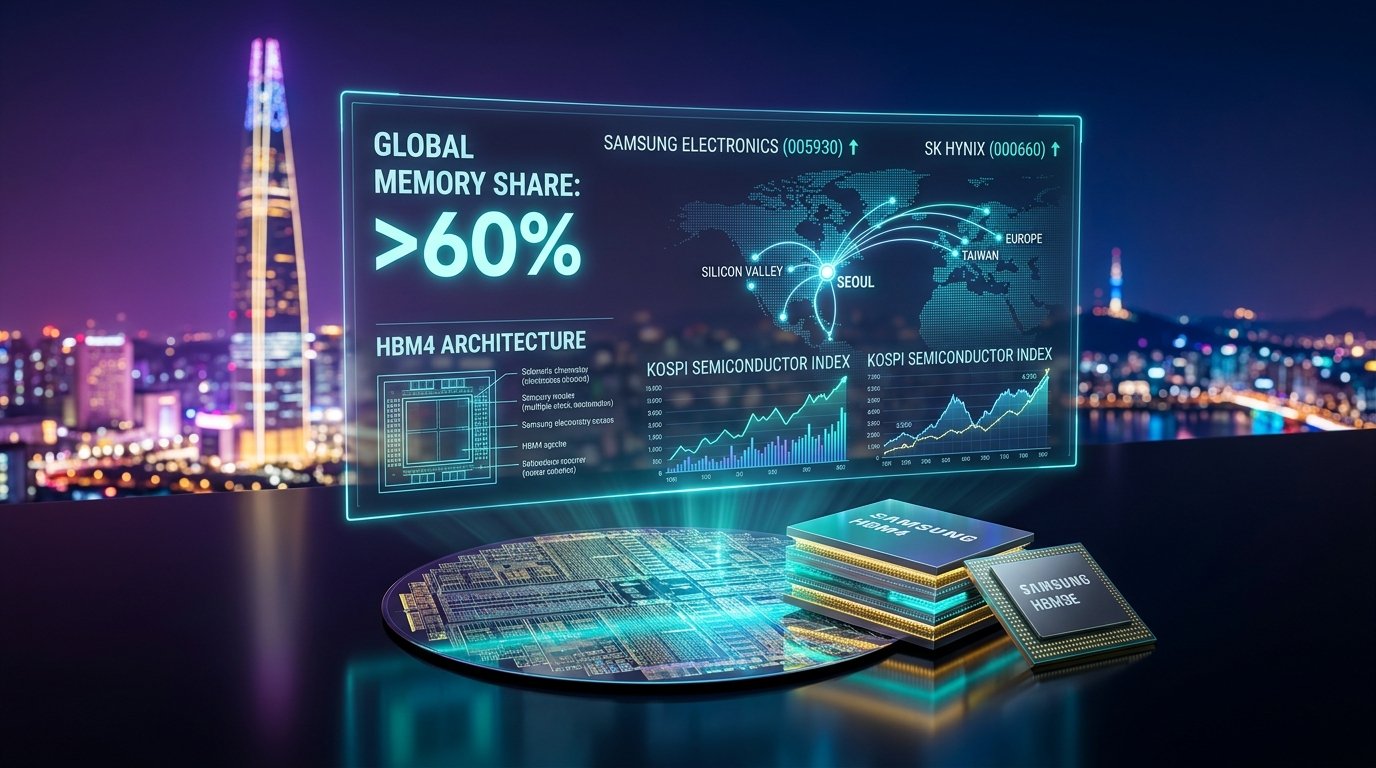
This is where the geopolitical and economic center of gravity shifts immediately to Seoul. South Korea does not just participate in the AI boom; it provides the essential bottleneck. Anchored by the dual titans of Samsung Electronics and SK Hynix, South Korea controls over 60% of the global memory market.
As AI scaling demands unprecedented data speeds, South Korea’s semiconductor sector has evolved from a cyclical commodity manufacturer into the indispensable foundation of global tech infrastructure. Here is the analytic reality of the Korean silicon engine, its brutal war with TSMC, its symbiotic rivalry with the U.S., and how it is permanently rewiring “Brand Korea.”
The HBM Chokehold
The generative AI revolution is entirely dependent on High-Bandwidth Memory (HBM). Standard memory chips cannot push data fast enough to keep Nvidia’s GPUs fed. SK Hynix and Samsung saw this architectural wall approaching and effectively cornered the market on next-generation HBM (HBM3 and the impending HBM4).
- The Export Reality: This dominance is driving historic national revenue. Driven by the surging demand for AI hardware, Korean semiconductor exports have shattered monthly records, recently eclipsing $15 billion in late-summer figures. This is not just corporate profit; it is the primary engine driving the national trade surplus, prompting organizations like the KDI to aggressively raise South Korea’s macroeconomic growth outlook.
- The Symbiotic Rivalry with the U.S.: South Korea’s dominance highlights a fascinating split in the global supply chain. The United States maintains undisputed hegemony in “Fabless” design (designing the chips—Nvidia, AMD, Apple, Qualcomm). However, they lack the domestic manufacturing base to build them. The U.S. writes the architectural blueprint; South Korea pours the concrete.
The Foundry Fight: Samsung vs. TSMC
While Korea owns memory, the true global war for technological supremacy is being fought in the “Foundry” sector (manufacturing chips designed by others). Here, Taiwan’s TSMC is the undisputed king.
Samsung is the only entity on earth with the capital and technical heritage to legitimately challenge TSMC’s monopoly. The reality, however, is a steep uphill battle. TSMC possesses unparalleled packaging technology and a deeply entrenched client ecosystem.
- Samsung’s Strategic Gamble: To break TSMC’s grip, Samsung is attempting to “leapfrog” the Taiwanese giant by heavily investing in and deploying 3nm Gate-All-Around (GAA) transistor architecture before TSMC scales it. It is a multi-billion dollar bet on pushing the laws of physics. If Samsung perfects GAA yield rates, they offer U.S. fabless giants the only viable alternative to a single point of failure in Taiwan.
The Structural Vulnerability: Non-Memory Diversification
Despite its massive success, South Korea faces a severe structural vulnerability: the non-memory (logic) and fabless design sectors.
While South Korea rules the memory storage space, the high-margin business of designing the logical “brains” of the devices remains firmly in the hands of American and Taiwanese firms. To ensure sovereign economic resilience, the South Korean government and private sector are currently attempting to incubate a domestic fabless ecosystem, though displacing entrenched U.S. giants remains a generational challenge.
Equities and Sovereignty: Anchoring the KOSPI and “Brand Korea”
The impact of these semiconductor giants extends far beyond their balance sheets; they are the sovereign wealth engines of the South Korean stock market.
- The KOSPI Anchors: Samsung and SK Hynix represent such a massive percentage of the KOSPI’s total market capitalization that their earnings calls dictate the fiscal health of the nation’s equity markets. As foreign capital floods into AI, it inevitably flows through these two equities, stabilizing the Korean Won and enriching domestic institutional funds.
- Elevating “Brand Korea”: For decades, global recognition of “Brand Korea” was largely driven by consumer electronics (TVs, smartphones) and, more recently, the soft-power explosion of K-Pop and K-Drama. The semiconductor boom has fundamentally matured the national brand. In the halls of Washington D.C., Beijing, and Silicon Valley, South Korea is no longer just viewed as an exporter of culture; it is respected as a hard-tech superpower wielding indispensable geopolitical leverage.
The Geopolitical Tightrope
Because the semiconductor industry is the most critical asset in the modern global economy, it is highly susceptible to U.S.-China technology export controls.
South Korea is navigating an incredibly delicate geopolitical tightrope. They must comply with U.S. restrictions on exporting advanced chip-making equipment to China, while simultaneously managing the reality that China remains a massive market for their legacy memory products.
To hedge against supply chain shocks, South Korea is rapidly domesticating its footprint. The government is backing the creation of massive “Mega Clusters” near Seoul—investing hundreds of billions to build the world’s largest concentrated semiconductor supply chain, ensuring that the future of global AI continues to run through the Korean peninsula.